Liber XVI · Indigenous & Ancient Religions · Chapter IV: Celtic Religion
Tuatha Dé Danann and the Book of Invasions: Irish Gods
The Tuatha Dé Danann in Lebor Gabála Érenn, the Irish Book of Invasions: the takings of Ireland, the four treasures, Mag Tuired, Lug and the síde.

The Tuatha Dé Danann, "the peoples of the goddess Danu", are the divine race of medieval Irish literature: the Dagda, Lug, Nuada, Brigit, the Morrígan, Ogma and their kin. Their fullest story is told in Lebor Gabála Érenn, the "Book of the Taking of Ireland", usually called the Book of Invasions, an eleventh-century Christian history that describes them as one of a series of peoples who settled Ireland before the ancestors of the Irish. Scholars read them as the old gods of Ireland, reshaped by monastic writers who could not worship them but would not forget them.
Lebor Gabála Érenn: Ireland's "Book of Invasions"§
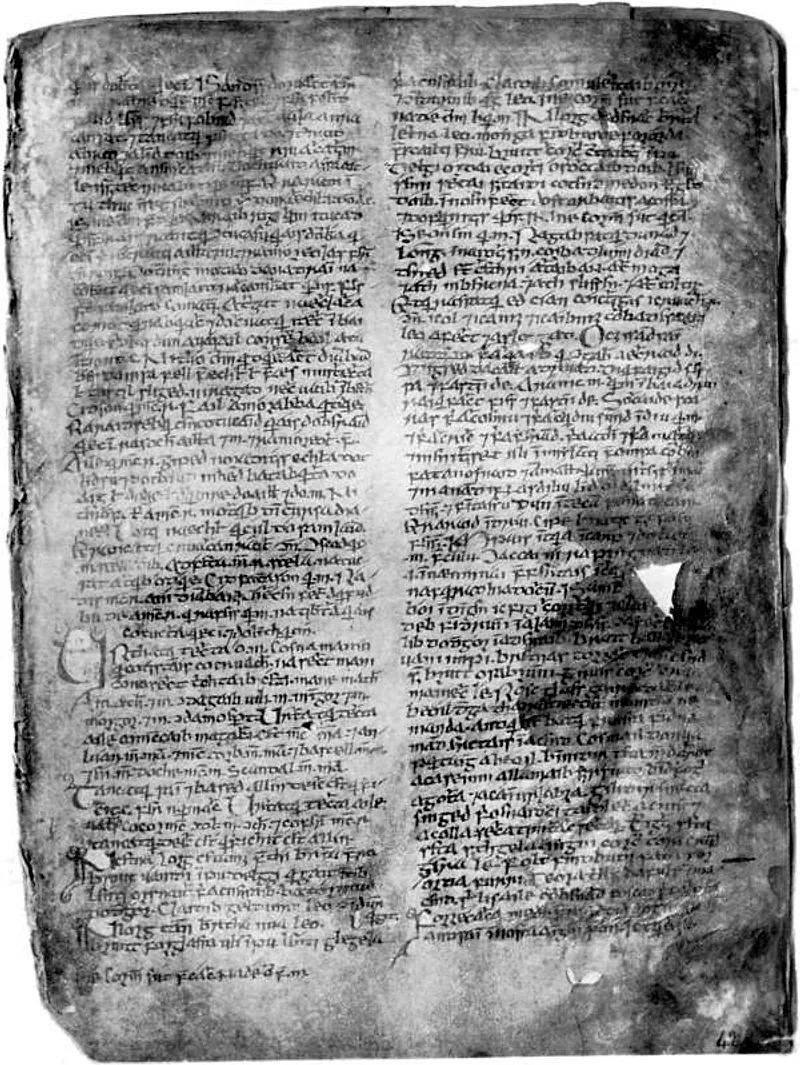
Lebor Gabála Érenn is not a single book but a body of prose and verse that grew over several centuries. Its core was assembled in the eleventh century, drawing on the poems of learned men such as Eochaid ua Flainn (died 1004) and Flann Mainistrech (died 1056), and it survives in several distinct recensions. Copies are found in great Irish manuscript compilations including the twelfth-century Book of Leinster and the later Book of Ballymote and Book of Lecan.
Its purpose was to give Ireland a place in universal Christian history. The compilers began with Creation and the Flood of Genesis, traced the Irish through Noah's son Japheth and the Scythians, and brought them by way of Egypt and Spain to Ireland. Biblical chronology, the late antique histories of Eusebius and Orosius, and native genealogy were woven together. John Carey has called this kind of writing "synthetic pseudohistory": a learned construction rather than a record of ancient tradition, but one that absorbed a good deal of older Irish lore.
The Successive Takings of Ireland§
The book describes a sequence of settlements, each ending in catastrophe or conquest:
- Cessair, a granddaughter of Noah, arrives before the Flood with fifty women and three men; all perish except Fintan mac Bóchra, who survives for millennia in animal forms and becomes the witness of Irish history.
- Partholón and his people clear plains and establish customs, then die of plague.
- Nemed and his followers struggle against the Fomoiri, a sea-dwelling race of raiders, and are scattered after a failed revolt.
- The Fir Bolg, descendants of Nemed's people, return and divide Ireland into provinces and establish kingship.
- The Tuatha Dé Danann arrive and take the land.
- The sons of Míl (the Milesians), the ancestors of the Gaels, come from Spain and win Ireland from the Tuatha Dé.
The Fomoiri, who appear in every age, act as a constant hostile power, often compared to the giants of other mythologies.
The Tuatha Dé Danann and Their Four Treasures§
The name of the divine people varies. Early texts often say simply Túatha Dé, "the peoples of the god(s)"; the fuller Túatha Dé Danann appears later. The goddess Danu from whom the name is supposedly drawn is barely attested in medieval sources, and some scholars think the form is partly a learned reconstruction. A goddess Anu or Ana, named by the glossator of Cormac's Glossary (around 900) as mother of the gods, is associated with the twin hills called the Paps of Anu in County Kerry.
According to the Book of Invasions the Tuatha Dé had learned druidry, knowledge and magic in four northern cities, Falias, Gorias, Findias and Murias, and brought a treasure from each: the Lia Fáil, the Stone of Destiny at Tara, which cried out under a rightful king; the spear of Lug, which ensured victory; the sword of Nuada, from which none escaped; and the cauldron of the Dagda, from which no company went away unsatisfied. They arrived, in one version, in dark clouds that hid the sun for three days, and burned their ships so they could not retreat.
The principal figures include the Dagda, "the good god", a father figure with a club and cauldron; Nuada, their king; Lug, master of all arts; Ogma, champion and, in later tradition, inventor of the ogham script; Dian Cécht, the healer; Goibniu, the smith; Brigit, whom Cormac's Glossary describes as a poetess worshipped by poets, with two sisters of the same name associated with healing and smithcraft; and the war goddesses grouped around the Morrígan, sometimes appearing as a trio, a pattern discussed in the triple goddess.
The Battles of Mag Tuired, Lug and the Fomoiri§
Two battles at Mag Tuired, in County Sligo, frame the reign of the Tuatha Dé. In the first they defeat the Fir Bolg, but their king Nuada loses his arm, and a maimed man cannot rule. Dian Cécht makes him an arm of silver, giving him the epithet Airgetlám, "Silver Hand", but in the meantime the kingship passes to Bres, whose father was a Fomorian. Bres is beautiful but mean: his guests leave his house without the smell of ale on their breath, and the poet Coirpre composes the first satire in Ireland against him, which brings him down.

The saga Cath Maige Tuired ("The Second Battle of Mag Tuired"), preserved in a single sixteenth-century manuscript but containing language of the ninth century or earlier, tells what followed. Lug arrives at the gate of Tara and is refused entry until he shows that he alone possesses every skill, as builder, smith, harper, poet, physician and warrior, earning the name Samildánach, "skilled in many arts together". He leads the Tuatha Dé against the Fomoiri and kills his own grandfather, Balor, whose single eye destroyed whatever it looked upon, with a sling stone. The saga also includes the Dagda's union with the Morrígan before the battle and the healing well of Dian Cécht.
Lug's name corresponds to the Gaulish god Lugus, honoured in place-names such as Lugudunum (Lyon), and to the Welsh Lleu, while Nuada corresponds to Nodens, worshipped at a Romano-British temple at Lydney Park in Gloucestershire, and to the Welsh Nudd or Lludd. These links, set out in the overview of Celtic religion, are among the strongest evidence that the Irish divine race preserves names of gods once worshipped across the Celtic-speaking world.
Gods in the Mounds: the Áes Síde§
The Tuatha Dé lose Ireland to the sons of Míl. When the Milesians land, the poet Amairgen speaks verses claiming the land, and three goddesses, Ériu, Banba and Fódla, each ask that Ireland bear her name; Ériu's survives in the Irish name Éire. After the Milesian victory at Tailtiu the island is divided: the Gaels take the surface, and the Tuatha Dé go beneath it, into the síde, the mounds and hills.
This is one of the most consequential ideas in Irish tradition. The Tuatha Dé become the áes síde, "the people of the mounds", living in an Otherworld that can be entered at certain places and seasons, especially the festival of Samain at the start of winter, when, as discussed in Samhain, the boundary between worlds was thought to open. The Dagda and his son Óengus are linked with Brug na Bóinne, the Neolithic passage tomb now called Newgrange, built thousands of years before any Celtic language was spoken in Ireland. Manannán mac Lir, lord of the sea, rules the overseas paradise of Emain Ablach.
Over centuries the lordly áes síde of the sagas merged with the smaller fairies of rural belief, the daoine maithe or "good people" who might steal children or punish disrespect, as described in changelings and fairy abduction.
Were the Tuatha Dé Danann Pagan Gods?§
The medieval authors were careful. The Book of Invasions calls the Tuatha Dé masters of druidry and magic and, in some passages, hints that they were demons or fallen angels; elsewhere they are human ancestors with extraordinary arts. This approach, called euhemerism after the Greek writer Euhemerus, who claimed that gods were deified kings, allowed Christian scholars to preserve traditions without endorsing worship. The scribe of the Book of Leinster made the same reservation about another saga, the Táin, adding a colophon to say that some of what he had copied was the deception of demons and some mere poetic invention.
Modern interpretation has swung between two poles. Earlier Celticists, among them T. F. O'Rahilly, treated the Irish texts as a fairly direct window onto pre-Christian religion. Later scholars, notably Kim McCone and John Carey, stressed how thoroughly they were shaped by Christian learning and the political interests of medieval dynasties. Mark Williams's history of the Irish gods takes a middle course, arguing that the Tuatha Dé are best understood as a literary creation of medieval Ireland that drew on, but did not simply transmit, older belief.
The Tuatha Dé also had a long afterlife. They were recast by the antiquarians and nationalists of the nineteenth-century Irish revival, by W. B. Yeats and Lady Gregory, whose Gods and Fighting Men (1904) retold their stories, and by modern Pagans and Druids who honour them today.
Frequently asked questions§
What does Tuatha Dé Danann mean?§
It is usually translated "the peoples (or tribes) of the goddess Danu". Older texts often call them simply the Tuatha Dé, "the peoples of the god(s)", and the goddess Danu herself is poorly attested, so the fuller name may be a later learned development.
What is the Book of Invasions?§
Lebor Gabála Érenn, "the Book of the Taking of Ireland", is an eleventh-century compilation of prose and verse that tells the history of Ireland from the Flood to the coming of the Gaels through a series of settlements. It is Christian pseudohistory that incorporates older mythological material.
What happened to the Tuatha Dé Danann?§
In the medieval story they are defeated by the sons of Míl and withdraw into the hills and mounds of Ireland, becoming the áes síde, the people of the Otherworld. Later folk tradition connects them with the fairies.
Are the Tuatha Dé Danann the same as the Celtic gods?§
Several of them have clear counterparts among gods worshipped in Gaul and Britain, such as Lug (Lugus) and Nuada (Nodens). Scholars agree they derive from pre-Christian deities but disagree on how faithfully the medieval texts preserve ancient belief.
Sources and further reading§
- Lebor Gabála Érenn: The Book of the Taking of Ireland — R. A. S. Macalister (ed. and trans.), 1938
- Cath Maige Tuired: The Second Battle of Mag Tuired — Elizabeth A. Gray (ed.), 1982
- Early Irish History and Mythology — T. F. O'Rahilly, 1946
- The Irish National Origin-Legend: Synthetic Pseudohistory — John Carey, 1994
- Ireland's Immortals: A History of the Gods of Irish Myth — Mark Williams, 2016
- The Celtic Heroic Age — John T. Koch and John Carey (eds.), 1994
- Gods and Fighting Men — Lady Augusta Gregory, 1904