Liber XVI · Indigenous & Ancient Religions · Chapter VII: Native American Religions
The Ghost Dance: Wovoka's Vision, Its Spread and Wounded Knee
The Ghost Dance of 1889–1890: the Paiute prophet Wovoka, his message of peace and renewal, its spread across the West, Lakota ghost shirts and Wounded Knee.

The Ghost Dance was a Native American religious movement that spread across the American West in 1889–1890 from the teaching of Wovoka, a Northern Paiute prophet in Nevada. He taught that if people lived in peace, worked honestly and performed a circle dance, they would soon be reunited with their dead relatives in a renewed world without sickness or death. Among the Lakota, the movement's growth alarmed United States officials, and the attempt to suppress it ended in the massacre of Lakota men, women and children at Wounded Knee Creek, South Dakota, on 29 December 1890.
Before Wovoka: The 1870 Ghost Dance§
The Great Basin of Nevada, home of the Northern Paiute (Numu), had been transformed within a generation by mining, ranching and the transcontinental railway. Game and pine-nut groves were lost, epidemics spread, and many families worked for settlers. Around 1869 a Paiute man known as Wodziwob, from the area of Walker Lake, announced visions in which the dead would return and the world would be restored, and called for round dances to hasten it. His teaching spread to neighbouring peoples and into northern California, where it influenced later movements such as the Earth Lodge and Bole-Maru religions among the Pomo and their neighbours. The movement faded in the early 1870s, but memory of it prepared the ground for what followed.
Prophetic movements of this kind were not new in Native America. The Shawnee Prophet Tenskwatawa early in the nineteenth century and the Seneca prophet Handsome Lake, whose Longhouse religion is discussed in Native American religions, had also called their peoples to moral reform and ritual renewal in times of crisis.
Wovoka's Vision and Teaching§
Wovoka (about 1856–1932), known in English as Jack Wilson, grew up in Mason Valley, Nevada, and worked for a white rancher, David Wilson, whose family gave him his English name and some knowledge of Christianity. His own family had a tradition of spiritual power; his father has sometimes been linked with Wodziwob's movement, though the evidence is uncertain. Wovoka was already known as a weather doctor, credited with bringing rain.
During a total eclipse of the sun on 1 January 1889, while he was ill with fever, Wovoka experienced what he described as a journey to the other world. He saw God and the dead living happily in a green land, young again and busy with their old pursuits. He was told to return and instruct his people: they must love one another, live in peace with the whites, work, not lie or steal, and give up the practice of war. If they did this and danced the round dance at intervals, they would be reunited with the dead, and sickness and old age would end.
The best record of his message is the so-called Messiah Letter, a statement Wovoka gave to a Cheyenne and Arapaho delegation in August 1891 and which the ethnologist James Mooney later obtained. It combines Paiute ideas with Christian elements; Wovoka refers to Jesus as being on the earth, and many listeners understood Wovoka himself as a messiah, a role he seems to have accepted at times and disclaimed at others. Scholars stress that his own teaching was peaceful and aimed at survival and accommodation rather than war.
How the Ghost Dance Spread across the West§
News of the prophet travelled along reservation networks, by letter and by railway. In 1889 and 1890 delegations from the plains made the long journey to Nevada to hear him, among them the Lakota Short Bull and Kicking Bear, the Arapaho Sitting Bull (not the Hunkpapa leader of the same name) and representatives of the Cheyenne, Shoshone, Bannock, Kiowa, Caddo and others. They returned with sacred paint, songs and accounts of what they had seen, and each nation adapted the dance to its own traditions.
The dance itself was a large circle in which men and women held hands and moved slowly, singing songs that often came to participants in visions. Some dancers fell into trance and spoke of meeting dead relatives. Mooney recorded and published many Ghost Dance songs in several languages, and they remain an important body of Native religious poetry. Ghost Dance songs and practices continue to carry meaning for some families and communities, and this library does not describe how the ceremony was or is performed.
Among the Arapaho and Cheyenne of Indian Territory (Oklahoma) the dance took root as a lasting religious practice; among the Kiowa a delegate, Apiatan, returned from Nevada in 1891 disillusioned, though the dance later revived among his people. Among the Pawnee it helped inspire a renewal of older ceremonies and games.
The Lakota Ghost Dance and the Ghost Shirt§
The Lakota of the Great Sioux Reservation embraced the Ghost Dance in 1890 in conditions of severe hardship. In 1889 the reservation had been broken up into smaller units and some nine million acres opened to settlers; government rations were cut; drought ruined crops; and measles, influenza and whooping cough killed many. The Sun Dance and other ceremonies had been banned under the Code of Indian Offenses. In this setting the promise of renewal was powerful.
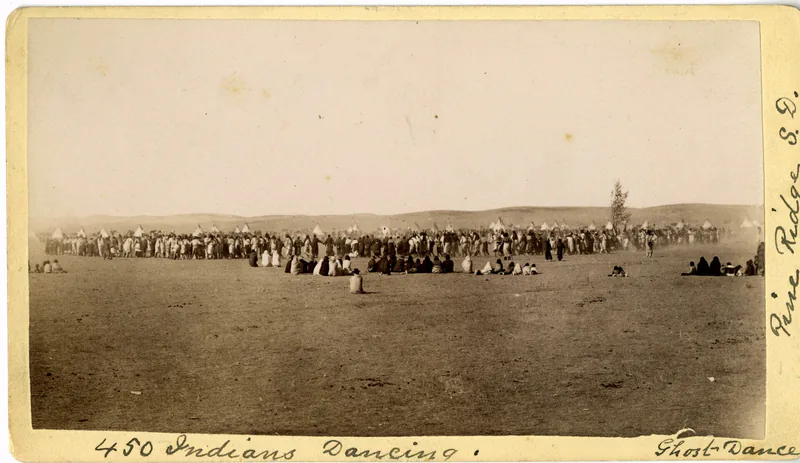
The Lakota dancers developed a distinctive element: the ghost shirt, a garment of muslin or buckskin painted with symbols such as stars, birds and the sun, which many believed would protect the wearer, including, in some accounts, from bullets. Some Lakota leaders also described the coming renewal as a time when the whites would disappear beneath a new layer of earth. Earlier historians took this as evidence that the Lakota had turned Wovoka's peaceful message into a militant one. Later scholars, including Raymond DeMallie and Jeffrey Ostler, argue that the Lakota dance remained essentially religious and defensive, and that the image of a hostile "Messiah craze" was largely created by frightened agents, newspapers and army officers.
The Massacre at Wounded Knee, 29 December 1890§
In October and November 1890 the new agent at Pine Ridge, Daniel Royer, inexperienced and alarmed by the dancing, telegraphed for troops. The army arrived on 20 November, and thousands of soldiers were eventually deployed. Many dancers withdrew to a remote plateau in the Badlands.
At Standing Rock, officials decided to arrest Sitting Bull, the Hunkpapa leader, whom they suspected of encouraging the dance. On 15 December 1890 Lakota agency police came to his cabin; in the confrontation that followed Sitting Bull and several of his followers and police officers were killed. Some of his people fled south to join the Miniconjou band of Spotted Elk (also called Big Foot), who set out for Pine Ridge.
On 28 December the Seventh Cavalry intercepted Spotted Elk's band and escorted it to Wounded Knee Creek. The next morning, while soldiers disarmed the Lakota men, a shot was fired, and the troops opened fire with rifles and rapid-firing Hotchkiss guns. Men, women and children were killed, many while fleeing; estimates of the Lakota dead range from about 250 to 300 or more, and roughly twenty-five soldiers died, some probably from their own side's fire. The frozen bodies were buried in a mass grave on the hill. Black Elk, then a young man, came on the scene and later described it in Black Elk Speaks as the end of a people's dream.
Twenty soldiers received the Medal of Honor for the action, awards that Lakota people and others have long asked to have rescinded. Wounded Knee remains a place of mourning and memory; descendants have held memorial rides on the route of Spotted Elk's band, and the site became a symbol of Native resistance when activists occupied it in 1973.
Interpreting the Ghost Dance: Mooney to the Present§
James Mooney, who visited Wovoka in 1892 and many participating peoples, published The Ghost-Dance Religion and the Sioux Outbreak of 1890 for the Bureau of Ethnology in 1896. Unusually for its time, it treated the movement with sympathy, comparing it with prophetic and millenarian movements in Christianity, Judaism and Islam. In 1956 the anthropologist Anthony F. C. Wallace used such movements to define the "revitalisation movement", a deliberate effort by a society under stress to construct a more satisfying culture, a concept still used in the study of new religious movements.
Later scholars have criticised the idea that the Ghost Dance was simply a desperate reaction to deprivation. Alice Beck Kehoe emphasised its continuity as a living religion, noting that it was practised in some communities well into the twentieth century. Louis S. Warren has argued that Wovoka's teaching was a modern religion of adaptation, which combined work for wages, moral discipline and hope. Native historians and communities stress that the movement and the massacre belong to their own history and should be told from their perspective.
Wovoka lived on in Nevada until 1932, corresponding with followers, receiving visitors and practising as a healer. The movement he inspired is remembered not as a failed prophecy but as an expression of faith, hope and survival under colonial pressure.
Frequently asked questions§
What was the purpose of the Ghost Dance?§
Wovoka taught that the dance, together with peaceful and honest living, would hasten a renewal of the world in which the dead would return and sickness and death would end. Different nations understood the promise in their own ways.
Did the Ghost Dance cause Wounded Knee?§
The dance did not cause the massacre; official fear of it did. Agents and army officers interpreted the Lakota Ghost Dance as a threat of uprising, deployed troops and tried to arrest leaders, which led to the killing of Sitting Bull and to the shootings at Wounded Knee.
Is the Ghost Dance still practised?§
It continued in some communities into the twentieth century, and its songs and memory remain important to descendants. Where it is still honoured, it belongs to those communities, and outsiders are asked not to imitate it.
Sources and further reading§
- The Ghost-Dance Religion and the Sioux Outbreak of 1890 — James Mooney, 1896
- Black Elk Speaks — John G. Neihardt, 1932
- The Ghost Dance: Ethnohistory and Revitalization — Alice Beck Kehoe, 1989
- Wovoka and the Ghost Dance — Michael Hittman, 1990
- The Plains Sioux and U.S. Colonialism from Lewis and Clark to Wounded Knee — Jeffrey Ostler, 2004
- God's Red Son: The Ghost Dance Religion and the Making of Modern America — Louis S. Warren, 2017
- Bury My Heart at Wounded Knee: An Indian History of the American West — Dee Brown, 1970