Liber XXI · New Religions · Chapter II: The Bahá'í Faith
The Báb and the Bábí Movement: Prophet of Shiraz, 1844–1850
The Báb and the Bábí movement: his 1844 declaration in Shiraz, the Letters of the Living, the Bayán, Táhirih, his execution in Tabriz and the Bahá'í legacy.

The Báb ("the Gate") was the title taken by Siyyid ʻAlí-Muhammad Shírází (1819–1850), a young merchant of Shiraz in Iran who in May 1844 announced that he was the bearer of a new divine revelation and soon claimed to be the promised Qá'im of Shiʻi Islam. His movement, the Bábí faith, spread rapidly across Iran, provoked violent conflict with the clergy and the Qajar state, and ended with his execution by firing squad in Tabriz on 9 July 1850. Bahá'ís revere the Báb as an independent Manifestation of God and the herald of Bahá'u'lláh, and his shrine on Mount Carmel in Haifa is one of their holiest places.
Shiraz, Shaykhism and the Expectation of the Qá'im§
Siyyid ʻAlí-Muhammad was born in Shiraz on 20 October 1819 into a family of merchants who claimed descent from the Prophet Muhammad, hence the title siyyid. His father died when he was a child, and he was raised by a maternal uncle, in whose trading business he worked at the Gulf port of Bushehr. Contemporary accounts describe him as unusually devout and meditative. Around 1841 he travelled to the Shiʻi shrine cities of Iraq and attended the lectures of Siyyid Kázim Rashtí, the leader of the Shaykhi school.
The Shaykhis, followers of Shaykh Ahmad al-Ahsá'í (1753–1826), had developed a mystical and philosophical reading of Twelver Shiʻism, the branch of Islam described in Sunni and Shia Islam, which awaits the return of the twelfth Imam, hidden since the ninth century. They taught that between the believers and the Hidden Imam stood a living intermediary, the "perfect Shiʻi", and that a new cycle of spiritual understanding was beginning. When Siyyid Kázim died at the turn of 1843–1844 without naming a successor, many of his students set out to find the person they expected to arise. The year 1844 also corresponded to 1260 in the Islamic calendar, a thousand lunar years after the disappearance of the twelfth Imam in 260 AH, which heightened expectation.
The Declaration of 1844 and the Letters of the Living§
One of those searchers, Mullá Husayn Bushrú'í, arrived in Shiraz in May 1844. According to the Bábí and Bahá'í accounts, the young merchant invited him to his house and on the evening of 22 May declared that he was the one Mullá Husayn was seeking, while beginning to compose a commentary on the Qur'anic Sura of Joseph (Surah 12) as a sign of his station. Mullá Husayn became the first of eighteen disciples later called the Letters of the Living; together with the Báb they made nineteen, a number that became central to Bábí thought. Among them was the poet Táhirih (Qurrat al-ʻAyn) of Qazvin, who, according to tradition, accepted him by letter without ever meeting him.
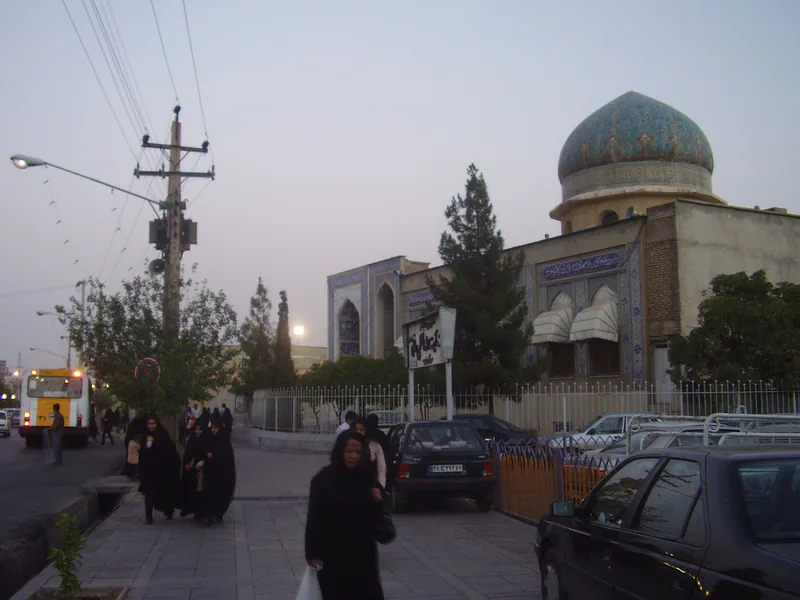
The Báb's earliest claim was expressed in the language of gates and intermediaries: he was the "Gate" to the Hidden Imam. Over the following years, and openly from 1848, he announced that he was the Qá'im himself, and finally that he was the bearer of a new revelation abrogating the Islamic law. Historians such as Abbas Amanat and Denis MacEoin have traced this gradual unfolding, which Bahá'í writers understand as a prudent, progressive disclosure. The disciples dispersed through Iran and Iraq to spread the message while the Báb made the pilgrimage to Mecca in late 1844.
Writings of the Báb: Qayyúm al-Asmá' and the Bayán§
The Báb wrote prodigiously, in Arabic and Persian, and his followers regarded the speed and abundance of his verses, often composed in the presence of witnesses, as the proof of his mission, as the Qur'an had been the proof of the Prophet's. His first major work, the Qayyúm al-Asmá', is a long and highly allusive commentary on the Sura of Joseph written in the style of Qur'anic revelation. His central work is the Bayán ("Exposition"), written in Persian with a shorter Arabic version during his imprisonment in 1847–1848.
In the Bayán the Báb reinterpreted the eschatological terms of Islam. The resurrection, judgment, paradise and hell were not events at the end of physical time but the appearance of a new divine messenger and the response people gave to him; each revelation was the "resurrection" of the one before. He laid down a new law, including a solar calendar of nineteen months of nineteen days, a new direction of prayer centred on his own house in Shiraz, and detailed rules of ritual purity, inheritance and conduct. Structurally the Bayán is built on the number nineteen, which in the abjad system of letter numerology described in Abjad Numerology in Islam is the value of wáḥid, "one"; nineteen times nineteen, 361, is the value of kull shay', "all things". His writings also include prayers and talismans laid out in the form of a five-pointed star (haykal, "temple" or "body"), drawing on the traditions surveyed in Islamic Occult Sciences.
Above all the Bayán points beyond itself to "Him whom God shall make manifest", a future messenger whose coming the Báb repeatedly urged his followers to recognise and obey, and for whose sake, he wrote, the whole of his own revelation had been given.
Imprisonment, Trial and the Conference of Badasht§
After his return from Mecca the Báb was arrested in Shiraz in 1845 and forced to make a public statement in the city's mosque that satisfied his opponents without, in his followers' view, denying his mission. In 1846 he went to Isfahan, where the Georgian-born governor Manúchihr Khán protected him until his own death in early 1847. The government then sent the Báb to the remote mountain fortress of Mákú in Azerbaijan and in 1848 to the fortress of Chihríq, near the Ottoman frontier. Large numbers of visitors still reached him, and much of his work was written in these prisons.
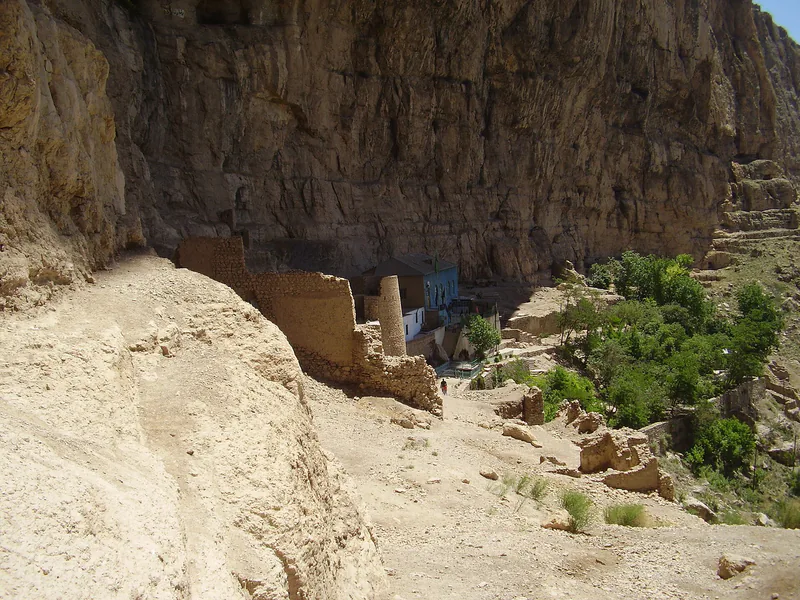
In July 1848 he was brought before a tribunal of clerics in Tabriz presided over by the crown prince, the future Násiru'd-Dín Sháh. There he openly proclaimed himself the Qá'im; the clergy declared him a heretic, and he was beaten on the soles of his feet. In the same summer a gathering of leading Bábís at the hamlet of Badasht in Khurasan, attended by Bahá'u'lláh, marked the break with Islamic law: Táhirih appeared before the assembled men without a veil, an act that shocked some of her co-religionists and has since made her a symbol of women's emancipation in Iran.
Upheaval and the Execution in Tabriz§
The death of Muhammad Sháh in September 1848 was followed by armed confrontations between Bábís and government forces at the shrine of Shaykh Tabarsí in Mazandaran (1848–1849), and at Nayríz and Zanján (1850–1851). Bábís presented these as defensive stands; the state treated them as rebellion. Thousands of Bábís, including Mullá Husayn and the disciple Quddús, were killed. The new prime minister, Amír Kabír, decided that the movement would end only with the death of its leader.
On 9 July 1850 the Báb and a young disciple, Mírzá Muhammad-ʻAlí Zunúzí, called Anís, were suspended by ropes in a barracks square in Tabriz before a regiment of soldiers. According to Bábí and Bahá'í accounts, the first volley merely severed the ropes and the Báb was later found in a nearby room completing a conversation with his secretary; a second regiment then carried out the execution. Bahá'ís regard these events as miraculous; historians note that the accounts were written down after the fact and differ in detail. The bodies were thrown beside the city moat, recovered secretly by Bábís and hidden for decades. In 1852 an attempt on the Shah's life by a few Bábís led to a wave of executions in Tehran, among them Táhirih.
Legacy: From the Bábís to the Bahá'í Faith§
Before his death the Báb had designated the youthful Mírzá Yahyá, known as Subh-i-Azal, as a nominal head of the community. In the 1850s and 1860s, in exile in Baghdad and Edirne, Yahyá's elder half-brother Bahá'u'lláh gradually revealed that he was the promised "Him whom God shall make manifest". Most Bábís accepted him and became Bahá'ís, as recounted in The Bahá'í Faith; a small minority, the Azalis, remained loyal to Subh-i-Azal. The Bahá'í Faith adopted the Báb's calendar, revering him as a Manifestation of God in his own right whose short ministry opened a new age. Bahá'ís celebrate the Declaration of the Báb on 23 May, his martyrdom on 9 July and his birth among their holy days.
In 1909 ʻAbdu'l-Bahá laid the Báb's remains in a shrine on Mount Carmel in Haifa, whose golden-domed superstructure was completed in 1953 and which stands at the centre of terraced gardens inscribed on the UNESCO World Heritage List in 2008. The Cambridge orientalist E. G. Browne, who collected Bábí manuscripts in the 1880s and 1890s, brought the movement to European scholarly attention. Modern scholars, including Amanat, MacEoin, Nader Saiedi and Todd Lawson, have studied the Báb as one of the most original religious thinkers of nineteenth-century Islam, an example of the messianic movements discussed in What Is a New Religious Movement?.
Frequently asked questions§
Who was the Báb?§
The Báb was Siyyid ʻAlí-Muhammad Shírází (1819–1850), a merchant of Shiraz who declared in 1844 that he brought a new revelation from God. He founded the Bábí movement and was executed in Tabriz in 1850; Bahá'ís regard him as a Manifestation of God and the forerunner of Bahá'u'lláh.
What is the Bayán?§
The Bayán is the Báb's principal scripture, written in Persian, with a shorter Arabic version, around 1847–1848. It reinterprets Islamic teachings about the resurrection, sets out a new religious law and calendar, and foretells the coming of "Him whom God shall make manifest".
Is the Báb the same as Bahá'u'lláh?§
No. They were two different people. The Báb (1819–1850) announced the coming of a greater messenger; Bahá'u'lláh (1817–1892), who had been a prominent Bábí, later declared that he was that promised one and founded the Bahá'í Faith.
Sources and further reading§
- Selections from the Writings of the Báb — The Báb, 1976
- The Dawn-Breakers: Nabíl's Narrative of the Early Days of the Bahá'í Revelation — Nabíl-i-Aʻẓam, 1932
- A Traveller's Narrative Written to Illustrate the Episode of the Bab — Edward Granville Browne (trans.), 1891
- Resurrection and Renewal: The Making of the Babi Movement in Iran, 1844–1850 — Abbas Amanat, 1989
- The Messiah of Shiraz: Studies in Early and Middle Babism — Denis MacEoin, 2009
- Gate of the Heart: Understanding the Writings of the Báb — Nader Saiedi, 2008
- Gnostic Apocalypse and Islam: Qur'an, Exegesis, Messianism and the Literary Origins of the Babi Religion — Todd Lawson, 2011