The Islamic Calendar: Hijri Months, Holy Days and Festivals
The Islamic Hijri calendar explained: its lunar months, the Hijra era, moon sighting, the two Eids, 'Ashura, the Mawlid and the other holy days of Muslims.

The Islamic or Hijri calendar is a purely lunar calendar of twelve months, counted from the Prophet Muhammad's emigration (hijra) from Mecca to Medina in 622. Its year of about 354 days is some eleven days shorter than the solar year, so Ramadan, the pilgrimage and every other holy day move steadily through the seasons; Muslims use it to time worship everywhere, and several countries also use it for civil purposes.
The Hijri Era and the Lunar Year§
Before Islam the Arabs of the Hijaz used lunar months but appear to have inserted extra months from time to time to keep the year in step with the seasons and the trading fairs. The Qur'an put an end to this: it declares that the number of months with God is twelve, of which four are sacred, and condemns the postponement of months (nasīʾ) as "an addition to disbelief" (at-Tawba 9:36–37). The Prophet's Farewell Pilgrimage in 632 is remembered as the moment when time "returned to its original form", and since then the Islamic year has been strictly lunar.
The era itself was introduced about seventeen years after the Hijra by the caliph 'Umar ibn al-Khattab, around 638, when administrators complained of undated official letters. After discussing alternatives, including the Prophet's birth and the beginning of revelation, the companions chose the emigration to Medina, the event that founded the Muslim community as a polity. They did not date the era from the day of the journey itself but from the first day of the lunar year in which it occurred, 1 Muharram, which corresponds to 16 July 622 in the Julian calendar.
A lunar month lasts on average about 29.53 days, so Hijri months have either 29 or 30 days and the year either 354 or 355. For administrative and astronomical purposes medieval scholars also used a fixed "tabular" calendar in which eleven years out of every thirty receive an extra day. The year 1448 AH began in mid-June 2026.
The Twelve Months and Their Meanings§
The month names come from the older Arabian calendar, and some reflect seasons they no longer match because the year now drifts. In order they are:
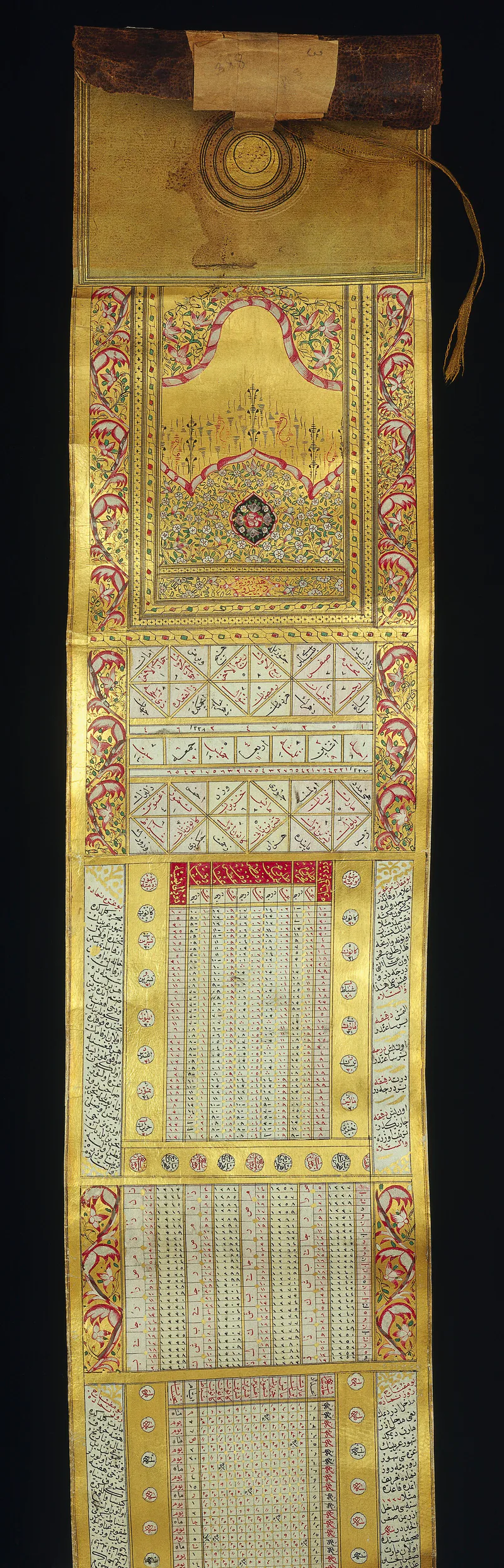
- Muharram, "the forbidden", a sacred month that opens the year.
- Safar, often explained as "empty", perhaps because homes were vacated for travel or war.
- Rabi' al-Awwal, the first month of "spring", in which the Prophet's birth is commemorated.
- Rabi' al-Thani (or al-Akhir), the second spring month.
- Jumada al-Ula, a name associated with dryness or the freezing of water.
- Jumada al-Akhira (or al-Thaniya), its pair.
- Rajab, a sacred month of reverence and, in pre-Islamic times, of sacrifice.
- Sha'ban, often linked to tribes "dispersing" in search of water.
- Ramadan, the month of fasting, from a root meaning intense heat.
- Shawwal, which begins with Eid al-Fitr.
- Dhu al-Qa'da, "the month of sitting", a sacred month of truce.
- Dhu al-Hijja, "the month of the pilgrimage", the fourth sacred month.
The sacred months, Dhu al-Qa'da, Dhu al-Hijja, Muharram and Rajab, were times of truce in pre-Islamic Arabia that allowed safe travel to the pilgrimage and fairs. Muslim jurists continue to regard wrongdoing in them as especially grave, and many believers increase voluntary fasting and devotion during them.
Moon Sighting, Calculation and Modern Calendars§
The start of each month traditionally depends on sighting the thin crescent (hilāl) on the evening after the new moon. A well-known hadith instructs believers to begin and end the fast on seeing the crescent, and to complete thirty days if it is hidden by cloud. Since the visibility of the crescent depends on the moon's age, its height above the horizon and atmospheric conditions, it may be seen in one region but not another on the same evening.
Muslim astronomers from the ninth century onward worked on the problem of predicting crescent visibility, producing tables and criteria that formed part of the science of timekeeping (ʿilm al-mīqāt), alongside prayer times and the direction of Mecca. Today communities follow different methods. Some insist on a local, naked-eye sighting; others accept a sighting anywhere in the Muslim world or a declaration by Saudi authorities; others, such as the Turkish Directorate of Religious Affairs and a number of North American bodies, rely on astronomical calculation. Saudi Arabia's official civil calendar, the Umm al-Qura calendar, is calculated in advance, while the beginning of Ramadan and the Eids is still confirmed by reported sightings. An international congress in Istanbul in 2016 proposed a single unified Hijri calendar, but adoption has remained limited. Readers who want to follow the lunar cycle itself can consult the site's moon calendar.
Several Muslim societies also kept solar calendars for taxation and agriculture. The Ottoman state introduced a fiscal "Rumi" calendar in 1840, and Iran made the solar Hijri calendar, counted from the same epoch but using solar years and Persian month names, its official calendar in 1925; its new year falls at the spring equinox with the ancient festival of Nowruz, described in Zoroastrian Calendar and Festivals.
The Two Eids and the Days of the Hajj§
All Muslims share two canonical festivals. Eid al-Fitr, on 1 Shawwal, marks the end of the fast described in Ramadan. Eid al-Adha, the Feast of Sacrifice, falls on 10 Dhu al-Hijja, during the pilgrimage, and commemorates Abraham's readiness to sacrifice his son, whom Muslim tradition generally identifies as Ishmael; families who can afford it sacrifice a sheep, goat or larger animal and share the meat with relatives and the poor. It is followed by the three "days of tashrīq", during which fasting is forbidden.
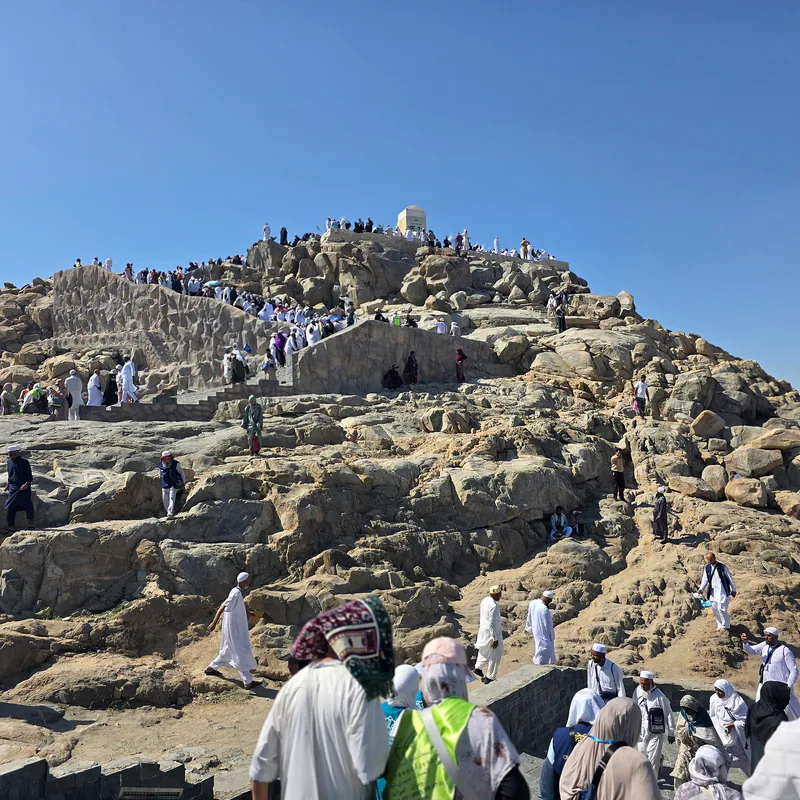
The day before it, 9 Dhu al-Hijja, is the Day of 'Arafa, when pilgrims stand in prayer on the plain of 'Arafat near Mecca and Muslims elsewhere are encouraged to fast. The first ten days of Dhu al-Hijja as a whole are counted among the most blessed of the year; the rites of the pilgrimage itself are outlined in The Five Pillars of Islam. Shi'i Muslims also celebrate Eid al-Ghadir on 18 Dhu al-Hijja, commemorating the Prophet's declaration at Ghadir Khumm, which they understand as the appointment of 'Ali as his successor.
Muharram, 'Ashura and Other Holy Days§
The Islamic New Year on 1 Muharram is usually a quiet occasion. The tenth of the month, 'Ashura, carries very different meanings in different communities. Sunni Muslims fast on it, following hadith reports that the Prophet found the Jews of Medina fasting in thanks for Moses' deliverance from Pharaoh, and often add the ninth or eleventh day. For Shi'i Muslims it is above all the anniversary of the martyrdom of the Imam Husayn at Karbala in 680, observed with mourning gatherings, recitations of the tragedy, processions and, in Iran and South Asia, the passion plays called taʿziya. Forty days later, on 20 Safar, the Arba'in draws millions of pilgrims to Karbala. See Sunni and Shi'a Islam and The Twelve Imams.
The Mawlid, the Prophet's birthday, is widely celebrated on 12 Rabi' al-Awwal by Sunnis and on the 17th by Twelver Shi'is, with recitations of poems in his praise, sermons and processions. Public celebrations are first documented under the Fatimids in Egypt, and a famous Sunni festival was held at Irbil in the early thirteenth century; some reformist and Salafi scholars reject the Mawlid as an innovation, while most Sunni scholars historically accepted it as a praiseworthy practice. Other occasions include the Night of the Ascension (Laylat al-Miʿrāj), commonly marked on 27 Rajab (see Isra and Mi'raj); the Night of Forgiveness (Laylat al-Barāʾa, the Shab-e Barat of South Asia) on 15 Sha'ban, which Twelver Shi'is also celebrate as the birthday of the Twelfth Imam; and the Night of Power in the last ten nights of Ramadan.
Time in Daily, Folk and Esoteric Life§
The Islamic day begins at sunset, so a holy "night" precedes its day: the eve of Friday is Thursday evening. Friday (al-jumuʿa, "the day of gathering") is marked by the congregational noon prayer and sermon, and in many Muslim countries it is the weekly holiday. The rhythm of the five daily prayers, fixed by the sun, interlocks with the lunar months, so that Muslim timekeeping combines both luminaries.
Popular religion added its own lore. Some regions regarded Safar as an unlucky month, although a hadith in al-Bukhari's collection explicitly denies any bad omen in it; in Java and parts of South Asia the last Wednesday of Safar was marked with prayers or outings for protection. Almanacs (taqwīm) prepared by court astronomers listed lunar mansions, planetary positions and favourable or unfavourable days, and the practice of choosing auspicious moments (ikhtiyārāt) for journeys, weddings or coronations belongs to the history of Islamic occult sciences. Religious scholars were often critical of such electional astrology, even as they relied on the same astronomers to fix the times of prayer and the beginning of the months.
Frequently asked questions§
What year is it in the Islamic calendar?§
The Hijri year 1448 began in mid-June 2026 and ends in late May or early June 2027. Because the year is lunar, each new Hijri year begins about eleven days earlier in the Gregorian calendar than the one before.
Why are Islamic months only 29 or 30 days long?§
Each month begins with a new crescent moon, and the average lunar cycle lasts about 29.5 days. A month therefore has 29 days when the crescent appears after the 29th and 30 days otherwise.
Does the Islamic calendar have leap years?§
The religious calendar adds no extra months, which the Qur'an forbids. Tabular versions used for calculation add one day to eleven years in every thirty to keep pace with the moon.
What are the four sacred months in Islam?§
They are Dhu al-Qa'da, Dhu al-Hijja, Muharram and Rajab. Fighting was traditionally forbidden in them, and Muslims regard good and bad deeds in them as carrying greater weight.
Sources and further reading§
- Mapping Time: The Calendar and Its History — E. G. Richards, 1998
- Calendrical Calculations — Nachum Dershowitz and Edward M. Reingold, 1997
- Astronomy in the Service of Islam — David A. King, 1993
- Muhammadan Festivals — Gustave E. von Grunebaum, 1951
- The Birth of the Prophet Muhammad: Devotional Piety in Sunni Islam — Marion Holmes Katz, 2007
- Ta'ziyeh: Ritual and Drama in Iran — Peter J. Chelkowski (ed.), 1979