Liber XIII · High Magick · Chapter VI: Magical Orders
Builders of the Adytum: Paul Foster Case and the Qabalistic Tarot
The Builders of the Adytum (B.O.T.A.) and founder Paul Foster Case: his Golden Dawn roots, the B.O.T.A. tarot, correspondence lessons and Los Angeles base.

The Builders of the Adytum (B.O.T.A.) is an American esoteric school founded by Paul Foster Case (1884–1954), a former officer of the Golden Dawn's successor order Alpha et Omega. Based in Los Angeles, it teaches a Christian-Hermetic "Qabalah" centred on the tarot, mainly through graded correspondence lessons and local study groups. Its black-and-white tarot deck, designed to be coloured by students, and Case's books made it one of the most influential channels through which Golden Dawn ideas reached the general public.
Paul Foster Case: From Musician to Tarot Teacher§
Paul Foster Case was born in 1884 in Fairport, New York, the son of a librarian. He showed musical talent early and earned his living for years as a pianist and organist, including work as a conductor and accompanist in the theatre circuits of the period. A story repeated in B.O.T.A. literature tells that as a young man he discussed the origins of playing cards with the architect and writer Claude Bragdon, which set him on the study of the tarot; like many founding stories it is difficult to verify in detail, but tarot remained the centre of Case's work for the rest of his life.
In the 1910s Case published articles on the tarot in occult periodicals, and An Introduction to the Study of the Tarot appeared in 1920. He also began to issue correspondence lessons. Around the same period he joined the Thoth-Hermes temple of the Alpha et Omega in New York, the American branch of the order led from London by Moina Mathers after the death of her husband, S. L. MacGregor Mathers. He quickly rose to the office of Praemonstrator, responsible for teaching. The background to that order is told in our article on the Stella Matutina and the Alpha et Omega.
Leaving the Alpha et Omega§
Case's association with the Alpha et Omega ended around 1921–1922 after a conflict with Moina Mathers. Surviving correspondence suggests that she objected to aspects of his teaching, including his views on the sexual dimension of occult practice, and to his independence as an author; Case for his part found the order's leadership unsatisfactory. He resigned, and continued to develop his own teaching, now independent of any Golden Dawn charter.
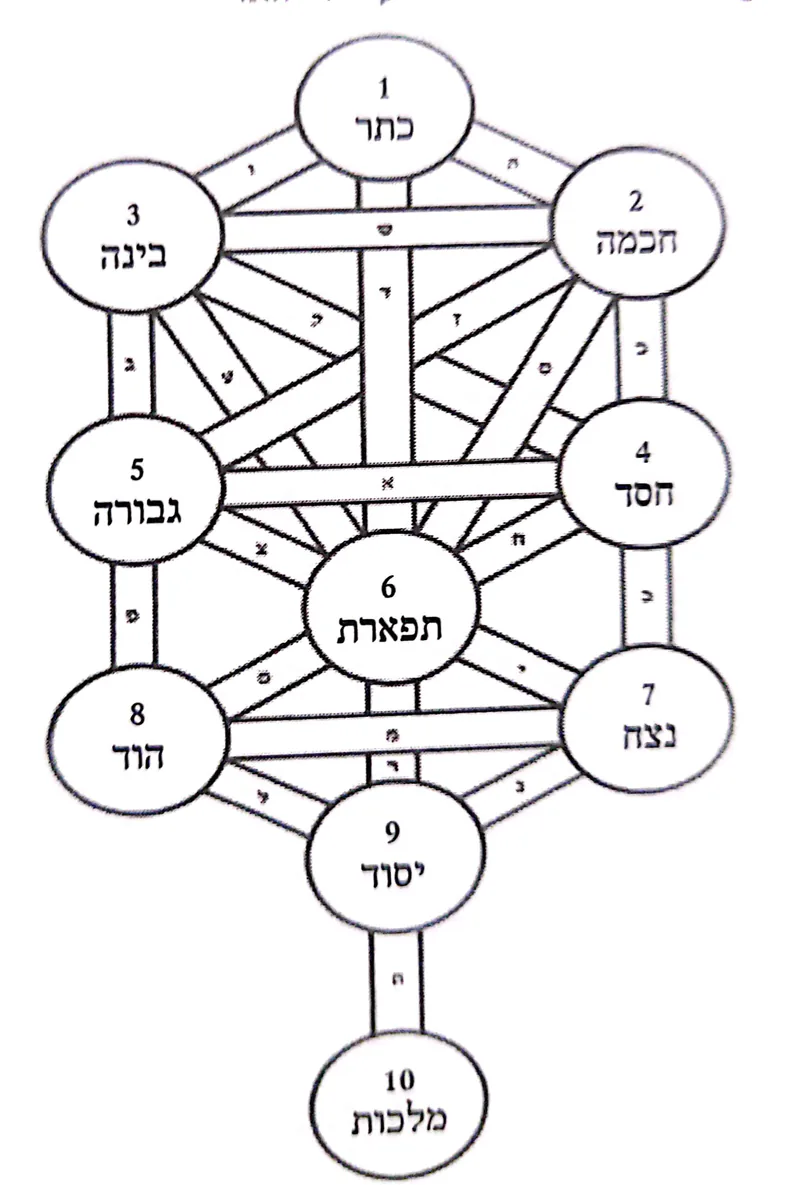
What Case took with him was the Golden Dawn's synthesis of Kabbalah, astrology, alchemy and tarot. He kept its attribution of the twenty-two trumps to the Hebrew letters and to the paths of the Tree of Life, including the exchange of Strength and Justice that puts Strength at number eight. He presented this material, however, in a new form designed for people who would never attend a lodge.
Founding the Builders of the Adytum§
Case's school was first known as the School of Ageless Wisdom. By the 1930s he had moved to Los Angeles, and the organisation took the name Builders of the Adytum. The Greek word adytum means the innermost sanctuary of a temple, the place that may not be entered by the profane; Case explained the name as a call to build the inner temple of the spirit. The school described itself as an outer court of a true but invisible Rosicrucian Order, an idea Case developed in writings later collected as The True and Invisible Rosicrucian Order. It echoes the Rosicrucian manifestos of the seventeenth century, discussed in our guide to Rosicrucianism.
Teaching by correspondence§
The core of the B.O.T.A. is a long sequence of correspondence lessons. Students begin with foundational courses in tarot and the Qabalah and proceed through further courses on the Tree of Life, alchemy, astrology and meditation. Daily practice centres on contemplation of the tarot "keys", as Case called the major arcana, and on prescribed affirmations. The lessons are confidential to members, and their content is known publicly mainly through Case's published books.
The pronaos and the temple§
Members may also attend local groups called pronaoi, from the Greek word for the porch of a temple, where ritual is performed and lessons discussed. The order built its headquarters and temple in Los Angeles, and groups were later established in other parts of the United States, Europe, Latin America and elsewhere. After Case's death in 1954 leadership passed to Ann Davies, who had worked closely with him and who expanded the school's ritual and outreach until her death in 1975.
The B.O.T.A. Tarot and Case's Interpretations§
The B.O.T.A. tarot was drawn under Case's direction by the artist Jessie Burns Parke and issued in the early 1930s. Its designs follow the Rider–Waite–Smith deck of 1909, described in our article on the Rider–Waite–Smith tarot, but with many changes of detail intended to correct or complete the symbolism. The cards were printed in black and white, and students were instructed to colour them themselves according to set colour schemes, so that the act of colouring became a meditation on each key.
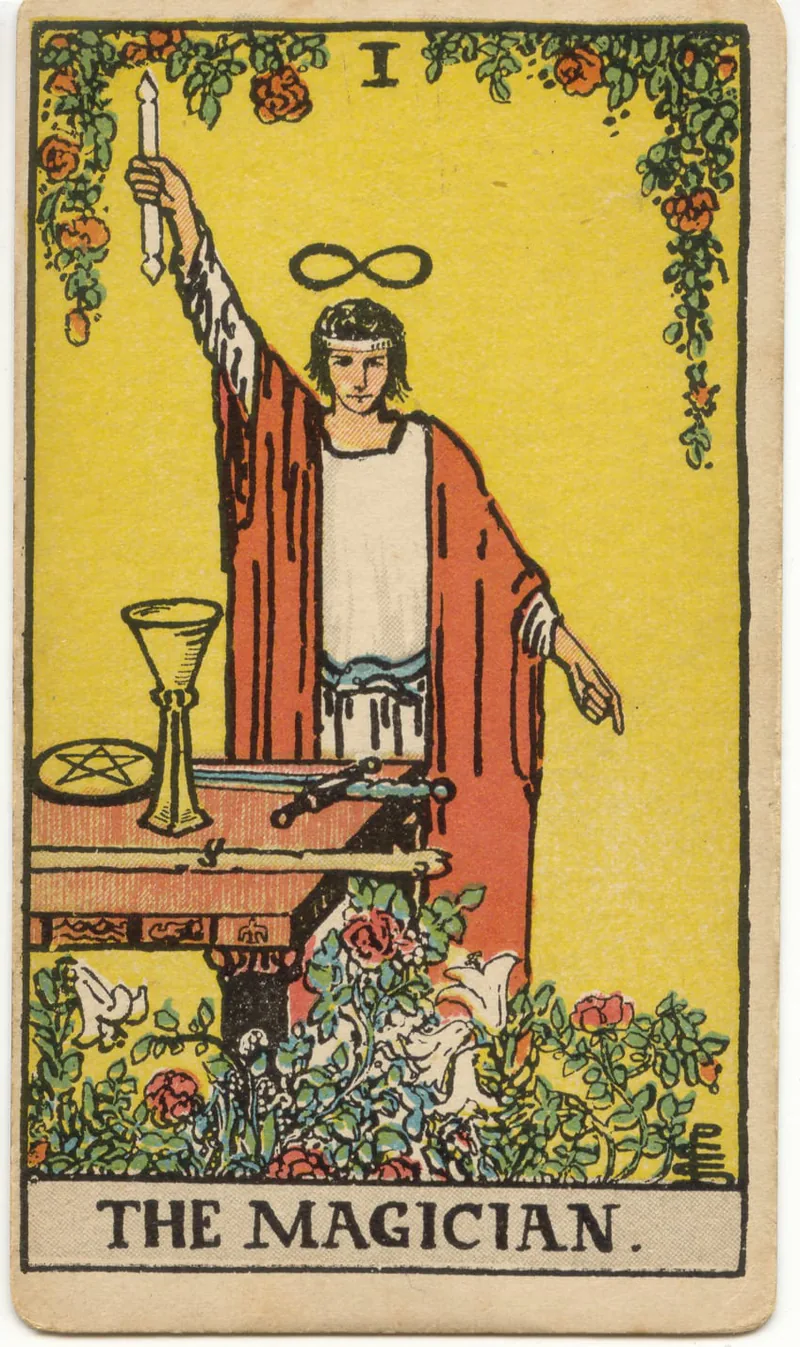
Case's interpretations are set out in The Tarot: A Key to the Wisdom of the Ages (1947). Each major arcanum is treated as a stage of consciousness and linked to its Hebrew letter, astrological attribution, colour and path on the Tree. The Magician, for instance, represents concentrated attention and the self-conscious mind, while the High Priestess stands for the subconscious memory that receives its impressions; see The Magician and The High Priestess. Case also gave each path a musical note, reflecting his own training, and his school practised the intoning of divine names on assigned tones.
The Book of Tokens (1934), a sequence of meditations on the twenty-two Hebrew letters, presents the same teaching in devotional form. Case's other works include writings on the symbolism of the Great Seal of the United States, in which he saw Masonic and Hermetic meanings, a reading that reflects the esoteric patriotism common in American occultism of the period.
Influence of the Builders of the Adytum§
Case's influence on twentieth-century tarot is difficult to overstate. Ronald Decker and Michael Dummett, in their history of the occult tarot, identify him as one of the main transmitters of Golden Dawn tarot doctrine in America. Many popular authors of the later twentieth century absorbed his interpretations, often without knowing their source, and his assignment of qualities of mind to the trumps underlies much modern psychological tarot reading. For the wider story of these ideas see our history of tarot.
Several later organisations derive from Case's teaching, founded by former students who left the B.O.T.A. and set up independent schools using his books and their own developments. The B.O.T.A. itself continues to operate from Los Angeles as a non-profit religious and educational organisation. It sits alongside the other Golden Dawn heirs surveyed in our guide to magical orders, but its emphasis on home study, devotional language and the tarot as a book of spiritual instruction gives it a distinctive character.
Frequently asked questions§
What does "Builders of the Adytum" mean?§
The adytum was the innermost sanctuary of an ancient temple. Paul Foster Case chose the name to express the aim of building an inner temple of the spirit through study and meditation.
Was Paul Foster Case a member of the Golden Dawn?§
He was a member and senior officer of the Alpha et Omega, the branch of the Golden Dawn loyal to S. L. MacGregor Mathers and later Moina Mathers. He left around 1921–1922 and founded his own school.
Why is the B.O.T.A. tarot black and white?§
The cards were designed to be coloured by students according to prescribed schemes. Case regarded the act of colouring each card as a form of meditation that impressed its symbolism on the mind.
Is the B.O.T.A. a religion?§
It describes itself as a mystery school teaching a Western esoteric tradition, and it operates as a non-profit religious and educational organisation. Its language is broadly Christian and Hermetic, but members may belong to other religious communities.
Sources and further reading§
- The Tarot: A Key to the Wisdom of the Ages — Paul Foster Case, 1947
- The Book of Tokens: Tarot Meditations — Paul Foster Case, 1934
- The True and Invisible Rosicrucian Order — Paul Foster Case, 1985
- A History of the Occult Tarot, 1870–1970 — Ronald Decker & Michael Dummett, 2002
- The Qabalistic Tarot: A Textbook of Mystical Philosophy — Robert Wang, 1983
- Women of the Golden Dawn: Rebels and Priestesses — Mary K. Greer, 1995