Liber XIII · High Magick · Chapter V: Golden Dawn
The Vault of the Adepti: The Golden Dawn's Rosicrucian Tomb
The Vault of the Adepti, the Golden Dawn's seven-sided chamber modelled on Christian Rosenkreutz's tomb: its symbolism, Adeptus Minor ritual and history.

The Vault of the Adepti is the seven-sided ritual chamber of the Golden Dawn's Second Order, built as a re-creation of the tomb of Christian Rosenkreutz described in the Rosicrucian manifesto Fama Fraternitatis (1614). Every wall, the ceiling and the floor carry coloured symbols of the planets, the zodiac and the Kabbalistic Tree of Life, and in its centre stands the Pastos, the symbolic coffin of the founder. The vault was the setting of the Adeptus Minor initiation, the order's central rite of death and resurrection.
The Tomb of Christian Rosenkreutz in the Fama§
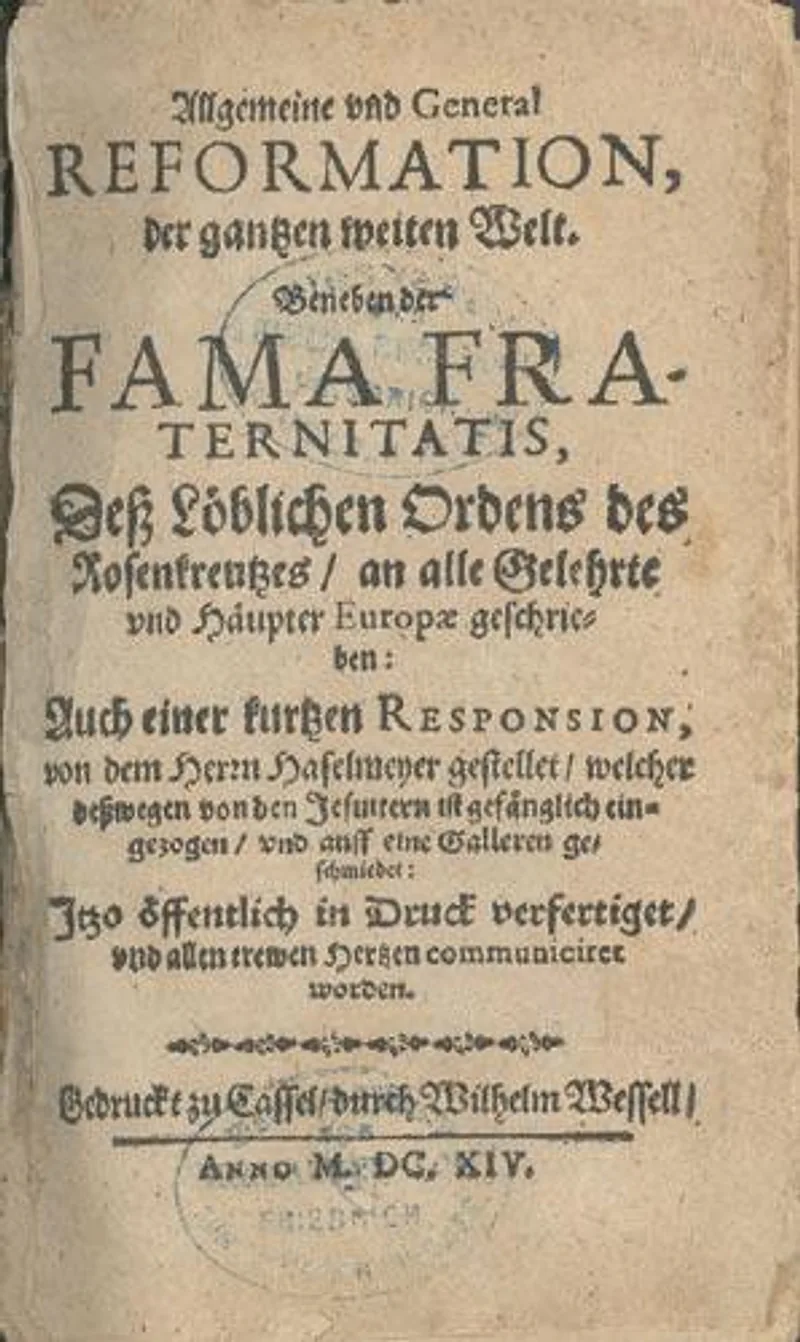
The vault's source is a story told in the Fama Fraternitatis, the first of the Rosicrucian manifestos, printed at Kassel in 1614 and discussed in our article on the Fama Fraternitatis. It relates how members of the secret brotherhood, repairing their house, uncovered a hidden door bearing the words Post CXX annos patebo, "After 120 years I shall open". Behind it lay a vault of seven sides and seven corners, each side five feet broad and eight feet high, lit by an inner sun in the upper part. In the centre stood a round altar, and beneath it the body of the founder, "Father C.R.C.", whole and uncorrupted, with books and instruments of the brotherhood around him.
The English translation of 1652, with a preface by Thomas Vaughan, can be read in our reading room. The tomb was always the manifesto's most memorable image: a sign that hidden wisdom, preserved in secret, was about to be revealed. Masonic Rosicrucian bodies of the eighteenth and nineteenth centuries, including the Societas Rosicruciana in Anglia, used the story in their ceremonies; for the wider background see our guide to Rosicrucianism.
Building the Vault: Walls, Ceiling and Floor§
When S. L. MacGregor Mathers created the Second Order of the Golden Dawn, the Ordo Rosae Rubeae et Aureae Crucis, he made the tomb a literal room. The first vault was built in London in the early 1890s, and members of the Second Order shared in painting its decorations. Its dimensions followed the Fama: seven walls, each five feet wide and eight feet high.
The seven walls§
Each wall is assigned to one of the seven classical planets and divided into forty squares, eight rows of five. The squares carry symbols of the planets, the signs of the zodiac, the elements and the Kabbalistic forces, painted in the "flashing colours" of the Golden Dawn, pairs of complementary colours intended to make the symbols seem to vibrate before the eye. The forty squares were explained as the ten sefirot of the Tree of Life in each of the four Kabbalistic worlds, so that every wall presents the whole structure of creation under the governance of one planet.
Ceiling, floor and Pastos§
The ceiling, chiefly white, bears a rose emblem symbolising the light from above, recalling the inner sun of the Fama. The floor, by contrast, represents the darker forces of the lower world, so that the adept stands between light and darkness. In the centre stands a circular altar painted with the four emblems of the cherubim, the lion, eagle, man and bull, and with the rose and cross. Beneath or beside it lies the Pastos, a painted coffin large enough to hold a man, its lid decorated with symbols of the crucified and risen adept. The whole vault was a three-dimensional diagram of the cosmos, and adepts were expected to know the meaning of every square.
The Adeptus Minor Ritual§
The vault existed for one ceremony above all: the initiation of the Adeptus Minor (5=6), the grade attributed to Tiphareth, the sefirah of beauty and harmony at the centre of the Tree. The ritual, written by Mathers, is in three parts, or "points", which in outline proceed as follows.
- The first point. The candidate, having passed through the Outer Order and the Portal grade, enters as a humble aspirant. After being challenged and admitted, the candidate is bound to a large cross, the Cross of Suffering, and takes the obligation of an adept, promising among other things to keep the order's secrets and to purify and exalt their spiritual nature.
- The second point. The vault is opened, and the candidate is led inside to hear the history of Christian Rosenkreutz and the discovery of his tomb. The Chief Adept lies within the Pastos, representing the founder.
- The third point. The Chief Adept rises from the Pastos and speaks as the risen master, and the candidate receives the symbols and teaching of the grade.
The drama joins two great narratives: the Rosicrucian myth of the founder's hidden tomb and the Christian pattern of crucifixion, burial and resurrection. Golden Dawn writers also drew parallels with the Egyptian myth of Osiris, slain and restored to life, so that the ritual could be read as a universal mystery of death and rebirth. The candidate was invited to identify with the figure in the tomb and to understand the grade as a spiritual resurrection of the higher self.
Life in the Vault: Consecrations and Corpus Christi§
For members of the Second Order the vault was also a working room. Adepts used it to consecrate the ritual implements they made for themselves: the Rose Cross lamen, discussed in our article on rose-cross sigils, the lotus wand and the four elemental weapons. They studied there, practised ritual and kept records of their work.
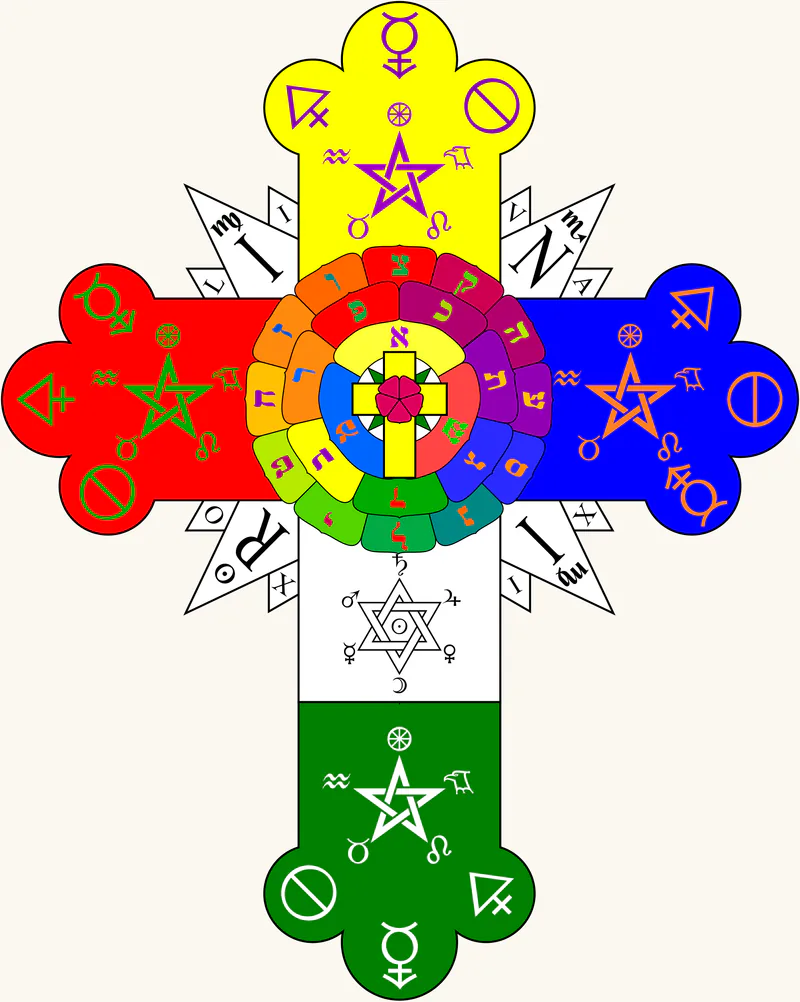
Each year the Second Order gathered for a ceremony on the feast of Corpus Christi, in which the vault was reconsecrated, officers were installed for the year, and the adepts renewed their bond with one another. The choice of a feast of the Christian calendar reflects the Christian-Rosicrucian character of the Second Order.
The vault also played a part in the order's history. In April 1900, during the schism that broke the Golden Dawn, Aleister Crowley arrived at the Second Order's rooms in Blythe Road, London, on Mathers' behalf in an attempt to take possession of the vault and its furnishings. He was refused entry, and the London adepts kept control. The confrontation, sometimes called the "Battle of Blythe Road", marked the end of Mathers' authority in London.
Surviving Vaults and Publication§
Vaults were built for the Second Order in London and, later, by temples of the successor orders. The best known survivor is at Whare Ra, Havelock North, New Zealand, where Robert Felkin's Stella Matutina temple worked until 1978; its vault, below the house, remained in place after the temple closed. The story of that order is told in our article on the Stella Matutina and the Alpha et Omega.
Detailed descriptions of the vault, with its colour scheme and the text of the Adeptus Minor ritual, were published by Israel Regardie in The Golden Dawn (1937–1940). These descriptions have since guided the construction of new vaults by revived Golden Dawn groups, and full reconstructions have been illustrated in later books on Golden Dawn temple practice. For the order's overall history see our article on the Hermetic Order of the Golden Dawn.
Frequently asked questions§
What is the Vault of the Adepti?§
It is the seven-sided ritual chamber of the Golden Dawn's Second Order, modelled on the tomb of Christian Rosenkreutz in the Rosicrucian Fama Fraternitatis. It was used for the Adeptus Minor initiation and for the consecration of members' ritual implements.
Why does the vault have seven sides?§
The Fama Fraternitatis describes the founder's tomb as a vault of seven sides and seven corners. The Golden Dawn assigned each wall to one of the seven classical planets.
What is the Pastos?§
The Pastos is the coffin that stands in the centre of the vault, representing the tomb of Christian Rosenkreutz. In the Adeptus Minor ritual the Chief Adept lies in it and rises, enacting the founder's symbolic resurrection.
Who designed the Vault of the Adepti?§
S. L. MacGregor Mathers devised the vault and the Adeptus Minor ritual when he organised the Second Order around 1891–1892, drawing on the Fama Fraternitatis. Members of the Second Order painted its symbolic decorations.
Sources and further reading§
- The Fame and Confession of the Fraternity of R: C: — Thomas Vaughan (trans.), 1652
- The Golden Dawn — Israel Regardie, 1937
- The Magicians of the Golden Dawn — Ellic Howe, 1972
- The Rosicrucian Enlightenment — Frances A. Yates, 1972
- The Secret Temple: Masonry, Rosicrucianism and the Golden Dawn — Robert Wang, 1980
- The Golden Dawn: Twilight of the Magicians — R. A. Gilbert, 1983