Liber VI · Christianity · Chapter IV: Creeds, Councils & Doctrine
Heaven, Hell and Purgatory: The Christian Afterlife in History
Heaven, hell and purgatory in Christianity: biblical roots, the Church Fathers, the birth of purgatory, Dante, Reformation and Orthodox views, modern debates.

In Christian teaching, heaven is the eternal life of communion with God, hell is final separation from God, and purgatory, in Catholic doctrine, is a state of purification after death for those who die in God's grace but are not yet wholly purified. These ideas grew from Jewish beliefs about resurrection and judgment and from the sayings of Jesus, were developed by the Church Fathers, and took their classic Western form in the Middle Ages; the Reformation rejected purgatory, and Orthodox Christianity has its own distinct teaching.
Sheol, Gehenna and Resurrection: Biblical Roots§
For most of the Hebrew Bible the dead go down to Sheol, a dim underworld where good and wicked alike lead a shadowy existence, cut off from the praise of God. Hope of something more appears in a few later texts. The clearest is Daniel 12, usually dated to the 160s BCE, which says that many who "sleep in the dust of the earth shall awake, some to everlasting life, and some to shame." Some scholars connect the rise of resurrection belief with Persian influence, a question discussed in Zoroastrian Eschatology and the Last Judgment; others stress developments within Judaism itself during persecution.
Jesus spoke often of the kingdom of God and warned of Gehenna, named after the Valley of Hinnom outside Jerusalem, once associated with child sacrifice (Jeremiah 7), as a place "where their worm dieth not, and the fire is not quenched" (Mark 9). The parable of the rich man and Lazarus (Luke 16) pictures the dead already rewarded or punished, and Jesus promises the penitent thief, "To day shalt thou be with me in paradise" (Luke 23). The parable of the sheep and the goats (Matthew 25) describes a final judgment based on deeds of mercy.
Paul taught that the dead would be raised with a "spiritual body," transformed as a seed is transformed into a plant (1 Corinthians 15), and in another passage spoke of a person whose work is burned up but who is "saved; yet so as by fire" (1 Corinthians 3), a verse later read as evidence for purgatory. The Book of Revelation closes with the lake of fire and the vision of a new heaven, a new earth and the heavenly Jerusalem (Revelation 21).
The Early Church: Judgment, Resurrection and Prayer for the Dead§
Early Christians affirmed the resurrection of the body and a final judgment in their creeds, while leaving many questions open: what happens between death and resurrection, how long punishment lasts, and whether the dead can be helped. Popular apocalypses filled the gaps. The Apocalypse of Peter, from the early second century, describes punishments suited to particular sins, and the Apocalypse of Paul (late fourth century), widely read in the Middle Ages, takes the apostle on a guided tour of heaven and hell.
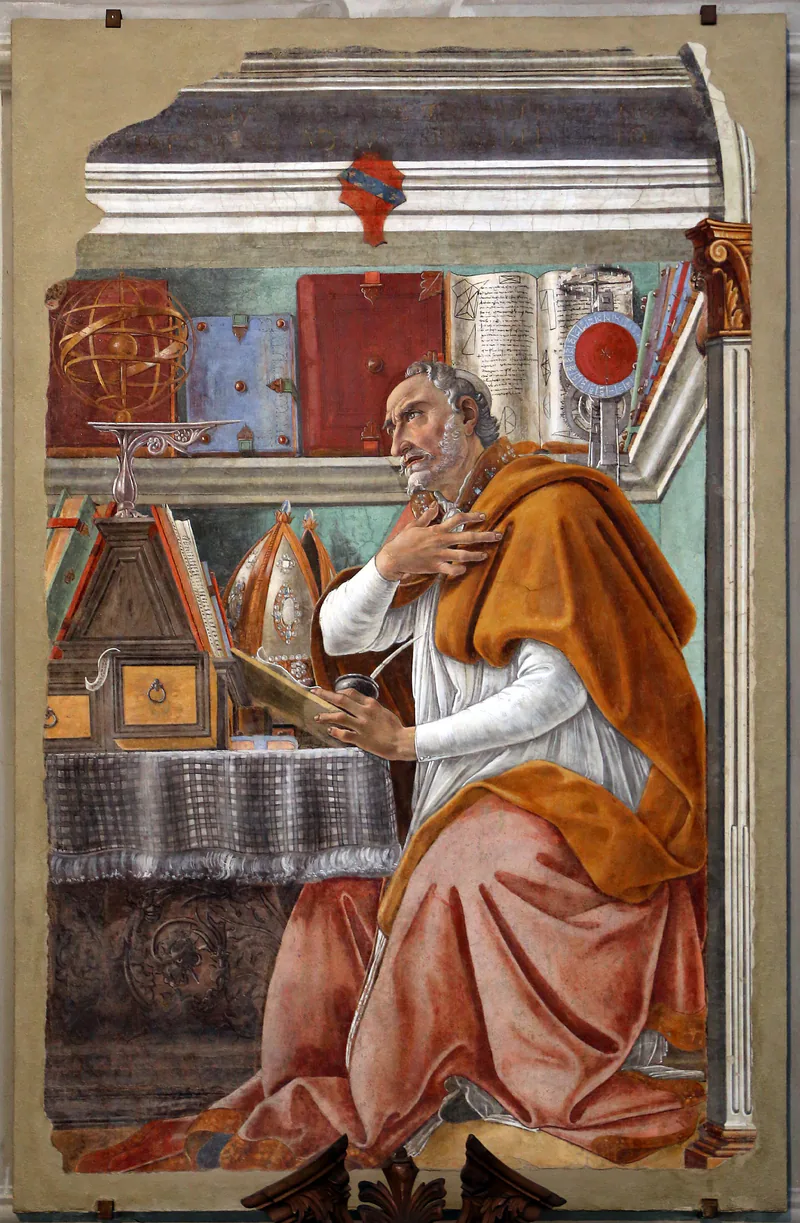
Origen of Alexandria suggested that punishment might be remedial and that in the end all rational beings, perhaps even the devil, might be restored to God (apokatastasis). This view was condemned in the sixth century, in anathemas associated with Emperor Justinian and the Second Council of Constantinople (553). In the West, Augustine argued in the City of God that the punishment of the damned is eternal, while allowing that some souls may be purified by a cleansing fire before the final judgment. Prayers and offerings for the dead are attested from early times: inscriptions in the catacombs ask peace for the departed, and Augustine's Confessions records his mother Monica's wish to be remembered at the altar. Catholic and Orthodox Christians also cite 2 Maccabees 12, where Judas Maccabeus offers sacrifice for fallen soldiers.
The Birth of Purgatory§
Pope Gregory the Great's Dialogues (c. 593–594) told stories of souls working off their sins after death, and the Venerable Bede recounted the vision of Drythelm, a Northumbrian who glimpsed places of purgation. In about 998 Abbot Odilo of Cluny instituted the commemoration of all the faithful departed on 2 November, which spread as All Souls' Day. The French historian Jacques Le Goff argued that purgatory as a distinct place, named by the noun purgatorium, appeared only in the later twelfth century, among Paris theologians and in popular visions such as the Irish Treatise on Saint Patrick's Purgatory (c. 1180s), which described a cave on Lough Derg as an entrance to the otherworld; that site is still a goal of the penitential pilgrimages described in Christian Pilgrimage.
The Second Council of Lyon (1274) and the Council of Florence (1439) defined that souls who die repentant but without having made full satisfaction for their sins are purified after death, and that the prayers, Masses and alms of the living help them. Purgatory became one of the great organising ideas of late medieval religion: chantries were endowed for Masses for the founder's soul, confraternities prayed for their dead members, and indulgences promised the remission of temporal punishment. Pope Benedict XII's constitution Benedictus Deus (1336) declared that the souls of the saved, once purified, see God face to face immediately, without waiting for the Last Judgment.
Visions of the Otherworld and Dante's Commedia§
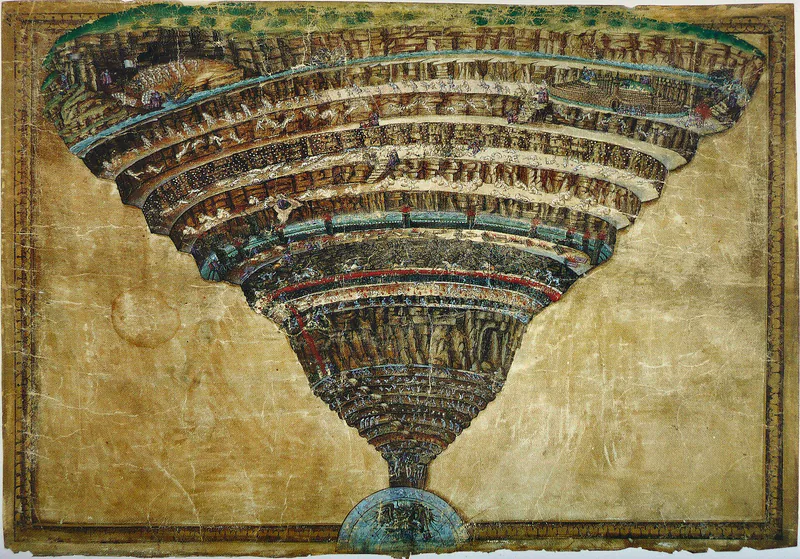
Medieval vision literature, including the Irish Vision of Tundale (1149) with its graphic torments, prepared the way for the greatest literary account of the Christian afterlife, Dante Alighieri's Divine Comedy (written c. 1308–1321). Dante's Hell is a funnel of nine circles descending to Satan frozen in ice at the earth's centre; Purgatory is a mountain on the opposite side of the globe, with seven terraces where the seven deadly sins are purged; Paradise rises through the heavenly spheres of medieval astronomy to the Empyrean and the vision of God. Dante drew on Thomas Aquinas, on Aristotelian cosmology and on Virgil, and his poem fixed the imagination of the afterlife for centuries.
Artists did the same. Last Judgment scenes over church doors and on chancel arches showed Christ enthroned, the dead rising, the archangel Michael weighing souls and demons dragging the damned into the mouth of hell. Giotto's Last Judgment in the Scrovegni Chapel at Padua (c. 1305), Michelangelo's fresco in the Sistine Chapel (1536–1541) and the visions of Hieronymus Bosch are among the most famous. Medieval theologians also spoke of limbo: the "limbo of the fathers," where the righteous of the Old Testament waited until Christ's descent into hell, and the "limbo of infants," for unbaptised children. The latter was never defined as doctrine, and a 2007 document of the Catholic International Theological Commission expressed hope for the salvation of such infants.
Reformation and Orthodox Views of the Afterlife§
The dispute over indulgences that sparked the Reformation, described in Martin Luther, was in large part a dispute about purgatory. The reformers concluded that purgatory had no basis in scripture and undermined justification by faith alone; the Church of England's Thirty-Nine Articles called the "Romish doctrine concerning purgatory" a "fond thing vainly invented." Masses for the dead, chantries and prayers for the departed were abolished in Protestant lands, transforming relations between the living and the dead. Some radical reformers held that souls sleep until the resurrection, a view Calvin attacked but which later reappeared among groups such as the Seventh-day Adventists. The Council of Trent reaffirmed purgatory in 1563 while warning against "curious" speculation and abuses.
Orthodox Christians reject the Latin definition of purgatory, which Mark of Ephesus opposed at Florence, but they pray for the dead and believe that these prayers benefit them. Memorial services are held on the third, ninth and fortieth days after death and on anniversaries. A popular teaching about "aerial toll-houses," through which the soul passes after death, is found in some Orthodox writings but is disputed among Orthodox theologians. Orthodoxy also emphasises that the final state is the experience of the same divine love, felt as joy by those who love God and as torment by those who reject him. For comparison with other traditions, see Islamic Eschatology and Reincarnation and the Afterlife.
Modern Debates: Universalism, Annihilationism and the Meaning of Hell§
Since the seventeenth century, when some English thinkers questioned eternal torment, many Christians have reconsidered hell. Universalists hold that all will finally be saved; the Universalist Church in America made this its central teaching, and the Swiss Catholic theologian Hans Urs von Balthasar argued that Christians may at least hope that hell is empty. Annihilationists, including some evangelical theologians, propose that the wicked are finally destroyed rather than tormented forever. Writers such as C. S. Lewis, in The Great Divorce (1945), portrayed hell as a state people choose by refusing God.
The Catechism of the Catholic Church (1992) describes hell as a "state of definitive self-exclusion from communion with God" and heaven as perfect life with the Trinity, avoiding spatial imagery. Popular interest in near-death experiences and debates over books such as Rob Bell's Love Wins (2011) show that the Christian afterlife remains a live question within and beyond the churches.
Frequently asked questions§
What is purgatory in Catholic teaching?§
Purgatory is the state of final purification after death for those who die in God's grace but still need cleansing before entering heaven. It is not a second chance for the unrepentant. Catholics believe that prayers and Masses offered by the living help souls in purgatory.
Do Protestants believe in purgatory?§
No. The Protestant reformers rejected purgatory as unscriptural and incompatible with salvation by grace through faith. Most Protestants believe that the souls of believers go directly to be with Christ at death.
Is limbo official Catholic doctrine?§
The limbo of infants was a widely held theological opinion but was never defined as dogma. In 2007 the International Theological Commission said there are serious grounds to hope that unbaptised infants who die are saved.
Where does the idea of hell come from?§
Christian ideas of hell draw on Jewish images of Gehenna and of final judgment, the sayings of Jesus in the Gospels, and the Book of Revelation. Later apocalypses, theologians and poets such as Dante elaborated these into detailed pictures of punishment.
Sources and further reading§
- The City of God — Augustine of Hippo, 426
- The Divine Comedy — Dante Alighieri, c. 1308–1321
- The Birth of Purgatory — Jacques Le Goff, 1981
- Heaven: A History — Colleen McDannell and Bernhard Lang, 1988
- The Formation of Hell: Death and Retribution in the Ancient and Early Christian Worlds — Alan E. Bernstein, 1993
- The Resurrection of the Body in Western Christianity, 200–1336 — Caroline Walker Bynum, 1995
- The Decline of Hell: Seventeenth-Century Discussions of Eternal Torment — D. P. Walker, 1964