Liber XVI · Indigenous & Ancient Religions · Chapter I: African Traditional Religions
Ifá Divination: Ọ̀rúnmìlà, the Babaláwo and the Yoruba Odù
Ifá divination of the Yoruba explained: Ọ̀rúnmìlà and destiny, the babaláwo priests, palm nuts and divining chain, the 256 Odù, their verses and Ifá today.

Ifá is the system of divination, and the body of sacred knowledge behind it, practised by the Yoruba of south-western Nigeria, Benin and Togo and by their descendants in the Americas. Priests called babaláwo, "fathers of secrets", consult Ọ̀rúnmìlà, the deity of wisdom and witness of human destiny, by casting sacred palm nuts or a divining chain to obtain one of 256 signs, the Odù, and then recite the verses associated with that sign to diagnose a client's situation and prescribe offerings. In 2005 UNESCO recognised the Ifá divination system as a masterpiece of the oral and intangible heritage of humanity.
Ọ̀rúnmìlà, Destiny and the Purpose of Ifá§
Yoruba religion, introduced in the overview of African traditional religions, recognises a supreme God, Olódùmarè, and many òrìṣà, divinities who act in the world. Among them Ọ̀rúnmìlà holds a special place. Yoruba tradition teaches that before birth every person kneels in heaven to choose an orí, literally "head", meaning a personal destiny. Ọ̀rúnmìlà was present at that choice and is therefore called Ẹlẹ́rìí Ìpín, "witness of destiny". Because human beings forget what they chose, they need Ifá to learn what their destiny holds and how to align themselves with it.
Ifá is thus not mainly about predicting the future as fixed fate. Its purpose is to discover what forces, human and spiritual, are affecting a person's path, whether a planned marriage, journey, illness or enterprise is favourable, and what should be done to secure good fortune (ire) and avert misfortune (ibi). The tradition holds that a good destiny can be spoiled by bad character and a difficult one improved by right action, so Ifá also teaches ìwà, character, as the foundation of a good life.
The sacred city of Ilé-Ifẹ̀, the place of creation in Yoruba myth, is regarded as the home of Ifá. Myths tell how Ọ̀rúnmìlà came down to earth, taught his followers and later withdrew, leaving the sacred palm nuts as the means of consulting him.
The Babaláwo: Training and Priesthood§
The priest of Ifá is the babaláwo. Training traditionally begins in childhood or youth and lasts many years, during which the apprentice learns the signs, the rituals and, above all, a vast number of verses by heart. A skilled babaláwo may know thousands of verses. Initiation into Ifá is a formal rite carried out by senior priests, after which the initiate receives his own sacred nuts.
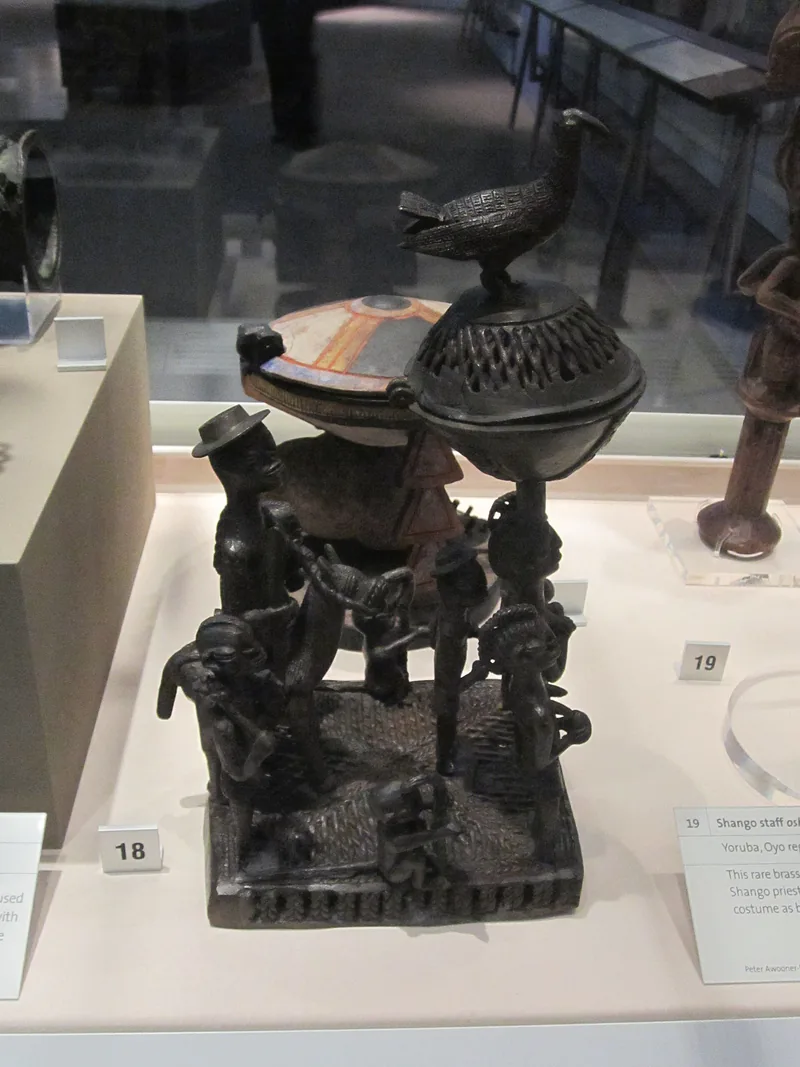
Babaláwo are organised in hierarchies with titles, often under an Àràbà in a town, and they meet regularly for worship and for the exchange of knowledge. Historically they advised kings and chiefs as well as ordinary people, and the selection of rulers and the timing of public festivals often involved consultation of Ifá.
The role of women is debated. In parts of Nigeria some lineages initiate women into Ifá as ìyánífá, "mothers of Ifá", while other Yoruba priests, and most Cuban practitioners, hold that women serve in other capacities, such as the apètèbí, the wife and assistant of a babaláwo. Women play central roles as priestesses of other òrìṣà and as diviners using the sixteen cowries.
The Nigerian scholar Wande Abimbola, who holds the title Àwísẹ Awo Àgbáyé, spokesman of Ifá worldwide, has done much to record the oral corpus and to represent Ifá internationally.
Instruments of Ifá Divination§
The most solemn instrument is a set of sixteen sacred palm nuts, ikin. The diviner manipulates them between his hands and, according to the result of each round, marks single or double lines in a fine wood powder (ìyẹ̀rọ̀sùn) spread on a carved wooden tray, the ọpọ́n Ifá. Repeated eight times, this produces a figure of two columns of four marks each. The trays are among the masterpieces of Yoruba sculpture, their borders carved with figures and almost always with the face of the messenger Èṣù at the top. The priest may strike the tray with a tapper (ìrọ́kẹ̀) to call on Ọ̀rúnmìlà.
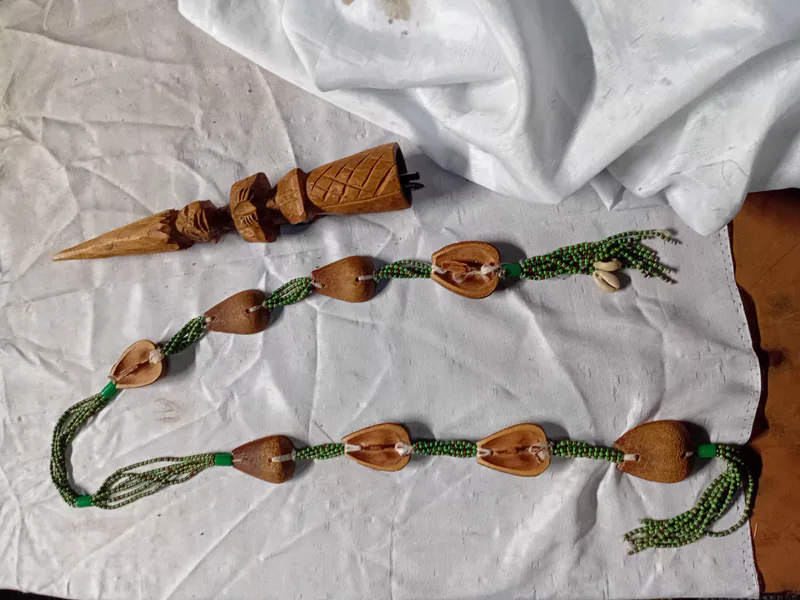
For everyday consultations a quicker instrument is used: the ọ̀pẹ̀lẹ̀, a chain of eight half seed-pods or other pieces, which, cast once, falls to show the whole figure at a glance. Further questions are answered by having the client choose between paired objects (ìbò), such as a shell and a bone, which allows the diviner to narrow down the meaning of the sign. The client often whispers the question to a coin or object without the priest hearing it, so that the verses chosen are believed to come from Ifá rather than from the diviner's knowledge of the problem.
The Odù Ifá: Signs, Verses and Stories§
The sixteen basic figures, in which both columns are the same, are the principal Odù, traditionally listed in an order of seniority beginning with Èjì Ogbè, Ọ̀yẹ̀kú Méjì, Ìwòrì Méjì and Òdí Méjì and ending with Ọ̀ṣẹ́ and Òfún. Combining them in pairs gives 16 × 16 = 256 Odù in all. Each Odù is regarded as a divinity in its own right as well as a chapter of knowledge.
Attached to each Odù is a body of verses, ẹsẹ Ifá. A typical verse names the diviners who once cast Ifá for a mythical client, an animal, a tree, a town or an òrìṣà, states the problem, gives the sacrifice prescribed, and tells what happened when the client did or did not perform it. The babaláwo recites verses of the Odù that has appeared, and the client, who knows his or her own situation, recognises which story applies. The verses form a great oral library of Yoruba myth, history, medicine, ethics and poetry, and much of what is known of Yoruba religion comes from them.
The binary structure of Ifá has prompted comparison with Arabic sand-writing geomancy (ʿilm al-raml), which also builds sixteen figures from single and double marks and which spread across Islamic Africa, and with Malagasy sikidy. Some historians have argued for a historical connection through trans-Saharan contact, while others stress Ifá's deep local roots and distinct literature; the question remains open. The European branch of the tradition is described in Geomancy. Closely related systems are practised by neighbouring peoples, such as Fá among the Fon of Benin, discussed in West African Vodun, and Afa among the Ewe.
Sacrifice, Èṣù and the Outcome of a Consultation§
A consultation usually ends with the prescription of an ẹbọ, a sacrifice or offering, together with advice about conduct. Offerings might include food, kola nuts, cloth, money or, for serious matters, animals, and part of them is set aside for Èṣù. In the verses, clients who neglect the prescribed offering suffer for it, while those who perform it prosper. Ifá may also direct the client to worship a particular òrìṣà or to receive medicines.
Èṣù (Ẹlẹ́gbára) is the indispensable partner of Ifá. He is the messenger who carries sacrifices to the gods and the guardian of crossroads and marketplaces, an unpredictable trickster who enforces the order of offerings. Nineteenth-century missionaries translating the Bible into Yoruba used his name for Satan, an identification that Yoruba scholars and practitioners reject as a serious misunderstanding of his role.
Ifá in the Americas and the Wider World§
Enslaved Yoruba brought Ifá to the Americas, where it survived above all in Cuba. In Cuban Lucumí religion, described in Santería and the orishas, the babalawo of Orula (Ọ̀rúnmìlà) form a distinct priesthood alongside the priests of other orishas, and each January groups of Havana babalawos publish a "Letter of the Year" with the Odù and advice for the coming year. In Brazil, where Ifá priests became rare, divination in Candomblé is chiefly carried out with sixteen cowries (jogo de búzios), a system closely related to the ẹẹ́rìndínlógún of Yoruba òrìṣà priests.
Since the late twentieth century Ifá has become an international religion, with practitioners in the United States, Latin America and Europe and renewed links between Nigerian and diaspora priests. Debates about authority, lineage, the initiation of women and the commercialisation of readings, including online consultations, are part of this growth. Many babaláwo emphasise that Ifá is a religious practice requiring years of training and proper initiation, not a technique to be learned from books.
Frequently asked questions§
What is the difference between Ifá and Santería?§
Ifá is the Yoruba divination system and priesthood centred on Ọ̀rúnmìlà, found in West Africa and the diaspora. Santería or Lucumí is an Afro-Cuban religion of orisha worship that includes Ifá as one of its priesthoods, alongside other forms of divination and initiation.
What does babaláwo mean?§
Babaláwo means "father of secrets" or "father of the mysteries" in Yoruba. It is the title of an initiated priest of Ifá who has learned the signs, rituals and verses needed to consult Ọ̀rúnmìlà.
How many Odù are there in Ifá?§
There are sixteen principal Odù, which combine in pairs to form 256 Odù in all. Each is associated with many verses that the babaláwo memorises and recites during a consultation.
Sources and further reading§
- Ifa Divination: Communication between Gods and Men in West Africa — William Bascom, 1969
- Sixteen Cowries: Yoruba Divination from Africa to the New World — William Bascom, 1980
- Ifá: An Exposition of Ifá Literary Corpus — Wande Abimbola, 1976
- Olódùmarè: God in Yoruba Belief — E. Bọlaji Idowu, 1962
- Flash of the Spirit: African and Afro-American Art and Philosophy — Robert Farris Thompson, 1983
- Òrìṣà Devotion as World Religion: The Globalization of Yorùbá Religious Culture — Jacob K. Olupona and Terry Rey, 2008