Liber XII · Hermeticism · Chapter II: Corpus Hermeticum
Discourse on the Eighth and Ninth: A Hermetic Ascent Text
The Discourse on the Eighth and Ninth from Nag Hammadi Codex VI: a Coptic Hermetic dialogue of prayer, silent hymns and the soul's ascent to the Ogdoad.

The Discourse on the Eighth and Ninth is a Hermetic dialogue preserved in Coptic in Codex VI of the Nag Hammadi library, discovered in Upper Egypt in 1945. In it a teacher, Hermes Trismegistus, leads his "son" in prayer until both experience a vision of the Eighth and Ninth heavens, the realms beyond the seven planetary spheres, and sing silent hymns to God. Unknown before its discovery, it is the clearest surviving description of what Hermetic spiritual practice may have looked like in late antique Egypt.
Discovery in Nag Hammadi Codex VI§
In December 1945 farmers near the town of Nag Hammadi found a jar containing thirteen leather-bound papyrus codices, now known as the Nag Hammadi library. Most of the fifty-odd texts are Christian and Gnostic, but Codex VI contains a cluster of Hermetic writings at its end. After works such as The Thunder, Perfect Mind, Authoritative Teaching and a Coptic paraphrase of a passage from Plato's Republic, the codex gives three Hermetic pieces in a row: the untitled dialogue now called the Discourse on the Eighth and Ninth (VI,6), the Prayer of Thanksgiving (VI,7), and a Coptic version of part of the Asclepius (VI,8, corresponding to chapters 21–29 of the Latin).
Between the prayer and the Asclepius extract the scribe added a short note explaining that he had copied this one discourse, though many others had reached him, on the assumption that the recipients already had the rest. The note suggests that Hermetic writings circulated in some quantity among the Christian readers who owned these books in the fourth century.
The Discourse has no title in the manuscript; its modern name comes from its subject. Like the other Nag Hammadi texts it is a Coptic translation from Greek. The original is usually dated to the second or third century CE, roughly contemporary with the treatises of the Corpus Hermeticum. The opening pages are damaged, so the beginning of the dialogue is partly lost.
The Teacher, the Son and the Hermetic Way§
The speakers are a master, addressed as "my father", and a disciple whom he calls "my son". The father is identified as Trismegistus later in the text; the son is not named, though readers have compared him to Tat, Hermes' pupil in the Greek treatises. The dialogue begins with the son reminding the father of a promise: once the son had passed through the lower stage, he would be brought to the Eighth and then the Ninth.
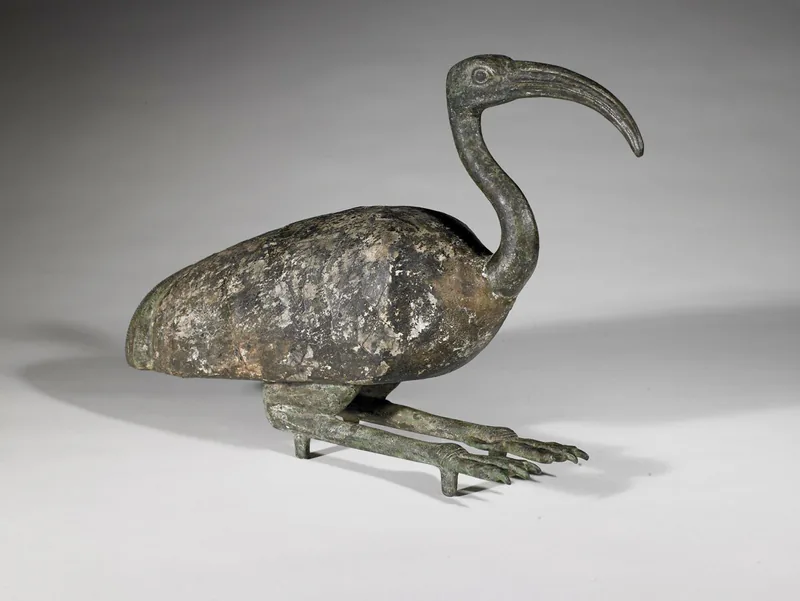
The text assumes a graded path. The son says that he has already progressed through the stage associated with the seven planetary spheres, the "Hebdomad", and that he has studied the books. In the Hermetic picture of the cosmos, which the Poimandres also describes, the soul descends through seven planetary zones into the body and must return through them; above them lies an eighth sphere, where purified souls praise God, and beyond that the realm of God's own powers. The Discourse translates this cosmology into a teaching relationship: knowledge from books prepares the pupil, but the final stage requires prayer, grace and a shared experience with the teacher.
Much of the dialogue concerns the bond between them. The father speaks of "spiritual births" and of the brothers born from the same teaching, implying a group of disciples. This language of rebirth closely resembles Treatise XIII of the Corpus Hermeticum, in which Hermes guides Tat through a regeneration on a mountain and teaches him a secret hymn.
Prayer, Vowels and the Vision of the Ogdoad and Ennead§
The central part of the text is a prayer, spoken by both father and son, addressed to the invisible God as ruler over the realm of power. It asks for the gift of wisdom and for a vision of the Eighth and Ninth. Embedded in the prayer are sacred names and sequences of Greek vowels, written out at length in the Coptic, together with names such as Zoxathazo. Such vowel chains and divine names are well known from the Greek magical papyri of Roman Egypt, where they represent the secret language of the gods and the harmonies of the seven planets (each Greek vowel was associated with one planet).
After the prayer the master falls into an ecstatic state. He describes seeing a power that is light and a Mind that moves the soul, and he speaks of himself as Mind seeing Mind. The pupil then shares the experience: he too sees, and is urged to sing in silence. The text emphasises that the highest praise is wordless; the pupil offers a "silent hymn" and then a spoken hymn of thanks. The Eighth (Ogdoad) is presented as a realm of souls and angels singing hymns, and the Ninth (Ennead) as the realm of the powers that praise the One beyond them.
The account is unusually intimate. It does not describe a mythic journey through gates and guardians, as some Gnostic texts do, but a transformation of consciousness within a ritual setting. Hermes warns the son to keep the teaching from the unworthy, a common Hermetic theme.
The Stelae of Diospolis and the Frog- and Cat-Faced Guardians§
At the end, Hermes instructs the son to write the discourse in hieroglyphic characters on stelae of turquoise for the temple at Diospolis, the Greek name for Thebes (or possibly another town of that name). The writing is to be done at an astrological moment connected with Hermes' own planet, Mercury, and the son is to place an oath in the book so that readers will not misuse it. The text describes eight guardians around the stelae: males with the faces of frogs and females with the faces of cats.
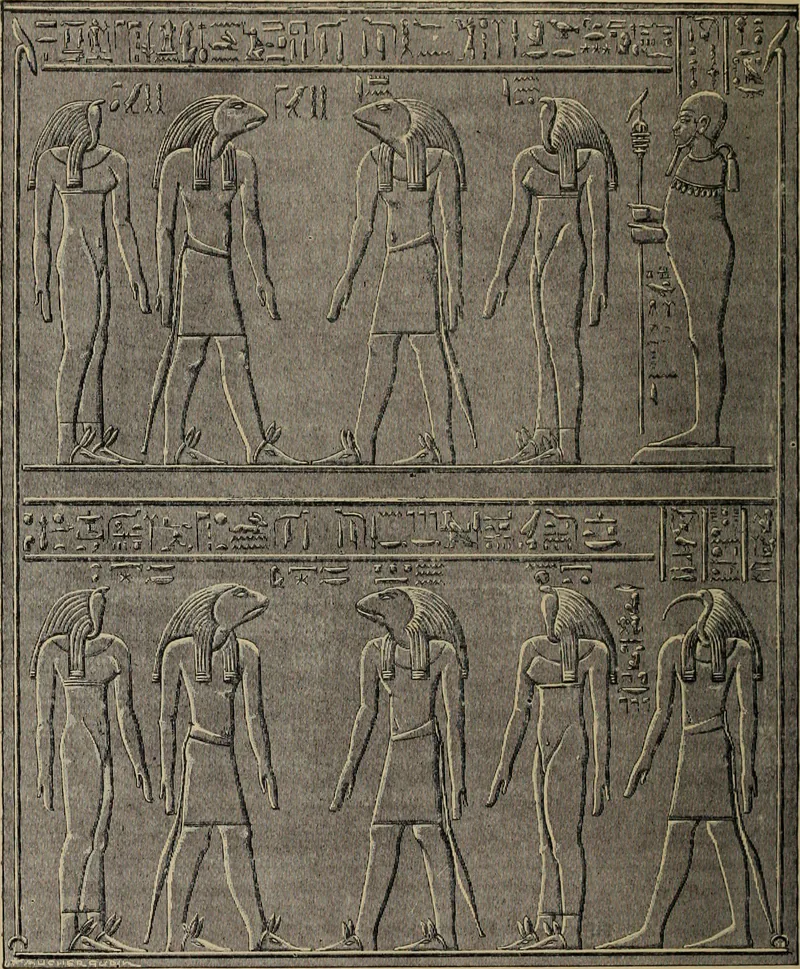
These details are strongly Egyptian. Hermes was the Greek name for Thoth, the ibis-headed god of writing (see Hermes Trismegistus), and Thoth's chief city, Hermopolis, was the centre of the cult of the Ogdoad, eight primordial deities depicted as four frog-headed gods and four serpent-headed goddesses. Most commentators see the frog- and cat-faced guardians as a version of this Hermopolitan Ogdoad, perhaps adapted with cat-headed goddesses resembling Bastet. The motif of sacred books inscribed on stelae and hidden in temples also belongs to Egyptian priestly lore about the writings of Thoth.
For scholars such as Jean-Pierre Mahé and Garth Fowden, these features show that the Hermetica were not merely Greek philosophy dressed in Egyptian costume, but grew out of an Egyptian temple culture in which Greek-educated priests reinterpreted their own traditions.
Was There a Hermetic Community?§
Because the Discourse describes a teacher, a pupil, "brothers", shared prayer, and hymns, it has become central to the debate about whether Hermetism was practised in organised groups. Some early twentieth-century scholars imagined a Hermetic church or "lodge" with sacraments; others argued that the Hermetica were literary exercises. The Nag Hammadi texts shifted the discussion. The Prayer of Thanksgiving that follows the Discourse ends with a note that, after praying, the participants embraced and ate a holy meal without blood, which suggests communal ritual.
Recent scholarship takes a middle position. Anna Van den Kerchove has studied the ritual practices implied by the Hermetic treatises, arguing for a graded "way of Hermes" involving instruction, prayer and initiation. Christian Bull connects the Hermetic master with the figure of the Egyptian priest teaching in Greek. Wouter Hanegraaff has argued that texts like the Discourse point to deliberately induced altered states of consciousness in which knowledge of God was experienced rather than reasoned. Whether these groups were large or small, formal or informal, remains uncertain.
Hermetic or Gnostic? The Text's Place in the Tradition§
Because it was found among Gnostic writings, the Discourse is sometimes labelled Gnostic. Its theology, however, is recognisably Hermetic. It does not present the cosmos as the product of an ignorant or hostile creator, as Sethian texts do (see The Demiurge), and it treats the planetary spheres as stages to be passed rather than prisons ruled by enemies. What it shares with Gnostic literature is the conviction that salvation comes through knowledge (gnosis) granted by revelation, and the vocabulary of Ogdoad and Ennead, which was widely used in this period.
Within the Hermetic corpus, the Discourse fills a gap. The Greek treatises refer to secret teachings and to hymns, but rarely show the moment of experience. Read together with Poimandres and Treatise XIII, it gives a picture of a path from instruction through rebirth to silent communion with God, and it shows how Hermetic writers combined Platonic philosophy, Egyptian temple tradition and the techniques of ritual prayer.
Frequently asked questions§
Where was the Discourse on the Eighth and Ninth found?§
It was found in Codex VI of the Nag Hammadi library, a collection of Coptic codices discovered in Upper Egypt in 1945. It is the sixth text of the codex and is followed by two further Hermetic texts, the Prayer of Thanksgiving and an extract from the Asclepius.
What are the Eighth and the Ninth?§
They are levels of reality above the seven planetary spheres. In Hermetic cosmology the Eighth (Ogdoad) is the realm where purified souls and angels praise God, and the Ninth (Ennead) lies closer still to the divine source.
Is the Discourse on the Eighth and Ninth a Gnostic text?§
It was preserved alongside Gnostic writings, but its teaching is Hermetic. It does not regard the cosmos or its creator as evil, and its practice centres on prayer, hymns and the guidance of Hermes as teacher.
Why is the text important for the study of Hermeticism?§
It is the most detailed ancient description of Hermetic spiritual practice. It suggests that Hermetic teaching involved a relationship between master and pupil, communal prayer and ecstatic experience, not just philosophical reading.
Sources and further reading§
- The Nag Hammadi Library in English — James M. Robinson (ed.), 1977
- The Nag Hammadi Scriptures — Marvin Meyer, 2007
- Nag Hammadi Codices V,2–5 and VI with Papyrus Berolinensis 8502, 1 and 4 — Douglas M. Parrott (ed.), 1979
- Hermès en Haute-Égypte — Jean-Pierre Mahé, 1978
- The Egyptian Hermes — Garth Fowden, 1986
- La voie d'Hermès: Pratiques rituelles et traités hermétiques — Anna Van den Kerchove, 2012
- The Tradition of Hermes Trismegistus: The Egyptian Priestly Figure as a Teacher of Hellenized Wisdom — Christian H. Bull, 2018
- Hermetic Spirituality and the Historical Imagination — Wouter J. Hanegraaff, 2022