Liber XXV · Secret Societies · Chapter III: Initiatory Orders
Egyptian Rite Freemasonry: Cagliostro, Misraïm and Memphis
Egyptian Rite Freemasonry explained: Cagliostro's Egyptian Masonry, the Rites of Misraïm and Memphis, Garibaldi, Yarker, Papus and Memphis-Misraïm today.

Egyptian Rite Freemasonry is the family of Masonic systems that claim to preserve the initiations of the priests of ancient Egypt. It began with the "Egyptian Masonry" of the adventurer Count Cagliostro in the 1780s, continued in the many-degreed Rites of Misraïm (from about 1805) and Memphis (1838), which were united as Memphis-Misraïm in 1881, and became a vehicle for occultists such as John Yarker, Theodor Reuss and Papus. Historians see these rites as products of European Egyptomania rather than of any ancient transmission.
Egyptomania and the Myth of Egyptian Initiation§
Long before anyone could read hieroglyphs, Europeans imagined Egypt as the homeland of secret wisdom. Renaissance scholars revered Hermes Trismegistus as an Egyptian sage (see what is Hermeticism), and hieroglyphs were thought to be symbolic codes for philosophical truths. In 1731 the French abbé Jean Terrasson published Séthos, a novel about an Egyptian prince who undergoes terrifying ordeals of fire, water and air beneath the pyramids before being admitted to the priesthood. Although fiction, Séthos was widely read as a plausible reconstruction of ancient mysteries.
Freemasons, who already traced their craft to the builders of Solomon's Temple, found the idea irresistible. In 1770 a German pamphlet, Crata Repoa, usually attributed to Carl Friedrich Köppen and Johann Wilhelm Bernhard von Hymmen, described seven grades of Egyptian priestly initiation as a model for Masonic degrees. In Vienna the mineralogist Ignaz von Born published in 1784 an essay on the mysteries of the Egyptians in a Masonic journal, and Mozart and Schikaneder's The Magic Flute (1791), with its temple of Isis and Osiris and its trials by fire and water, brought Egyptian-Masonic initiation to the stage. None of this reflected the actual religion of ancient Egypt (see ancient Egyptian religion), which became known in detail only after Champollion's decipherment in 1822.
Cagliostro and the Egyptian Rite of the Grand Copht§
The first true Egyptian rite was the creation of "Count Alessandro di Cagliostro", the name used by a Sicilian adventurer whom most historians identify with Giuseppe Balsamo (1743–1795) of Palermo. After years of travel as a healer and alchemist, he was initiated in April 1777 into a London lodge, L'Espérance, meeting in Soho. He later claimed to have found in London a manuscript on Egyptian Masonry by an otherwise unknown George Cofton, and from about 1779 he began founding lodges of his own rite, first in Courland and then across Europe.
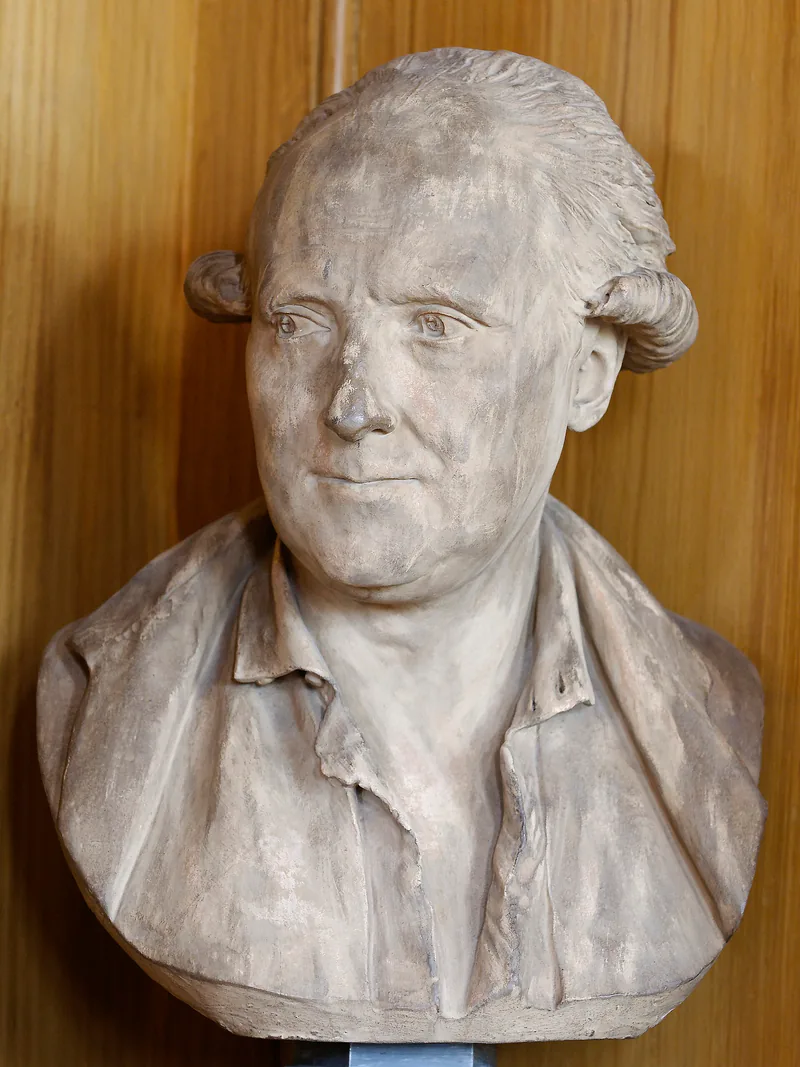
Cagliostro presented himself as the Grand Copht, the supreme head of a Masonry restored to its Egyptian purity, which he contrasted with the decadent lodges of his day. His rite had three degrees, Egyptian Apprentice, Companion and Master. The rituals invoked God, angels and the patriarchs and mixed Christian, Hermetic and kabbalistic language with Egyptian names. Its most celebrated feature was the use of a "dove" or "pupil", usually a child or young woman regarded as innocent, who gazed into a carafe of water and was said to see angels and give answers, a form of scrying with a long history in Western magic.
Regeneration, Women's Lodges and the Fall of Cagliostro§
Cagliostro's teaching promised two kinds of regeneration. Moral regeneration would restore the initiate to Adam's state before the fall; physical regeneration, reserved for the highest adepts, was to renew the body through a long retreat and a secret regimen. These ideas belong to the same world as contemporary Martinism and Rosicrucian alchemy, with which Cagliostro's followers often overlapped.
Unusually, the Egyptian Rite admitted women in lodges of adoption led by Cagliostro's wife, Serafina (Lorenza Feliciani), who presided as Grand Mistress. In Lyon, Cagliostro founded in 1784 the mother lodge La Sagesse Triomphante (Triumphant Wisdom), which attracted wealthy Masons and inaugurated a purpose-built temple. In Paris in 1785 he was a social sensation, with a following among aristocrats and a reputation as a miraculous healer.
His fall was swift. He was arrested in 1785 in connection with the Diamond Necklace Affair, a fraud involving Queen Marie-Antoinette's name; acquitted in 1786, he was nonetheless expelled from France. In 1789 he went to Rome, where he was arrested by the papal authorities, tried by the Inquisition for Freemasonry and heresy, and condemned in 1791. His death sentence was commuted to life imprisonment, and he died in the fortress of San Leo in 1795. The Inquisition published an official account of his life, and Goethe, who had investigated the Balsamo family in Palermo, satirised him in the comedy Der Gross-Cophta (1791). Iain McCalman's biography presents him as a figure who embodied both the hopes and the credulity of the late Enlightenment.
After Napoleon in Egypt: The Rite of Misraïm§
Bonaparte's expedition to Egypt in 1798–1801, and the great Description de l'Égypte that followed, fed a new wave of Egyptomania. Around 1805 a Masonic system calling itself the Rite of Misraïm, from the Hebrew name for Egypt, appeared in northern Italy among French officers and Italian Masons. It offered ninety degrees, arranged in series that gathered up symbolic, philosophical, mystical and kabbalistic grades from almost every existing system, crowned by the "Arcana Arcanorum".
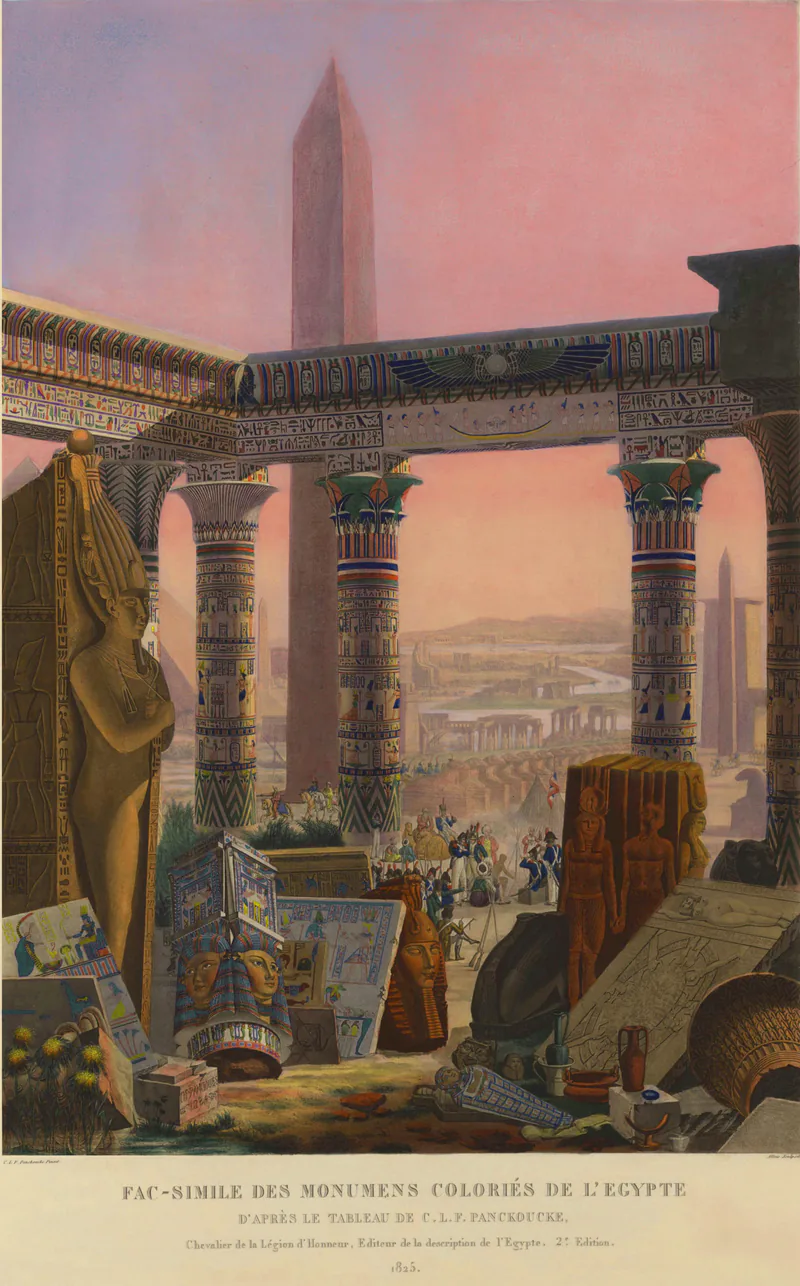
The rite was carried to France around 1814–1815 by three brothers from a Jewish family of Cavaillon, Michel, Marc and Joseph Bédarride, who became its tireless promoters. It clashed repeatedly with the Grand Orient of France, which refused to recognise its high degrees, and with the police of the Restoration, who suspected political conspiracy; its lodges were closed more than once. Marc Bédarride's history of the order, published in 1845, gave it a legendary genealogy reaching back to Adam. The supposed inner teaching of its highest grades, sometimes said to concern an internal alchemy of the soul, is known chiefly from later and contested sources.
The Rite of Memphis and the Union of Memphis-Misraïm§
In 1838 Jacques-Étienne Marconis de Nègre founded in Paris the Rite of Memphis, a rival Egyptian system of more than ninety degrees. Its legend held that a wise Egyptian named Ormus, converted by Saint Mark, had united the Egyptian mysteries with Christianity, and that the tradition had passed through the Essenes, the Templars and the Rosicrucians to the Masons. The rite was suspended in the 1840s, revived after 1848 and, in 1862, placed under the Grand Orient of France, which absorbed its lodges. Marconis also carried it to the United States.
In Britain the Manchester antiquary John Yarker (1833–1913) obtained charters for both rites and promoted an "Ancient and Primitive Rite" reduced to thirty-three degrees. In 1881 the two rites were united under the nominal headship of the Italian patriot Giuseppe Garibaldi, a Freemason honoured as Grand Hierophant. Yarker's charters later passed to the German occultist Theodor Reuss, who used them in building the Ordo Templi Orientis associated with Aleister Crowley, while in France Papus became head of Memphis-Misraïm in the years before the First World War, linking it with the Martinist Order and the occult revival (see French occultism from Lévi to Papus).
Egyptian Masonry Today and How Historians Judge It§
After the Second World War the French occultist Robert Ambelain reorganised a unified Rite of Memphis-Misraïm, and today the rite is worked by several independent obediences in France, Italy, Belgium, Latin America and elsewhere, most of which confer only a selection of the ninety-plus degrees in full ceremony. Some admit women. Regular grand lodges in the Anglo-American tradition do not recognise these bodies; within mainstream Freemasonry the closest analogue is the elaborate higher-degree system of the Scottish Rite.
Historians of esotericism, among them Erik Hornung and the authors of studies of French high-degree Masonry, treat Egyptian rites as a creative modern invention. They show how Egypt functioned as a symbol of primordial, pre-Christian wisdom that could legitimise new rituals, and how the long lists of degrees reflect the eighteenth- and nineteenth-century fascination with collecting and ordering every known initiation. No continuity with the actual priesthoods of pharaonic Egypt has ever been demonstrated, and the hieroglyphic Egypt revealed by Egyptology after 1822 looked very different from the Egypt of the lodges (see Freemasonry and initiatory orders).
Frequently asked questions§
What is Egyptian Rite Freemasonry?§
It is a group of Masonic systems, beginning with Cagliostro's Egyptian Masonry in the 1780s and continuing in the Rites of Misraïm and Memphis, that claim to transmit the initiations of ancient Egyptian priests. They use Egyptian names and imagery alongside Hermetic, kabbalistic and Christian elements.
Was Cagliostro a real count?§
No. "Count Cagliostro" was an assumed title. Most historians identify him with Giuseppe Balsamo of Palermo, born in 1743, although he himself denied it and a few writers still dispute the identification.
How many degrees does Memphis-Misraïm have?§
Historically the Rite of Misraïm had 90 degrees and the Rite of Memphis more than 90; the combined rite is usually presented with 95 or more. In practice most obediences confer only a handful in full and communicate the rest by title.
Is Memphis-Misraïm recognised by regular Freemasonry?§
No. The United Grand Lodge of England and the grand lodges in amity with it do not recognise Memphis-Misraïm bodies, which belong to the independent and liberal Masonic world.
Sources and further reading§
- Séthos, histoire ou vie tirée des monumens anecdotes de l'ancienne Égypte — Jean Terrasson, 1731
- Cagliostro: The Splendour and Misery of a Master of Magic — W. R. H. Trowbridge, 1910
- The Last Alchemist: Count Cagliostro, Master of Magic in the Age of Reason — Iain McCalman, 2003
- The Secret Lore of Egypt: Its Impact on the West — Erik Hornung, 2001
- Maçonnerie égyptienne, rose-croix et néo-chevalerie — Gérard Galtier, 1989
- Handbook of Freemasonry — Henrik Bogdan and Jan A. M. Snoek, 2014