Liber XXII · Occultism · Chapter XI: Occultism & Science
Karl von Reichenbach and the Odic Force: Od, Sensitives, Aura
The chemist Karl von Reichenbach (1788–1869) and his odic force: experiments with sensitives, the Od controversy, and its legacy in occult ideas of the aura.

The odic force, or Od, was a universal vital energy proposed in the 1840s by the German chemist and industrialist Karl von Reichenbach (1788–1869). Reichenbach claimed that certain "sensitive" people could see faint flames streaming from magnets, crystals and human hands in total darkness and could feel these emanations as warmth or coolness. Mainstream science rejected Od as an effect of suggestion, but the idea passed into psychical research, Theosophy and modern teachings about the human aura.
Karl von Reichenbach: Chemist and Industrialist§
Karl Ludwig von Reichenbach was born in Stuttgart on 12 February 1788, the son of the court librarian. As a student he joined a secret society that planned a utopian colony in the South Seas, which earned him a period of imprisonment. He then turned to practical science, studying metallurgy and charcoal production, and made a fortune managing ironworks and wood-distillation plants, above all at Blansko in Moravia. He was raised to the rank of baron and later bought the castle of Reisenberg near Vienna.
Reichenbach's reputation as a scientist was solid. Investigating the products of wood tar, he isolated paraffin in 1830 and creosote in 1832, among other substances, and he was a noted collector and student of meteorites. When he began to publish on Od in the mid-1840s he was a man in his late fifties with a distinguished record in chemistry, which is why his claims were taken seriously at first.
The Sensitives and the Discovery of Od§
Reichenbach's inquiry began in 1844 with patients of Viennese physicians who suffered from nervous disorders. One young woman, he reported, could perceive light at the poles of a magnet in a completely dark room and felt the magnet's influence on her body. He soon found others who described the same experiences, and by his own account he eventually examined well over a hundred "sensitives" of both sexes and many social backgrounds, though invalids and young women predominated.

What the sensitives reported§
In carefully darkened rooms, after a period of adaptation, the sensitives described pale flames or glowing vapours rising from the poles of magnets, from crystals, from the tips of human fingers, from plants and from fresh graves. Some said that the emanations differed in colour, bluish from one pole and reddish-yellow from the other. They also reported sensations of coolness or tepid warmth when objects were passed over their bodies, and discomfort when lying in certain orientations relative to the earth's magnetic field. Reichenbach concluded that he had found a force distinct from magnetism, electricity and heat, but associated with all of them and present throughout nature.
Naming the force§
He called it Od, a word he explained by reference to the Germanic god Wodan or Odin and to the idea of something that pervades all things. Od had, he argued, a polarity of its own, positive and negative, which corresponded broadly to the right and left sides of the human body, and it was concentrated in the hands, which explained the effects claimed by mesmerists for their "passes".
Publications and Reception§
Reichenbach first published his results in 1845 in the Annalen der Chemie, edited by the eminent chemist Justus von Liebig, and then as a book, Physikalisch-physiologische Untersuchungen über die Dynamide des Magnetismus, der Elektricität, der Wärme, des Lichtes, in 1849. English translations quickly followed: the Edinburgh chemist William Gregory, himself an enthusiast for mesmerism, published Researches on Magnetism, Electricity, Heat, Light, Crystallization, and Chemical Attraction, in Their Relations to the Vital Force in 1850. Later works include the popular Odisch-magnetische Briefe (1852) and the two-volume Der sensitive Mensch (1854–1855).
The reaction of physicists and physiologists was largely hostile. No instrument could detect Od, and its existence depended entirely on the testimony of sensitives, whom critics suspected of hysteria, suggestibility or a desire to please. In 1846 James Braid argued in The Power of the Mind over the Body that the same sensations could be produced in his own subjects simply by telling them what to expect, and that Reichenbach had not excluded the influence of his own questions. Braid's critique, discussed in our article on the origins of hypnotism, is an early classic of the problem of experimenter expectation.
Reichenbach responded with ever larger volumes of observation and growing bitterness towards the scientific establishment. Late in life, around 1867, he persuaded the psychophysicist Gustav Theodor Fechner to observe experiments in Leipzig; Fechner found the results suggestive but not conclusive. Reichenbach died in Leipzig on 19 January 1869, convinced that his discovery had been unjustly ignored.
Od, Mesmerism and the Vital Force Debate§
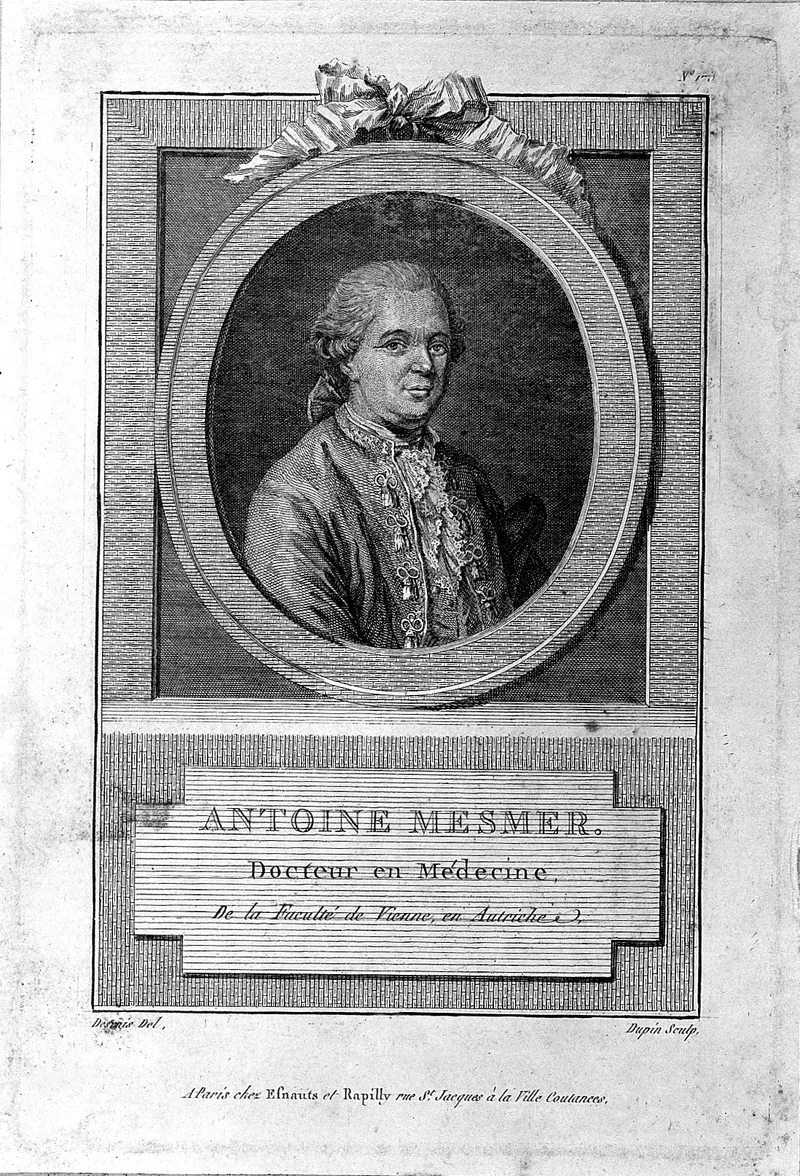
Od belonged to a long line of proposed subtle fluids. Mesmer's animal magnetism had posited a universal fluid acting on the nerves; Romantic nature philosophy spoke of a world-soul and of polar forces running through nature; and physiologists of the early nineteenth century still debated whether life required a special "vital force" beyond chemistry. Reichenbach presented Od as a natural, physical force that could be studied empirically, and he distanced himself from the spiritual claims of the mesmerists even as his work gave them a new vocabulary.
His timing was unfortunate. During the 1840s and 1850s German physiologists such as Hermann von Helmholtz and Emil du Bois-Reymond were campaigning to explain living processes entirely through physics and chemistry, and the conservation of energy left little room for a new imponderable. Od became, for its critics, a cautionary example of how a competent scientist could be misled by subjective testimony. The wider pattern is traced in our article on occultism and science.
Od in Psychical Research and Occultism§
The idea nevertheless proved durable. When the Society for Psychical Research was founded in London in 1882, one of its first committees was devoted to "Reichenbach phenomena"; it reported a few observations of faint luminosity by some subjects but reached no firm conclusion. In France the occultist and engineer Albert de Rochas returned to Reichenbach's sensitives in his studies of the "exteriorisation of sensibility" in the 1890s, and the German philosopher Carl du Prel drew on Od in his theory of the soul.
Od and the astral light§
Occultists readily identified Od with older ideas. Éliphas Lévi's "astral light", the universal medium of magic, was compared with it, and Helena Blavatsky in Isis Unveiled (1877) cited Reichenbach's Od among the many names she gave to a single universal life-force known, she argued, to ancient sages. Through these channels "odic force" entered the vocabulary of Theosophy and spiritualism, where it was used to explain table-turning, healing and the luminous phenomena of the séance room.
Od and the aura§
Reichenbach's descriptions of flames streaming from fingertips and bodies also anticipated later teaching about the human aura. In 1911 the London physician Walter Kilner claimed in The Human Atmosphere that a coloured screen made the aura visible, and Theosophical writers described auric colours as signs of character and spiritual state. Twentieth-century theories of "life energy", from Wilhelm Reich's orgone to some forms of energy healing, have been compared with Od by both admirers and critics. Our guide to crystals, auras and energy follows this later history. None of these energies has been demonstrated under controlled conditions, and energy-based therapies are not a substitute for medical treatment.
Frequently asked questions§
What is the odic force?§
The odic force, or Od, was a supposed universal energy proposed by Karl von Reichenbach in the 1840s. He believed it flowed from magnets, crystals, the sun and living bodies and could be seen as faint light by sensitive people in total darkness.
Was Karl von Reichenbach a real scientist?§
Yes. He was a respected chemist and industrialist who discovered paraffin and creosote and studied meteorites. His later work on Od, however, rested on subjective reports and was rejected by most of his scientific contemporaries.
Is the odic force the same as the aura?§
Not exactly, but the ideas are related. Reichenbach described luminous emanations from the human body, and later occultists and Theosophists linked his Od to the astral light and to the coloured aura of modern esoteric teaching.
Sources and further reading§
- Researches on Magnetism, Electricity, Heat, Light, Crystallization, and Chemical Attraction, in Their Relations to the Vital Force — Karl von Reichenbach, 1850
- Letters on Od and Magnetism — Karl von Reichenbach, 1852
- The Power of the Mind over the Body — James Braid, 1846
- Isis Unveiled — Helena Petrovna Blavatsky, 1877
- The Human Atmosphere — Walter J. Kilner, 1911
- A History of Hypnotism — Alan Gauld, 1992
- Mesmerized: Powers of Mind in Victorian Britain — Alison Winter, 1998