Liber VIII · Eastern Mysticism · Chapter I: Chakras & Subtle Body
Sahasrara: The Crown Chakra in Tantra, Yoga and History
Sahasrara, the crown chakra: the thousand-petalled lotus of the tantric texts, Paramashiva and Shakti, the letters and the void, and its modern Western form.

Sahasrara (Sanskrit sahasrāra, "thousand-spoked") is the thousand-petalled lotus at or just above the crown of the head, where, in tantric yoga, the rising goddess Kuṇḍalinī unites with Śiva. In the sixteenth-century Ṣaṭ-cakra-nirūpaṇa it is not counted among the six chakras at all: it is the supreme abode beyond them, a downward-facing white lotus containing the full moon, a triangle and the great void. Calling it the "seventh chakra", coloured violet and linked with spirituality and the pineal gland, is a modern Western convention.
Name and Meaning of Sahasrara§
Sahasra means "thousand" and ara the spoke of a wheel, so sahasrāra is "the thousand-spoked", a wheel so full of spokes that it becomes a figure of infinity. Texts more often speak of the "thousand-petalled lotus" (sahasradala-padma or sahasrāra-padma); "thousand" in Sanskrit, as in many languages, also suggests the innumerable.
Its status differs from that of the centres below. The title of the Ṣaṭ-cakra-nirūpaṇa, "Description of the Six Centres", already shows that the crown lotus stands outside the series. The six chakras from Muladhara to Ajna are stations on the way; Sahasrara is the destination, the place of Śiva towards which the power of kundalini rises. Other names for the region include śūnya, "the void", and brahmarandhra, the "aperture of Brahman", a term that also refers to the opening at the top of the skull through which, in many Indian traditions, the life of a yogin leaves the body at death.
Place in the Body: At and Above the Crown§
The Ṣaṭ-cakra-nirūpaṇa places the lotus "above all these", in the void where the subtle channel called Śaṅkhinī ends (on the channels, see nadis, prana and the subtle body), and below the point of visarga, the final aspiration of the Sanskrit alphabet used here as a name for the highest point of the head. Commentators debate whether it lies within the skull or just above it, and paintings show both.
Other traditions locate the summit differently. Kashmir Shaiva and related texts speak of the dvādaśānta, "the end of twelve", a point twelve finger-breadths above the head where the breath is said to culminate; the Vijñāna Bhairava and Abhinavagupta's works use it as a focus of contemplation. In hatha yoga the head holds the moon from which cooling nectar drips, a nectar that practices such as khecarī mudrā aim to retain. In Tibetan Buddhism, the practice of phowa (transference of consciousness at death) directs the consciousness out through an aperture at the crown, and the protuberance on the Buddha's head (uṣṇīṣa) is often read in esoteric terms.
Modern writers have linked Sahasrara with the cerebral cortex, the pineal gland or the whole brain. These are later analogies; there is no scientific evidence for chakras as physical structures, and the texts describe a lotus of the subtle body, known through meditation.
The Lotus: Petals, Syllables and Bija§
The text describes the lotus as lustrous and whiter than the full moon, with its head turned downward, its clustered filaments tinged with the colour of the rising sun, and its petals luminous with the letters beginning with a. Commentators explain that the fifty letters of the Sanskrit alphabet are written twenty times over its thousand petals. The alphabet distributed singly across the six lotuses below (fifty letters on four, six, ten, twelve, sixteen and two petals) thus appears here in its fullness, as if all speech were gathered into one flower.
Within the lotus is the full moon without the mark of the hare, shining as in a clear sky; within the moon a triangle flashing like lightning; and within that the great void, the śūnya, which the text says is served in secret by all the gods. At its centre is the supreme point (bindu), identified with Paramaśiva. The verses go on to describe extremely subtle powers called kalās, "digits" of the moon: the sixteenth digit, Amā, which never wanes, and beyond it Nirvāṇa-kalā and Nirvāṇa-śakti, the power of liberation itself. These images belong to a contemplative vocabulary in which the moon, the void and the point stand for consciousness beyond change.
There is no seed syllable for Sahasrara in the Ṣaṭ-cakra-nirūpaṇa. The element-bījas end at the throat and the praṇava Oṃ belongs to the brow. Modern books assign the crown various "mantras": Oṃ, the visarga ḥ, or silence. These are later conventions.
Element, Deity and Shakti§
Sahasrara holds no element. It is "beyond the principles" (tattvātīta), the state into which earth, water, fire, air, ether and mind have been dissolved in the course of the ascent. The presiding reality is Paramaśiva, the supreme Śiva, together with the highest form of his power; in Shakta language Kuṇḍalinī, having passed the six lotuses, here becomes one with him. On the god and goddess of this theology, see Shaivism and Shaktism.
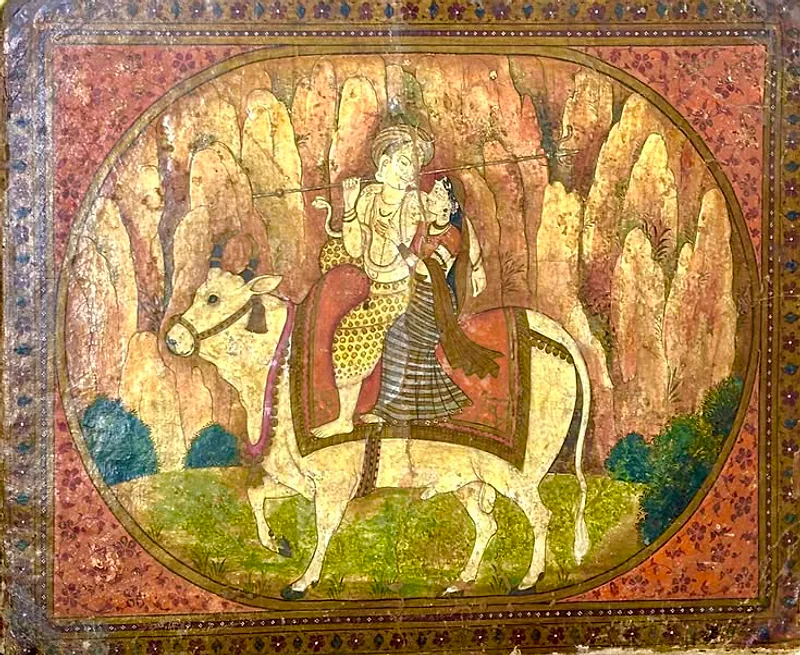
One of the best-known verses of the text is notably ecumenical. It says that the Śaivas call this place the abode of Śiva; the Vaiṣṇavas call it the supreme Person; others name it the place of Hari and Hara together; devotees of the goddess call it her excellent abode; and the great sages call it the pure place of Prakṛti and Puruṣa, nature and spirit. Whatever the name, the text presents the crown as the meeting of all paths.
The Ṣaṭ-cakra-nirūpaṇa also describes the return. Having drunk the nectar of union, Kuṇḍalinī descends again through the centres, re-creating the elements in reverse order, and comes to rest in the root lotus. The ascent and descent together form a ritual of dissolution and re-creation (laya and sṛṣṭi) within the practitioner's own body, which explains why the work is called a nirūpaṇa, a "description" for meditation, rather than a map of anatomy.
How the Texts Differ§
The thousand-petalled lotus is one of the most widely shared features of Indian subtle-body systems, but it is understood in different ways.
Hindu tantra and hatha yoga§
Hatha texts such as the Śiva Saṃhitā describe a thousand-petalled lotus in the head, the source of nectar and the goal of the yogin, but vary in the details of what lies within it. The Nāth Siddha Siddhānta Paddhati places two centres at the top of its list of nine: a centre of liberation (nirvāṇa-cakra) at the brahmarandhra and a centre of space (ākāśa-cakra) above it. Some Kaula and Trika sources set the culmination at the dvādaśānta outside the body, emphasising that the summit is not a place in the head but a state of consciousness. As Christopher Wallis and other scholars of Hindu tantra stress, each map served a particular practice.
Buddhist tantra§
In the Hevajra Tantra and related systems the head centre is the "wheel of great bliss" (mahāsukha-cakra), usually with thirty-two petals rather than a thousand. In the completion-stage practice of inner heat (caṇḍālī, Tibetan tummo), described among the Six Yogas of Nāropa, the fire at the navel melts a white "drop" (bindu, here equated with bodhicitta) at the crown, which descends through the centres producing successive kinds of bliss. The syllable oṃ is commonly placed at the crown in Tibetan visualisation. On these traditions, see Tibetan Buddhism.
The Modern Western Layer§
The "crown chakra" of modern books comes from a chain of reinterpretations traced in Chakras in the West. C. W. Leadbeater, in The Chakras (1927), described the crown centre as the most resplendent of all, with an inner whorl of twelve and an outer ring of 960 "spokes", and associated it with the highest spiritual faculties; Theosophical and later writers linked it with the pineal or pituitary gland. C. G. Jung, in his 1932 seminar, treated Sahasrara as a philosophical concept beyond any experience he could speak of.
From the 1970s the rainbow scheme made the crown violet, sometimes white or gold, and the human potential movement turned it into the centre of spirituality, transcendence and "cosmic consciousness". In Anodea Judith's Wheels of Life (1987) the crown is linked with thought and knowing, with attachment as its distortion. Modern practice may involve visualising light at or above the head, silent meditation, or crystals such as clear quartz and amethyst. These forms can be meaningful to modern practitioners, but they differ from the tantric texts, in which the thousand-petalled lotus is not a seventh energy centre to be balanced but the supreme state in which the whole system of centres is dissolved.
Frequently asked questions§
What does Sahasrara mean?§
Sahasrāra is Sanskrit for "thousand-spoked", from sahasra, "thousand", and ara, "spoke". The centre is usually called the thousand-petalled lotus, and "thousand" also carries the sense of the innumerable.
Is Sahasrara really the seventh chakra?§
In the Ṣaṭ-cakra-nirūpaṇa (1577), the source of the standard system, there are six chakras, and the thousand-petalled lotus is the supreme abode above them. Counting it as a seventh chakra on a par with the others is a modern convention that became standard in the twentieth century.
What is the bija mantra of the crown chakra?§
The classic text gives Sahasrara no seed syllable, since it lies beyond the elements whose bījas belong to the lower centres. Modern books variously assign Oṃ, the visarga, or silence.
What colour is the crown chakra?§
In the Ṣaṭ-cakra-nirūpaṇa the lotus is whiter than the full moon, with filaments the colour of the rising sun. The violet crown chakra comes from the modern rainbow scheme of the 1970s.
Sources and further reading§
- The Serpent Power — Arthur Avalon (Sir John Woodroffe), 1919
- The Garland of Letters — Sir John Woodroffe, 1922
- Tantra Illuminated — Christopher D. Wallis, 2012
- The Hevajra Tantra: A Critical Study — David L. Snellgrove, 1959
- The Six Yogas of Naropa: Tsongkhapa's Commentary — Glenn H. Mullin, 2005
- The Shiva Samhita — James Mallinson, 2007
- The Chakras — C. W. Leadbeater, 1927
- The Psychology of Kundalini Yoga — C. G. Jung, ed. Sonu Shamdasani, 1996