Liber VIII · Eastern Mysticism
What Is Eastern Mysticism? Yoga, Tantra, the Dao and Zen
What is Eastern mysticism? An overview of Vedanta, yoga and samadhi, tantra, Buddhist meditation, Zen, Tibetan Vajrayana, Daoism and Sufism, and their reception.

"Eastern mysticism" is a modern Western umbrella term for the contemplative and esoteric traditions of Asia: the Upanishads and Vedanta, yoga and samadhi, Hindu and Buddhist tantra, Buddhist meditation, Zen and Tibetan Vajrayana, Daoist internal alchemy and, by extension, the Sufi path within Islam. These traditions differ deeply in doctrine, but each teaches disciplined practices meant to transform perception and lead to liberation, awakening or union with ultimate reality.
What "Eastern Mysticism" Means, and Its Limits§
The word "mysticism" comes from the Greek mystikos, connected with the mystery cults and, later, with the hidden meaning of Christian scripture and sacraments. When European scholars began to translate Sanskrit, Pali, Chinese and Persian texts in the late eighteenth and nineteenth centuries, they reached for this familiar word to describe what they found: teachings about the self, the absolute and states of consciousness that seemed to lie beyond ordinary religion. Friedrich Max Müller's Sacred Books of the East series (1879–1910) made dozens of these texts available in English, and with them a picture of a contemplative "Orient" set against a supposedly materialist West.
That picture was partial. Scholars such as Richard King have shown how the idea of a timeless, mystical East grew out of colonial scholarship and was then taken up by Asian reformers themselves. Swami Vivekananda's addresses at the World's Parliament of Religions in Chicago in 1893 presented Vedanta and yoga as a universal spiritual science; D. T. Suzuki did something similar for Zen in the twentieth century. These figures were creative interpreters, not neutral reporters. The articles in this section therefore try to describe each tradition in its own terms, with its own texts, ritual life and institutions, before turning to its Western reception.
Hindu Foundations: Vedas, Upanishads and the Darshanas§
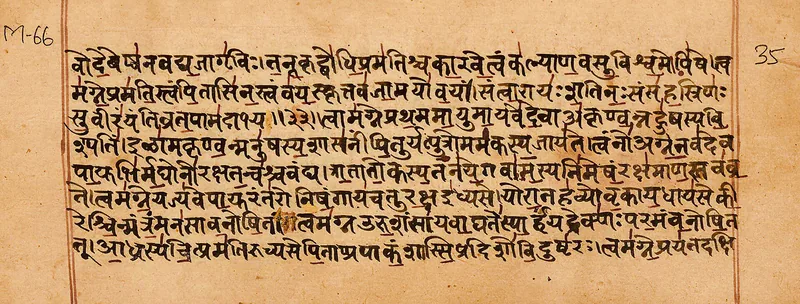
The oldest layer of Hindu religion is the Veda, a body of hymns and ritual texts transmitted orally in Sanskrit; the Rigveda is usually dated to roughly 1500–1200 BCE. Toward the end of the Vedic corpus come the Upanishads, the earliest of which are generally placed between about 800 and 300 BCE. They turn from external sacrifice to inward knowledge, teaching that the deepest self (atman) is one with, or grounded in, the absolute reality (brahman). Their dialogues on sleep, breath and consciousness are the starting point of much later Indian mystical thought.
Classical Hindu philosophy organised itself into schools called darshanas, "views." Six became orthodox: Nyaya, Vaisheshika, Samkhya, Yoga, Mimamsa and Vedanta. Vedanta, which systematised the Upanishads, the Bhagavad Gita and the Brahma Sutras, divided into non-dual (Advaita), qualified non-dual (Vishishtadvaita) and dualist (Dvaita) schools. The Hinduism and Vedanta guide sets out these schools and their great teachers, Shankara, Ramanuja and Madhva.
Yoga, Samadhi, Tantra and the Subtle Body§
Yoga, in its classical sense, is a discipline of the mind. The Yoga Sutras attributed to Patanjali, now usually dated to around the fourth or early fifth century CE, define yoga as the stilling of the fluctuations of the mind and set out eight limbs culminating in samadhi, a state of complete absorption. Its metaphysics draws on Samkhya, the dualism of pure consciousness (purusha) and matter (prakriti); the yoga philosophy and samadhi guide explains these ideas in detail.
From the middle of the first millennium CE a new body of revealed texts, the Tantras, transformed Hindu and Buddhist practice. Tantra introduced initiation, mantra, the worship of deities through diagrams (yantra, mandala) and a detailed map of the body as a network of channels (nadis) and centres (chakras). In some systems a coiled power, kundalini, is said to rise through the central channel to unite with pure consciousness at the crown of the head. The history of the chakras shows how varied the early systems were before the modern "seven chakras" became standard, and the article on kundalini yoga traces the serpent power from tantra to the West. From the eleventh century onward, hatha yoga adapted these methods into a discipline of posture, breath control and seals (mudras).
Buddhist Paths: Meditation, Zen and Tibetan Vajrayana§
Buddhism began with the teaching of Siddhartha Gautama, the Buddha, whose life is usually placed in the fifth century BCE. Its early texts describe meditative absorptions (jhana), the cultivation of mindfulness and insight into impermanence, unsatisfactoriness and not-self, all aimed at nirvana, the end of craving and rebirth. The meditation guide compares these methods with Hindu, Daoist and other contemplative techniques.

The Mahayana schools that arose around the turn of the common era added the ideal of the bodhisattva and the philosophy of emptiness (shunyata). In China, Mahayana met Daoist sensibilities and produced Chan, known in Japan as Zen, with its emphasis on seated meditation, sudden awakening and the paradoxical teaching stories known as koans; see Zen and Chan. In India, Buddhist tantra, or Vajrayana, developed esoteric initiations and visualisations that were carried to Tibet from the eighth century onward and became the basis of Tibetan Buddhism.
Daoism, Internal Alchemy and the Internal Arts§
Chinese mystical thought looks to the Daodejing, attributed to the legendary Laozi and probably compiled around the fourth or third century BCE, and to the Zhuangzi. Both describe the Dao as the nameless source of all things and recommend a return to simplicity, stillness and spontaneity (ziran). Organised Daoism, from the Celestial Masters of the second century CE onward, developed liturgy, scriptures and methods for achieving long life and transcendence.
The most esoteric of these methods is Taoist internal alchemy, or neidan, which reinterprets the language of laboratory alchemy as the refinement of essence, breath and spirit within the body. Breathing, posture and movement practices drawn partly from neidan, medicine and the martial arts were reorganised in the twentieth century as qigong, while taijiquan and related styles came to be called "internal" martial arts; the qigong and internal arts guide covers these developments.
Sufism: The Mystical Path of Islam§
Sufism is not "Eastern" in the geographical sense that India or China are, and Muslims regard it as part of Islam rather than a separate mysticism. It is included here because Western writers have long grouped it with Asian contemplative traditions, and because it flourished across Persia, Central Asia and India. Sufis seek nearness to God through remembrance (dhikr), love and the purification of the self under a spiritual master, organised from the twelfth century onward into orders such as the Qadiriyya and Mevleviyya. Poets such as Rumi (d. 1273) and thinkers such as Ibn Arabi (d. 1240) gave the path its classic expression; see Sufism: history, masters and practices.
How the West Received Eastern Mysticism§
Western interest in these traditions has a long history: the American Transcendentalists read the Bhagavad Gita in the 1840s, and Arthur Schopenhauer drew on the Upanishads, which he knew through a Latin translation of a Persian version. The Theosophical Society, founded in New York in 1875 and soon based at Adyar in India, popularised ideas of karma, reincarnation, chakras and hidden masters, often in forms quite remote from their sources. Through the twentieth century, Indian teachers, Japanese Zen missionaries, Tibetan lamas in exile after 1959 and the counterculture of the 1960s brought practice, not only ideas, to Western audiences.
Historians such as Mark Singleton have shown that much of what the West now calls yoga, especially flowing posture sequences, took shape in the early twentieth century in dialogue with gymnastics and physical culture. Similar studies exist for modern mindfulness and for "neo-tantra." None of this makes modern forms illegitimate, but it does mean that claims of unchanged ancient wisdom should be treated with care. Intensive breath and meditation practices can also unsettle vulnerable people, and traditional teachers stress gradual training under supervision; anyone with a history of mental illness should approach intensive retreats with caution and qualified support.
Frequently asked questions§
Is "Eastern mysticism" a real tradition?§
Not as a single tradition. It is a Western label for many distinct Hindu, Buddhist, Daoist and Islamic paths with different scriptures, goals and institutions. The label is useful as a library heading but can hide real differences, for example between the Hindu self (atman) and the Buddhist doctrine of not-self.
What do Eastern mystical traditions have in common?§
Most teach that ordinary perception is limited or distorted and that disciplined practice, such as meditation, breath control, mantra or devotion, can reveal a deeper reality. Most also stress ethics, a qualified teacher and transmission through a lineage.
Is yoga a form of mysticism?§
Classical yoga, as described by Patanjali, is a contemplative discipline aiming at samadhi and liberation, so it fits most definitions of mysticism. Modern posture-based yoga often emphasises health and fitness instead, though many practitioners still connect it to spiritual goals.
Where should a beginner start reading?§
Good starting points are a modern translation of the Upanishads or the Bhagavad Gita, the Daodejing, and a reliable historical introduction such as Mircea Eliade's study of yoga or Annemarie Schimmel's book on Sufism, followed by the chapter guides in this section.
Sources and further reading§
- The Upanishads — Patrick Olivelle (trans.), 1996
- The Yoga Sutras of Patanjali — Patanjali, c. 400 CE
- Yoga: Immortality and Freedom — Mircea Eliade, 1958
- Orientalism and Religion: Postcolonial Theory, India and "The Mystic East" — Richard King, 1999
- Roots of Yoga — James Mallinson & Mark Singleton, 2017
- Tao Te Ching — Laozi, c. 4th c. BCE
- The Encyclopedia of Taoism — Fabrizio Pregadio (ed.), 2008
- Mystical Dimensions of Islam — Annemarie Schimmel, 1975