Liber XIV · Hinduism · Chapter XI: Vaishnavism
The Ten Avatars of Vishnu: Dashavatara Myths and Meaning
The ten avatars of Vishnu (Dashavatara) from Matsya the fish to Kalki: their myths, Vedic roots, variant lists, temple art and modern interpretations.

The ten avatars of Vishnu, known in Sanskrit as the Dashavatara, are the "descents" in which the preserver god is believed to take form in the world to restore cosmic and moral order: Matsya the fish, Kurma the tortoise, Varaha the boar, Narasimha the man-lion, Vamana the dwarf, Parashurama, Rama, Krishna (or Balarama), the Buddha and the future Kalki. The list took shape gradually in the Puranas during the first millennium CE, drawing on older Vedic myths, and it remains one of the most familiar frameworks in Hindu art, story and devotion.
What Avatar Means: Descent and the Defence of Dharma§
The Sanskrit word avatara comes from a verb meaning "to cross down" or "to descend." In Vaishnava theology it names the coming of the supreme God, Vishnu or Narayana, into the world in a particular form. The idea is stated most famously in the fourth chapter of the Bhagavad Gita, where Krishna tells Arjuna that whenever righteousness wanes and unrighteousness rises, he brings himself forth, age after age, to protect the good and to destroy evildoers.
The avatar acts within the great cycle of ages described in Hindu cosmology, each descent answering a particular crisis in a particular yuga, and theologians insisted that the descended form is not a lesser copy. In the Pancharatra tradition and later in Sri Vaishnavism, God is described as existing in five modes: the supreme form (para), the emanations (vyuha), the descents (vibhava), the inner controller in every heart (antaryamin) and the consecrated temple image (arca). The avatars of the Dashavatara belong to the third mode, but the same theology allows that God also "descends" into a temple image so that devotees can see and serve him.
Commentators distinguished full descents from partial ones. For the Bhagavata Purana, Krishna is not an avatar at all in the ordinary sense but the Lord himself, the source from whom the other descents come.
The Ten Avatars of Vishnu in Order§
The order of the ten is broadly fixed in most medieval lists, and each avatar is tied to a story of rescue.
The First Four: Fish, Tortoise, Boar and Man-Lion§
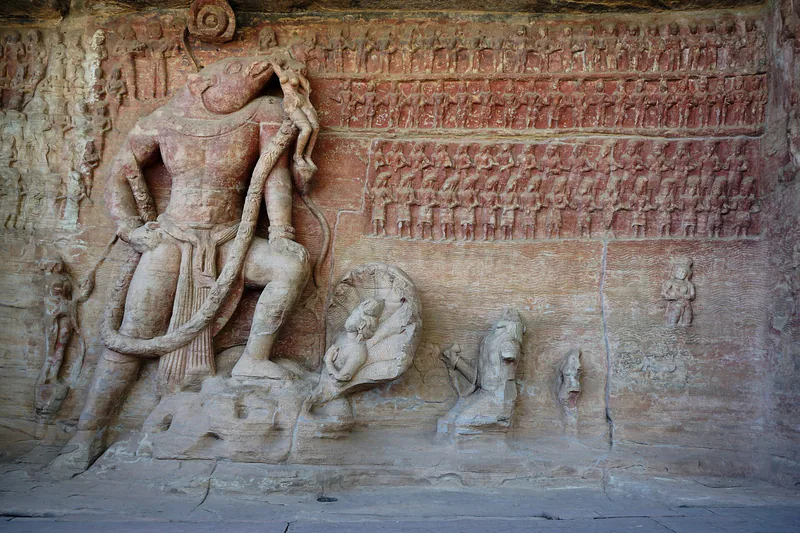
Matsya, the fish, warns the first man Manu of a coming flood, grows from a tiny fish into a giant, and tows Manu's ship (in Puranic versions carrying the seeds of life and the sages) to safety; in some tellings he also recovers the stolen Vedas. Kurma, the tortoise, supports Mount Mandara on his back when gods and demons churn the ocean of milk for the nectar of immortality. Varaha, the boar, dives into the cosmic waters to rescue the earth goddess Bhudevi, carried off by the demon Hiranyaksha, and lifts her on his tusk.
Narasimha, the man-lion, protects the boy devotee Prahlada from his father, the demon king Hiranyakashipu, who had won a boon that he could be killed by neither man nor beast, by day nor by night, inside nor outside. Narasimha bursts from a pillar at twilight and kills him on a threshold, neither man nor animal, so that the boon is outwitted rather than broken.
Vamana and Parashurama§
Vamana, the dwarf, comes as a young Brahmin to the generous demon king Bali, who has conquered the three worlds, and asks for as much land as he can cover in three steps. Granted the gift, he grows to cosmic size, spans earth and heaven in two strides, and places the third on Bali's head, pressing him down to rule the underworld. Parashurama, "Rama with the axe," is a Brahmin warrior, son of the sage Jamadagni, who in the epic and Puranic stories destroys the arrogant warrior class (kshatriyas) twenty-one times over.
Rama, Krishna, the Buddha and Kalki§
Rama, prince of Ayodhya and hero of the Ramayana, embodies the ideal king and son, and Krishna, the cowherd god of Vrindavan and counsellor of the Mahabharata, is the most widely worshipped avatar of all; both are discussed in The Mahabharata, Ramayana and Bhagavad Gita Explained. The ninth place usually goes to the Buddha, and the tenth to Kalki, who is expected to come at the end of the present Kali Yuga on a white horse, sword in hand, to destroy the wicked and open a new age of truth.
Vedic Roots and the Growth of the Avatar Lists§
Most historians see the Dashavatara as a synthesis built over many centuries. Several of the stories are clearly older than the Vishnu cult in its classical form. The Shatapatha Brahmana, a Vedic ritual text of the first millennium BCE, tells of a fish that saves Manu from a flood, and Vedic texts also describe a boar that raises the earth from the waters and a tortoise associated with the creator Prajapati. In these early sources the fish and the boar are not identified with Vishnu at all; they are linked with Brahma or Prajapati.
The dwarf story, by contrast, has its seed in the Rigveda itself, where Vishnu is praised for the three wide strides that measure out the worlds. Rama and Krishna were heroes of epic before they were avatars; the process by which they were absorbed into the Vishnu cult, along with the older Vasudeva-Krishna worship described in the article on Vaishnavism, took place over roughly the last centuries BCE and the early centuries CE.
The number of avatars long remained fluid. The Mahabharata gives several lists, some shorter than ten. The Bhagavata Purana names twenty-two descents, including the sage Kapila, the divine physician Dhanvantari and the enchantress Mohini, and adds that the avatars are innumerable, like streams flowing from an inexhaustible lake. The ten-fold list became standard in the later Puranas and in medieval art.
Buddha, Balarama and the Variant Lists§
The most debated place in the list is the ninth. The Buddha appears as an avatar of Vishnu in Puranic texts from about the middle of the first millennium CE, but early versions present him in an uncomfortable light: in the Vishnu Purana and related texts a deluding figure leads demons away from the Vedas so that they lose their power, and the Buddha is cast in that role. Later writers softened the picture. The twelfth-century poet Jayadeva, whose Gita Govinda opens with a hymn to the ten avatars, praises the Buddha for condemning animal sacrifice out of compassion.
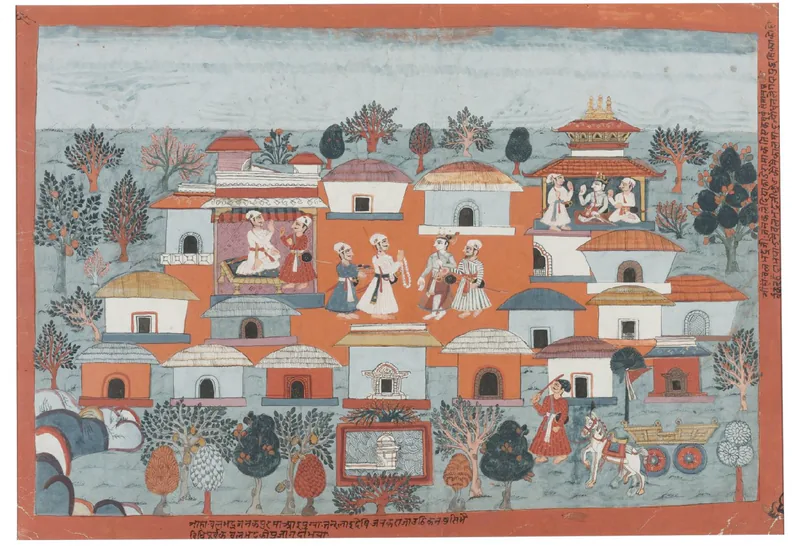
Krishna's own place is also variable. In many lists, including Jayadeva's, the eighth avatar is Krishna's elder brother Balarama, the plough-bearing god of strength, while Krishna himself is honoured as the source of all ten. In some southern and western Indian lists Balarama replaces the Buddha instead. In parts of Odisha, Jagannatha of Puri may take the Buddha's place, and in Maharashtra the god Vithoba of Pandharpur has sometimes been counted among the descents. These variants show how regional cults were linked to the pan-Indian Vishnu through the flexible logic of descent.
Buddhists generally do not accept the Buddha's inclusion, while many Hindus see it as reverence; historians tend to read it as both, an act of inclusion that also placed the Buddha under Vishnu's authority.
Avatars in Temples, Art and Festivals§
The avatars are among the oldest subjects of Hindu sculpture. At Udayagiri in central India, a monumental relief of Varaha lifting the earth goddess, usually dated to the early fifth century CE under the Gupta king Chandragupta II, is one of the masterpieces of early Indian art. At nearby Eran a colossal free-standing boar, covered in rows of tiny sages, bears an inscription of the Huna ruler Toramana, and the so-called Dashavatara temple at Deogarh, of around 500 CE, shows Vishnu reclining on the serpent Ananta.
From the medieval period the ten were carved as a series on temple doorways, painted in manuscripts and on cloth, and set in metal on the frames of shrine images. The round playing cards called ganjifa of Odisha and Sawantwadi include Dashavatara decks with ten suits, one for each avatar.
Festivals celebrate the most popular descents: Rama Navami and Krishna Janmashtami mark the births of Rama and Krishna, Narasimha Jayanti is kept with special fervour in Andhra Pradesh, and Diwali in much of north India commemorates Rama's return to Ayodhya, as described in Hindu Temples, Rituals and Festivals.
Interpretations: Theology, Evolution and Modern Readings§
Within the tradition, the avatars are first of all objects of devotion. The Alvar poets and the later bhakti saints dwell on the tenderness of a God who becomes a fish or a dwarf, a child or a charioteer, for his devotees. Vaishnava teachers held that the avatar's body is not made of ordinary matter but of pure divine substance.
In the nineteenth century Bengali reformers and, later, Theosophical writers noted that the series moves from fish to amphibious tortoise, land mammal, man-beast, small man and fully developed men, and presented the Dashavatara as an ancient intuition of evolution. Historians reply that the list was assembled from separate myths over many centuries; the reading says more about the encounter between Hindu thought and Darwinism than about the Puranas. Scholars of religion see the Dashavatara rather as a tool of integration, by which Vaishnavism drew local heroes, animal cults and rival teachers into one story of a single God's care for the world.
Frequently asked questions§
What are the ten avatars of Vishnu in order?§
The usual order is Matsya (fish), Kurma (tortoise), Varaha (boar), Narasimha (man-lion), Vamana (dwarf), Parashurama, Rama, Krishna or Balarama, the Buddha, and Kalki. Some lists substitute Balarama, Jagannatha or another local form for the Buddha, or place Balarama in Krishna's position.
Has Kalki already come?§
According to traditional chronology, Kalki will appear only at the end of the Kali Yuga, which still has hundreds of thousands of years to run. Modern claims to identify Kalki are not accepted by Vaishnava traditions as a whole.
Is the Buddha really an avatar of Vishnu?§
Many Puranas and Hindu traditions count him as the ninth avatar, but the earliest versions describe this avatar as misleading demons, and Buddhists themselves do not accept the identification. Some Hindu lists leave the Buddha out entirely.
Why are there sometimes more than ten avatars?§
The number ten is a convenient classical frame. The Bhagavata Purana lists at least twenty-two descents and says that they are countless, and Vaishnava theology also speaks of God descending into temple images and saints.
Sources and further reading§
- Hindu Myths: A Sourcebook Translated from the Sanskrit — Wendy Doniger O'Flaherty, 1975
- Classical Hindu Mythology: A Reader in the Sanskrit Purāṇas — Cornelia Dimmitt and J. A. B. van Buitenen, 1978
- Avatar and Incarnation — Geoffrey Parrinder, 1970
- Vishnu: Hinduism's Blue-Skinned Saviour — Devdutt Pattanaik, 1999
- The Art of Ancient India — Susan L. Huntington, 1985
- The Vishnu Purana: A System of Hindu Mythology and Tradition — H. H. Wilson, 1840