Liber XVIII · Jainism · Chapter VI: Temples & Pilgrimage
Bahubali and the Gommateshvara Statue of Shravanabelagola
Bahubali in Jain tradition and the Gommateshvara statue at Shravanabelagola: the duel with Bharata, Chavundaraya's colossus and the Mahamastakabhisheka.

Bahubali ("the strong-armed") is a son of the first Tirthankara, Rishabhanatha, who in Jain tradition renounced a kingdom at the moment of victory over his brother and stood motionless in meditation until vines grew over his body. He is honoured above all in the colossal granite statue known as Gommateshvara at Shravanabelagola in Karnataka, carved around 981 CE and, at about 17 metres, one of the largest free-standing monolithic sculptures in the world. Every twelve years it is anointed in the great ceremony called the Mahamastakabhisheka.
Bahubali in the Jain Story of the First Age§
Bahubali belongs to the opening of the present descending half of the Jain time cycle. His father was Rishabhanatha, the first Tirthankara and first king, and his mother Sunanda; his half-brother Bharata, son of Sumangala, became the first universal emperor (chakravartin). When Rishabha renounced the world he divided his kingdom among his hundred sons. Bharata received Ayodhya, and Bahubali received Takshashila in Shvetambara accounts or Podanapura in Digambara ones.
The story is told in many works, including Jinasena's Digambara Adipurana (ninth century), the Kannada Adipurana of the poet Pampa (941 CE) and Hemachandra's Shvetambara Trishashtishalakapurushacharitra (twelfth century). The versions differ in detail, but share a common shape: a conflict of power, a renunciation at the point of triumph, and a final struggle not with an enemy but with the self.
The Duel with Bharata and the Renunciation§
A conflict of brothers§
Bharata set out to conquer the world, led by a divine discus (chakraratna). On his return the discus would not enter his capital, a sign that his conquest was incomplete: his own brothers had not submitted. Ninety-eight of them chose to renounce the world and join their father as monks rather than bow to Bharata. Bahubali alone refused both to submit and to renounce.
The armies gathered, but ministers (or, in some versions, the gods) urged that the quarrel be settled between the two brothers to spare the lives of soldiers. Three contests were agreed: a staring contest, a water fight and a wrestling match. Bahubali won all three. Humiliated, Bharata hurled his discus at his brother, but the weapon would not harm a member of his own family and returned to him.
The raised fist§
At this point Bahubali raised his fist to strike his brother — and stopped. Seeing the futility of a kingdom won by such means and the shame of violence against his own kin, he turned the gesture inward and used the same hand to pluck out his hair, the act by which a Jain renouncer takes initiation. He gave up his kingdom on the spot.
The year of standing meditation§
Bahubali then stood in the posture of kayotsarga, "abandoning the body", motionless with arms hanging at his sides. The texts say he remained so for a year, while creepers wound up his legs and arms, birds nested in his hair and snakes made their homes in anthills at his feet. Yet omniscience did not come.
The traditions explain the obstacle differently. In the Shvetambara account Bahubali had refused to go to his father's assembly because he would have had to bow to his younger brothers, who had become monks before him. Rishabha sent his daughters Brahmi and Sundari, now nuns, who told their brother to "come down from the elephant" — the elephant of pride. Understanding them, Bahubali took a step to go and pay homage, and at that moment attained omniscience. In the Digambara account a lingering thought troubled him: that he was standing on land that belonged to Bharata. When Bharata came and bowed to him, the thought dissolved and Bahubali became a kevalin. Digambaras also hold that he was the first person of this age to attain final liberation, even before his father.
The theme is characteristic of Jain teaching: the most heroic austerity is fruitless while the subtlest passion — here pride — remains. The posture of Bahubali became a standard image of the meditation of standing still that all Jain ascetics practise.
Chavundaraya and the Making of the Gommateshvara Colossus§
Shravanabelagola, in Hassan district of Karnataka, was already an ancient Jain centre when the statue was made. Its smaller hill, Chandragiri, is associated in Digambara tradition with the teacher Bhadrabahu and the Mauryan emperor Chandragupta, and hundreds of inscriptions there record ascetics who ended their lives by sallekhana.
On the larger hill, Vindhyagiri (also called Indragiri), Chavundaraya, general and minister of the Western Ganga king Rachamalla IV, had the image of Bahubali carved from the living granite of the summit. The work is usually dated to about 981 CE, though dates between the late 970s and early 990s are proposed. Chavundaraya was also a writer: his Kannada prose work on the lives of the illustrious persons, the Chavundaraya Purana (978), is among the earliest Kannada prose texts. His teacher, the Digambara scholar Nemichandra, named his great doctrinal compendium the Gommatasara after Chavundaraya, whose personal name appears to have been Gommata. The image was thus called Gommateshvara, "the lord of Gommata", and the name later passed to Bahubali images in general.
Local tradition preserves a story of origins. Chavundaraya's mother, Kalala Devi, longed to see an image of Bahubali said to have been set up by Bharata at Podanapura. Unable to reach it, Chavundaraya shot an arrow from Chandragiri, and the image was revealed or carved where it struck on the opposite hill. Another popular story tells of the first anointing: the milk poured by the proud patron would not flow below the statue's navel, until a poor old woman, Gullekayi Ajji, poured the contents of a small fruit-shell and bathed the image completely. A figure of her stands near the shrine as a reminder that devotion, not wealth, is what counts.
Iconography and Inscriptions of the Statue§
The statue stands about 17 metres (some 57 feet) high, nude, in kayotsarga, facing north. The face is serene, with a slight smile, elongated ears and curled hair. Creepers twine up the legs and arms to the shoulders, and anthills with emerging serpents rise beside the feet, all recalling the year of motionless meditation. Behind him the hill was cut back to form a support up to the thighs, and an enclosure of cloisters with images of the Tirthankaras was added in the twelfth century.
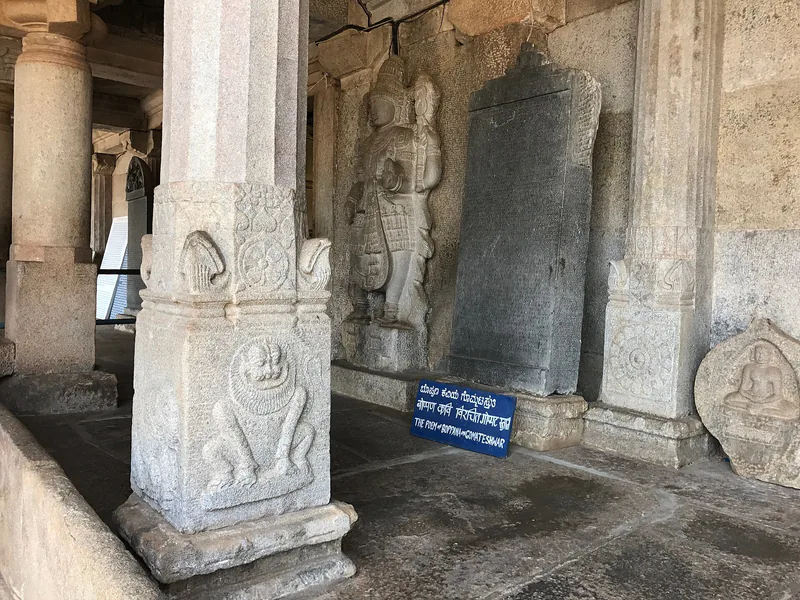
The inscriptions at the foot of the statue record Chavundaraya's patronage in Kannada and Tamil, and a short line in an early form of Marathi that is often cited as among the oldest surviving inscriptions in that language. The hundreds of records from Shravanabelagola's two hills, collected by B. Lewis Rice in the nineteenth century, are a major source for the history of Jainism in South India.
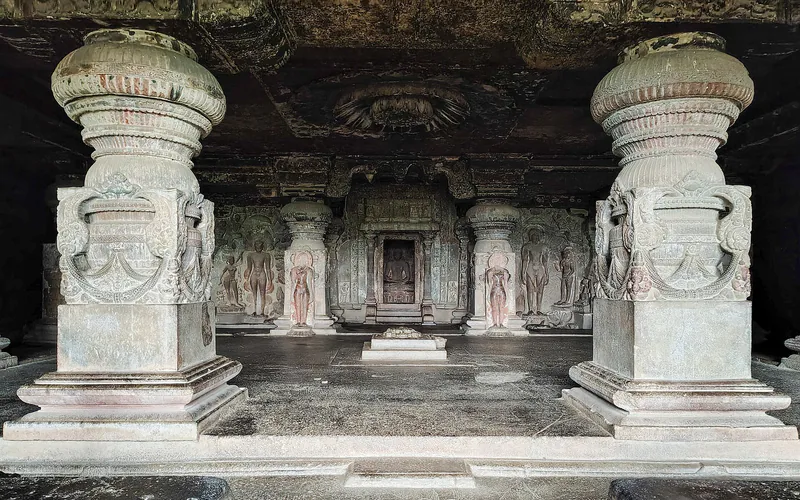
Bahubali had been represented in sculpture before Shravanabelagola, for example in the cave temples of Badami (seventh century) and Ellora (ninth century), but the Gommateshvara colossus fixed the type. Later colossi followed in coastal Karnataka: at Karkala (1432), Venur (1604) and Dharmasthala, where a modern image was installed in 1982. Each stands in the same posture with the same creepers, making Bahubali one of the most recognisable figures of Jain art, as surveyed in Jain Temples and Pilgrimage.
The Mahamastakabhisheka: Anointing the Head§
The Mahamastakabhisheka ("great head-anointing") is held at Shravanabelagola about once every twelve years, at a date fixed by the Digambara authorities of the site; recent ceremonies took place in 2006 and 2018. Scaffolding is raised behind the statue, and over several days devotees who have sponsored the right to do so pour pots of water, milk, sugar-cane juice, rice flour, turmeric, sandalwood paste, saffron and flowers over the head of the image, so that coloured streams flow down the body. The ceremony is accompanied by the recitation of mantras, including the Navkar Mantra, and by the presence of large numbers of Digambara monks and nuns.
For Jains, the ritual does not influence Bahubali, who as a liberated soul cannot respond to worship. Its purpose is the inner transformation of the worshipper, who through devotion and giving loosens attachment and accumulates merit. The ceremony also has a strong public and civic dimension, attracting state support, very large crowds and international visitors, and many Jains plan years ahead to attend. The pilgrimage involves climbing more than six hundred steps cut into the granite of Vindhyagiri, traditionally barefoot.
Frequently asked questions§
Who was Bahubali in Jainism?§
Bahubali was a son of the first Tirthankara, Rishabhanatha. Jains believe he defeated his brother Bharata in a duel, renounced his kingdom at the moment of victory and stood in meditation until he attained omniscience. Digambaras regard him as the first person of this age to reach liberation.
Who built the Gommateshvara statue?§
It was commissioned by Chavundaraya, a general and minister of the Western Ganga king Rachamalla IV, and is usually dated to about 981 CE. It was carved from a single granite outcrop on the summit of Vindhyagiri hill at Shravanabelagola.
Why are vines shown on Bahubali's statue?§
The creepers on his arms and legs, and the anthills and snakes at his feet, illustrate the tradition that he stood motionless in meditation for a year. They represent complete indifference to the body.
How often is the Mahamastakabhisheka held?§
It is held approximately every twelve years. The most recent ceremonies took place in 2006 and 2018.
Sources and further reading§
- Inscriptions at Sravana Belgola — B. Lewis Rice, 1889
- Inviting Death: Indian Attitude Towards the Ritual Death — S. Settar, 1989
- Mediaeval Jainism: With Special Reference to the Vijayanagara Empire — B. A. Saletore, 1938
- Jaina Art and Architecture — A. Ghosh, 1974
- The Jains — Paul Dundas, 1992
- Jaina Iconography — Jyotindra Jain & Eberhard Fischer, 1978