Liber XIV · Hinduism · Chapter I: Bhakti & Saints
Ramakrishna Paramahamsa: Life, Teachings and Dakshineswar
Ramakrishna Paramahamsa (1836–1886), the Bengali mystic of Dakshineswar: his visions of Kali, many spiritual paths, Sarada Devi, the Kathamrita and legacy.

Ramakrishna Paramahamsa (1836–1886) was a Bengali Hindu mystic and priest of the Kali temple at Dakshineswar near Calcutta, famous for his ecstatic devotion to the Goddess, his experiments with many spiritual disciplines and his teaching that different religions are different paths to the same God. Through his disciple Swami Vivekananda and the monastic order founded in his name, he became one of the most influential figures of modern Hinduism, revered by millions as a saint and by many as an incarnation of God.
Early Life: Gadadhar of Kamarpukur§
Ramakrishna was born on 18 February 1836 in the village of Kamarpukur in rural Bengal, the son of a pious but poor Brahmin, Khudiram Chattopadhyay, and his wife Chandramani. Named Gadadhar, he was a lively boy with a gift for song, mimicry and religious drama, who showed little interest in formal schooling. His biographers record that at about six or seven, while watching a flight of white cranes against a dark storm cloud, he lost outward consciousness in a rapture of beauty, the first of the trance states that marked his life.
In 1852 he went to Calcutta to help his elder brother Ramkumar, who ran a small Sanskrit school and served as a priest. His brother hoped he would learn enough to earn a living, but Gadadhar reportedly refused a "bread-winning education," saying that he wanted knowledge that would bring him to God.
Dakshineswar and the Vision of Kali§
In 1855 a wealthy widow of a lower caste, Rani Rasmani, consecrated a great temple complex to the goddess Kali at Dakshineswar, on the east bank of the Ganga north of Calcutta. Because of her caste, orthodox Brahmins were reluctant to serve there; Ramkumar accepted the post of priest, and after his death in 1856 Gadadhar succeeded him.
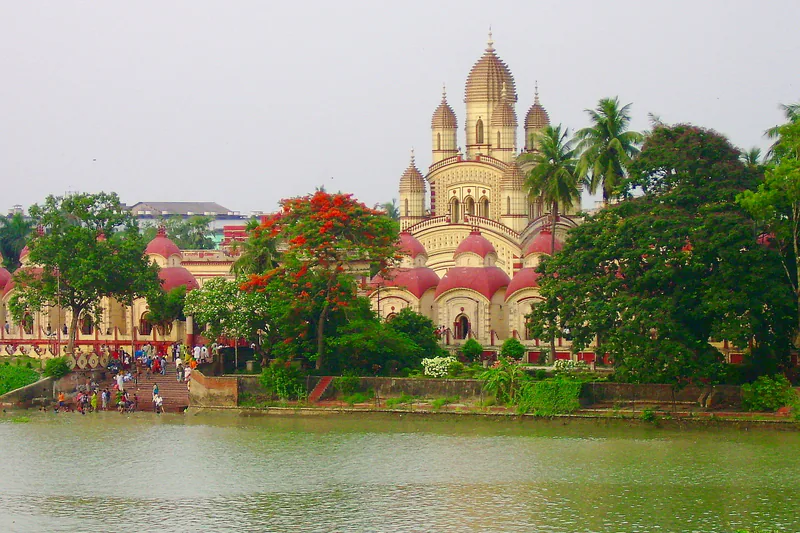
Worshipping the image of Kali as Bhavatarini, "she who carries across the ocean of existence," he became consumed by longing to see the Mother directly. His later accounts describe days of weeping and desperation, until one day, at the point of seizing the temple sword to end his life, he was overwhelmed by a vision of boundless, shining waves of consciousness and the living presence of the Mother. Thereafter his worship became unconventional; he fed the image as one would a child, talked and laughed with it, and passed into states that observers took for madness. The goddess at the centre of his devotion is described in Kali: Goddess of Time, Death and Liberation.
His family, alarmed, arranged a marriage in 1859 with a girl from a nearby village, Saradamani Mukhopadhyay, who was then about five years old; such child marriages were common at the time, and she remained with her own family for several years.
Many Paths: Tantra, Vaishnava Devotion, Advaita and Beyond§
From around 1861 Ramakrishna practised a remarkable succession of disciplines. His first guide was a wandering woman adept known as the Bhairavi Brahmani, learned in the Tantras and in Vaishnava scripture. Under her guidance he went through the sixty-four principal tantric disciplines over several years; she also convened learned men who declared that his states were not illness but the signs of an avatar. His tantric training is discussed in the wider context of Tantra in Hinduism.
He then practised the devotional moods of Vaishnavism, worshipping Rama as a servant in the manner of Hanuman, and Krishna in the mood of the cowherd women's love, at times dressing and living as a woman to enter that attitude. Around 1864 or 1865 a naked Advaita monk named Totapuri initiated him into renunciation and guided him to nirvikalpa samadhi, the formless absorption taught in Advaita Vedanta, which Ramakrishna is said to have reached within a few days and remained in for long periods. The name Ramakrishna is usually said to date from this period.
According to his biographers he later followed a Muslim teacher, Govinda Roy, and practised Islamic prayer for some days, and in the 1870s, after hearing the Bible read, had a vision of Christ. These experiences, filtered through the accounts of his disciples, underlay his central teaching that all religions lead to the same goal.
Sarada Devi, the Holy Mother§
In 1872 Saradamani, now a young woman, walked from her village to Dakshineswar to join her husband. Ramakrishna received her with respect and taught her spiritual practice, and the couple lived a celibate married life. On a night in 1872 he performed a tantric worship of the goddess Shodashi in which he worshipped Sarada herself as the living Goddess, a ceremony later remembered as a sign of her divine status.
After Ramakrishna's death Sarada Devi (1853–1920) became the spiritual guide of many of his disciples and initiated large numbers of lay devotees. Known as the Holy Mother, she combined a simple, hard-working village life with a reputation for compassion and wisdom, and she is venerated in the Ramakrishna tradition alongside him. The order later established a separate women's monastic order in her name, the Sri Sarada Math, founded in 1954.
The Teachings of Ramakrishna and the Kathamrita§
Ramakrishna taught in homely parables, songs and sayings rather than systematic treatises. The principal record is the work of Mahendranath Gupta, a Calcutta schoolmaster who signed himself "M." From 1882 until Ramakrishna's death he kept diary notes of the conversations he witnessed, which he published in Bengali in five volumes between 1902 and 1932 as the Sri Sri Ramakrishna Kathamrita. Swami Nikhilananda's English version, The Gospel of Sri Ramakrishna (1942), made it widely known.
His teaching joins devotion and nondual knowledge. Brahman, the formless absolute of Vedanta, and Shakti, the Mother who creates and acts, are one reality, as fire and its power to burn are inseparable. Religions are different paths up the same mountain, captured in a saying usually given as "as many faiths, so many paths." The chief obstacles to God-realisation are attachment to "woman and gold," lust and greed, an expression addressed primarily to male renunciants and much discussed since. For householders he counselled devotion amid ordinary duties, like a maidservant who looks after her master's children while knowing that her real home is elsewhere.
He also distinguished between the "ripe" ego of the devotee, which knows itself as the servant or child of God, and the "unripe" ego of pride, and he described a state beyond liberation in which the saint returns from absorption in the absolute to see God in all things, which he called vijnana.
Disciples, Legacy and Scholarly Debate§
From 1875 the Brahmo Samaj leader Keshab Chandra Sen wrote about Ramakrishna in his journals, bringing a stream of educated visitors to Dakshineswar. Among them, in 1881, was the student Narendranath Datta, who after years of doubt became his chief disciple and later, as Swami Vivekananda, took his teacher's message to the West. Ramakrishna developed cancer of the throat and died on 16 August 1886 at a garden house in Cossipore. His young disciples took monastic vows, and the Ramakrishna Math and Ramakrishna Mission, with headquarters at Belur Math across the Ganga from Dakshineswar, grew into a major monastic and educational institution.
Early Western interest came through the Sanskritist Max Müller, who published Ramakrishna: His Life and Sayings in 1898, and through the French writer Romain Rolland's biography of 1929. Interpretations have varied widely. Followers see his trances as the highest mystical states and regard him as an avatar. Some psychologically minded writers have read them as symptoms of illness or trauma. Jeffrey Kripal's Kali's Child (1995) argued, from the Bengali sources, that Ramakrishna's mysticism had homoerotic dimensions; the book won an academic prize but was strongly criticised by members of the Ramakrishna Order and by other scholars, who disputed its translations and conclusions, and the controversy became a landmark in debates about how outsiders should interpret Hindu saints.
Frequently asked questions§
What does "Paramahamsa" mean?§
Paramahamsa, "supreme swan," is a title given to renunciants of the highest spiritual attainment; the swan is a symbol of discrimination and freedom. It was applied to Ramakrishna by his devotees as an honorific.
What is the difference between Ramakrishna and Vivekananda?§
Ramakrishna was the mystic and teacher at Dakshineswar who taught mainly in Bengali conversation and never travelled abroad. Vivekananda was his disciple, who organised his followers into a monastic order and presented a systematic Vedanta, inspired by his teacher, in India and the West.
Is Ramakrishna considered an avatar?§
Many of his followers, including the Ramakrishna Order, regard him as an incarnation of God for the modern age. Other Hindus honour him as a great saint without accepting that status.
Sources and further reading§
- The Gospel of Sri Ramakrishna — Swami Nikhilananda (tr.), 1942
- Sri Ramakrishna, the Great Master — Swami Saradananda, 1952
- Ramakrishna: His Life and Sayings — F. Max Müller, 1898
- The Life of Ramakrishna — Romain Rolland, 1929
- Ramakrishna and His Disciples — Christopher Isherwood, 1965
- Kali's Child: The Mystical and the Erotic in the Life and Teachings of Ramakrishna — Jeffrey J. Kripal, 1995
- Interpreting Ramakrishna: Kali's Child Revisited — Swami Tyagananda and Pravrajika Vrajaprana, 2010