Liber XIX · Judaism · Chapter VII: Modern Judaism
Modern Judaism: Reform, Orthodox, Conservative and Beyond
How Judaism met the modern world: emancipation and the Haskalah, Reform, Orthodox, Conservative and Reconstructionist Judaism, Zionism and Judaism today.

Modern Judaism is the range of Jewish religious movements and identities that arose from the late eighteenth century, when European Jews gained civil rights and encountered Enlightenment thought. Faced with the question of how to remain Jewish as citizens of modern states, Jews developed Reform, Orthodox, Conservative and Reconstructionist Judaism, as well as Hasidic, secular and Zionist forms of identity. The Holocaust and the founding of the State of Israel in 1948 transformed Jewish life again, and today the world's Jews live mainly in Israel and North America.
Emancipation and the Jewish Enlightenment§
In medieval and early modern Europe Jews generally lived as a separate, self-governing community, subject to special taxes and restrictions and ruled internally by rabbinic law. This changed with emancipation. Revolutionary France granted Jews full citizenship in 1791, and over the following century Jews in the Netherlands, Germany, Britain, Austria-Hungary and finally Russia (in 1917) gained equal rights. Emancipation brought opportunity but also the expectation that Jews would become loyal citizens whose Judaism was a private religion.
The intellectual movement that prepared for this change was the Haskalah, the Jewish Enlightenment, led in Berlin by the philosopher Moses Mendelssohn (1729–1786; see Jewish philosophy). Mendelssohn and his circle published a German translation of the Torah in Hebrew characters, encouraged secular education and the revival of Hebrew, and argued that Jews could participate in European culture while remaining faithful to Jewish law. In the nineteenth century the Haskalah spread to Eastern Europe, where it clashed with both the rabbinic establishment and the Hasidic movement (see Hasidism and the Baal Shem Tov). Scholars of the Wissenschaft des Judentums, the "science of Judaism", began studying Jewish history and texts with modern critical methods.
Reform Judaism§
Reform Judaism began in Germany as an effort to make worship dignified and intelligible to emancipated Jews. In 1810 the philanthropist Israel Jacobson opened a temple in Seesen with an organ and German hymns, and the Hamburg Temple, founded in 1818, issued a revised prayer book. The scholar and rabbi Abraham Geiger gave the movement its theology: Judaism, he argued, had always evolved, and its essence was ethical monotheism and the universal message of the prophets rather than unchanging ritual law. Reformers shortened the liturgy, introduced vernacular prayers and sermons, and removed prayers for the return to Zion and the restoration of sacrifice.
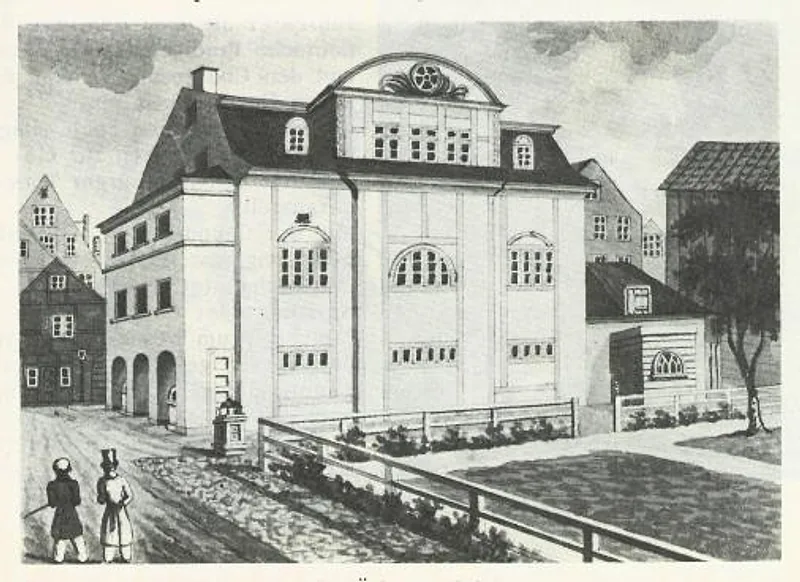
Reform found its largest home in the United States. Isaac Mayer Wise founded the Hebrew Union College in Cincinnati in 1875, and the Pittsburgh Platform of 1885 declared that only the moral laws of the Torah were binding and that Jews were a religious community, not a nation. Later statements, beginning with the Columbus Platform of 1937, embraced more traditional practice and support for a Jewish homeland. Reform Judaism has pioneered egalitarian worship — Sally Priesand became the first woman ordained by an American rabbinical seminary in 1972, though Regina Jonas had been privately ordained in Germany in 1935 — and in 1983 American Reform recognised Jewish descent through either parent. In Britain a related Liberal movement developed alongside Reform.
Orthodox Judaism and the Response to Modernity§
The term Orthodox was first applied, by reformers, to those who rejected reform, and it covers several responses to modernity. In Hungary, Rabbi Moses Sofer (the Hatam Sofer, 1762–1839) opposed all innovation, summing up his position with a Talmudic phrase turned into a slogan: what is new is forbidden by the Torah. In Frankfurt, Samson Raphael Hirsch (1808–1888) developed Neo-Orthodoxy, combining strict observance of halakha with German education and culture under the motto Torah im derekh eretz, "Torah with the way of the land".
Today Orthodoxy includes Haredi ("ultra-Orthodox") communities — Hasidic groups such as Chabad, Satmar and Ger, and the "Lithuanian" yeshiva world — which maintain separation from secular culture, distinctive dress and large families; Modern Orthodoxy, associated in America with Yeshiva University and the thinker Joseph B. Soloveitchik, which engages with secular learning and society; and Religious Zionism, inspired by Rabbi Abraham Isaac Kook (1865–1935), which sees the return to the Land of Israel as part of the process of redemption. All Orthodox Jews regard halakha as divinely binding.
Conservative, Reconstructionist and Other Movements§
Conservative Judaism (called Masorti outside North America) grew from the "positive-historical" school of Zecharias Frankel, who in 1845 broke with the German reformers over their abandonment of Hebrew in worship and later headed the Jewish Theological Seminary of Breslau, founded in 1854. In the United States the Jewish Theological Seminary of America, founded in 1886 and led from 1902 by Solomon Schechter, became its centre. Conservative Judaism holds that Jewish law is binding but has developed historically and can continue to develop through rabbinic interpretation; it ordained its first woman rabbi, Amy Eilberg, in 1985.
Reconstructionist Judaism grew from the thought of Mordecai Kaplan, whose Judaism as a Civilization (1934) described Judaism as the evolving religious civilisation of the Jewish people rather than a supernaturally revealed law. Kaplan held the first public bat mitzvah in America, for his daughter Judith, in 1922, and the Reconstructionist Rabbinical College opened in 1968. Other movements include Humanistic Judaism, founded by Rabbi Sherwin Wine in 1963, which celebrates Jewish culture without belief in a personal God, and Jewish Renewal, inspired by Rabbi Zalman Schachter-Shalomi, which draws on Hasidic and mystical spirituality.
Zionism, the Holocaust and the State of Israel§
In the late nineteenth century, pogroms in the Russian Empire and the persistence of antisemitism in Western Europe led many Jews to seek a national solution. The Viennese journalist Theodor Herzl published Der Judenstaat ("The Jewish State") in 1896 and convened the First Zionist Congress in Basel in 1897. Zionism took many forms — political, cultural, socialist, religious — and some Orthodox and Reform Jews initially opposed it. Waves of immigration built a Jewish community in Ottoman and then British Palestine, and the British Balfour Declaration of 1917 promised support for a Jewish "national home".
Between 1939 and 1945 Nazi Germany and its collaborators murdered about six million Jews, destroying the great centres of European Jewry and the world of Yiddish-speaking Eastern Europe. The Holocaust (in Hebrew Shoah) posed profound theological questions about God and evil that Jewish thinkers have wrestled with ever since. On 14 May 1948 the State of Israel was proclaimed. Its founding, the war that followed and the displacement of Palestinian Arabs remain central to the politics of the region. Israel absorbed Holocaust survivors, hundreds of thousands of Jews from Arab and Muslim countries, and later large immigrations from Ethiopia and the former Soviet Union.
Judaism Today: Demography, Diversity and Debate§
Demographers estimate the world Jewish population at roughly fifteen to sixteen million, with the largest communities in Israel and the United States, followed by France, Canada, the United Kingdom and Argentina. In the United States a 2020 Pew Research Center survey found that a plurality of Jews identified with Reform, smaller shares with Conservative and Orthodox Judaism, and about a third with no movement at all. In Israel Jews often describe themselves as haredi, religious, traditional (masorti) or secular rather than by denomination, and the Orthodox rabbinate controls marriage and conversion.
Contemporary debates concern the role of women in ritual and leadership, the inclusion of LGBTQ Jews, conversion and Jewish status, intermarriage, relations between Israel and the diaspora, and the growth of Haredi communities. Alongside these debates there has been a widespread revival of interest in Jewish learning, spirituality and mysticism, from adult Talmud study to new prayer communities (see Jewish prayer and the synagogue) and the popularisation of Kabbalah. The essentials of Jewish belief and practice common to most of these movements are summarised in What Is Judaism?.
Frequently asked questions§
What are the main branches of Judaism?§
The main religious movements are Orthodox (including Haredi and Modern Orthodox), Conservative or Masorti, Reform or Liberal, and Reconstructionist. Many Jews, especially in the United States and Israel, identify as Jewish without belonging to any movement.
What is the difference between Orthodox and Reform Judaism?§
Orthodox Judaism holds that the Torah and rabbinic law are divinely given and binding, and observes them in full. Reform Judaism regards Jewish tradition as evolving, emphasises ethics and personal choice in observance, and practises full equality of women and men.
When was the State of Israel founded?§
Israel declared its independence on 14 May 1948, following the end of the British Mandate for Palestine. Its founding fulfilled the aim of the Zionist movement launched by Theodor Herzl in the 1890s.
Sources and further reading§
- Response to Modernity: A History of the Reform Movement in Judaism — Michael A. Meyer, 1988
- American Judaism: A History — Jonathan D. Sarna, 2004
- The Jewish Enlightenment — Shmuel Feiner, 2004
- Judaism as a Civilization — Mordecai M. Kaplan, 1934
- The Jewish State — Theodor Herzl, 1896
- Modern Judaism: An Oxford Guide — Nicholas de Lange & Miri Freud-Kandel (eds.), 2005
- The Destruction of the European Jews — Raul Hilberg, 1961