Liber XIX · Judaism · Chapter VII: Modern Judaism
Moses Mendelssohn and the Haskalah: The Jewish Enlightenment
Moses Mendelssohn and the Haskalah: the Berlin philosopher, his Bible translation and Jerusalem, and how the Jewish Enlightenment reshaped modern Jewish life.

Moses Mendelssohn (1729–1786) was a German Jewish philosopher who became the leading figure of the Haskalah, the Jewish Enlightenment. Self-taught in European philosophy, he won fame in Berlin as a writer on metaphysics and aesthetics, translated the Torah into German, and in his book Jerusalem (1783) argued for freedom of conscience and for Judaism as a religion compatible with reason. The movement he inspired, spreading from Prussia to Galicia and Russia between the 1770s and the 1880s, sought to open Jewish life to secular learning and civic equality, and laid foundations for most forms of modern Judaism.
From Dessau to Berlin: Mendelssohn's Early Life§
Mendelssohn was born in Dessau, in the small principality of Anhalt-Dessau, in 1729, the son of Mendel Heymann, a poor Torah scribe and teacher. He received a traditional education under the town's rabbi, David Fränkel, a scholar of the Jerusalem Talmud who also introduced him to Maimonides' Guide for the Perplexed — a work Mendelssohn later said had shaped his thinking (see Maimonides). When Fränkel became chief rabbi of Berlin in 1743, the fourteen-year-old followed him there on foot.
Berlin under Frederick the Great permitted only a limited number of "protected Jews" to reside in the city, and Mendelssohn lived for years on the edge of poverty with an uncertain right of residence. He taught himself German, Latin, French and English, studied mathematics and the philosophy of Leibniz and Christian Wolff, and found work as a tutor and then a bookkeeper in the silk factory of Isaac Bernhard, eventually becoming its manager and partner. In 1754 he met the dramatist Gotthold Ephraim Lessing, who became his close friend and helped publish his first works. In 1762 he married Fromet Gugenheim of Hamburg; the couple had several children, among them the banker Abraham Mendelssohn, father of the composer Felix Mendelssohn Bartholdy.
The "German Socrates": Philosophy and the Lavater Affair§
Mendelssohn's early writings — Philosophical Conversations and Letters on Sentiments (both 1755) — made him a respected contributor to German philosophy and aesthetics. In 1763 his essay on evidence in metaphysics won the prize of the Prussian Academy of Sciences, ahead of an entry by the young Immanuel Kant. His Phädon (1767), a dialogue modelled on Plato's Phaedo arguing for the immortality of the soul, was a European bestseller translated into many languages and earned him the name "the German Socrates". In 1784 he answered the question "What is enlightenment?" in the Berlinische Monatsschrift in the same year as Kant's famous essay.
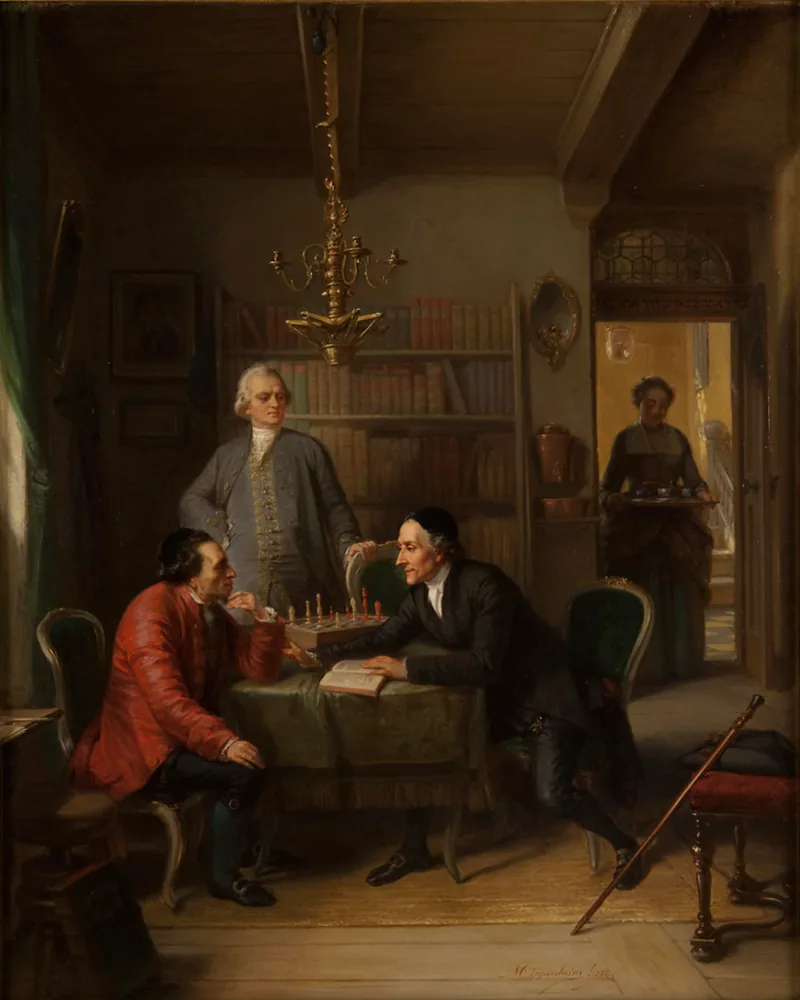
His fame drew him into religious controversy. In 1769 the Swiss pastor Johann Caspar Lavater publicly dedicated to him a translation of a work on the proofs of Christianity, challenging him either to refute it or to do what Socrates would have done and convert. Mendelssohn replied with a dignified letter affirming his loyalty to Judaism, refusing to attack Christianity, and arguing that Judaism did not seek converts and taught that the righteous of all nations have a share in the world to come. The affair, which caused him great strain and was followed by a long illness, convinced him that he must defend Judaism publicly. Lessing's play Nathan the Wise (1779), whose wise Jewish hero preaches tolerance, was widely understood as a portrait of his friend.
The Bible Translation and the Biur§
Mendelssohn's most important contribution to Jewish life was his translation of the Pentateuch into German, published between 1780 and 1783 under the title Netivot ha-Shalom ("Paths of Peace"). The German text was printed in Hebrew characters, so that Jews who read Yiddish and Hebrew could use it to learn standard German; it was accompanied by a Hebrew commentary, the Biur ("Explanation"), written by Mendelssohn and collaborators such as Solomon Dubno, Naphtali Herz Wessely and Herz Homberg. The commentary drew on the medieval Jewish exegetes, especially those who stressed the plain sense of the text, and on the study of Hebrew grammar and poetry. Mendelssohn also translated the Psalms and the Song of Songs.
The translation had a double purpose: to replace what he saw as poor Yiddish renderings and to offer a pure, rational and aesthetically sensitive reading of the Hebrew Bible. It was welcomed by many but opposed by some leading rabbis, who feared that it would draw young Jews away from Talmud study and towards German culture — fears that were not entirely misplaced, since for many readers it became a bridge to secular education.
Jerusalem: Religious Freedom and Judaism as Revealed Law§
In 1781, at Mendelssohn's encouragement, the Prussian official Christian Wilhelm von Dohm published a treatise On the Civil Improvement of the Jews, arguing that the Jews' faults were the result of oppression and that they should be granted civic rights. Mendelssohn supported the cause by sponsoring a German translation of Menasseh ben Israel's seventeenth-century Vindiciae Judaeorum, with a preface in which he argued against the power of religious communities to excommunicate. Challenged to explain how this could be reconciled with Mosaic law, he wrote Jerusalem, or On Religious Power and Judaism (1783).
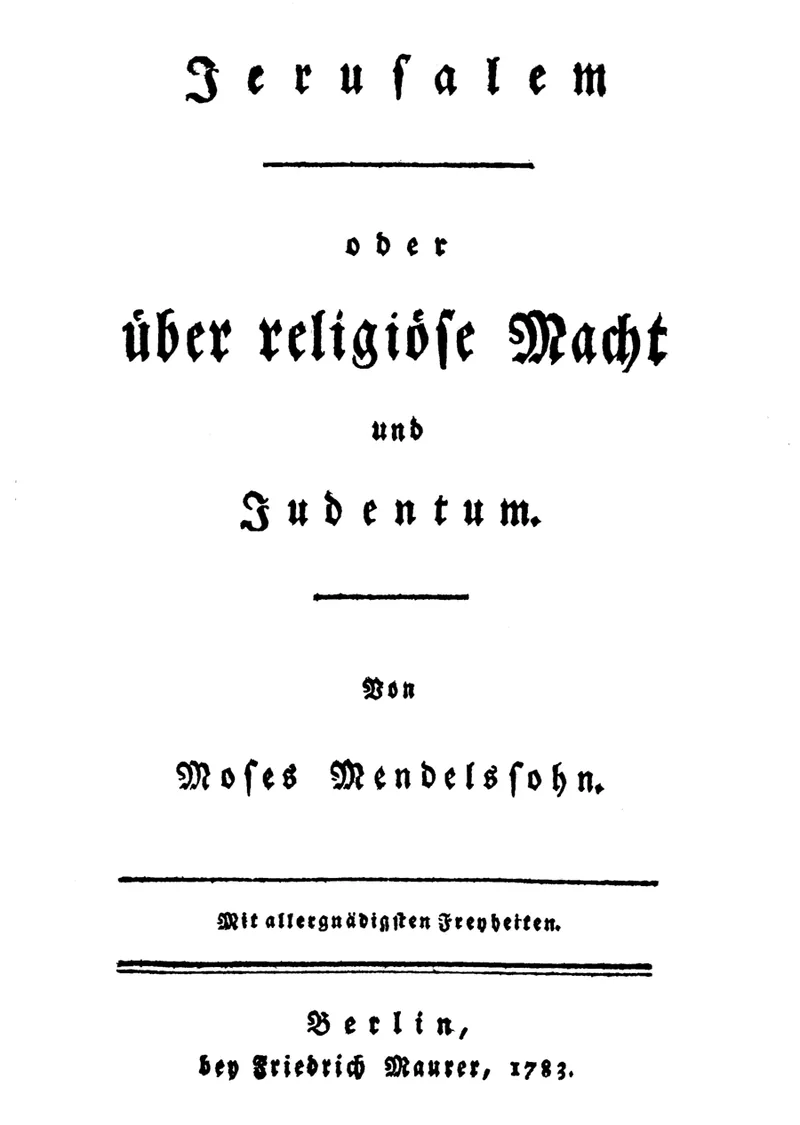
The first part of Jerusalem argues that the state may regulate actions but has no right to coerce belief, and that churches — including Jewish communities — should rely only on persuasion, without power to punish or exclude. The second part offers a philosophy of Judaism. The eternal truths on which salvation depends, such as the existence of God, providence and the immortality of the soul, are accessible to all human beings through reason; what was revealed at Sinai was not doctrine but legislation, a body of commandments given to the Jewish people. The commandments, Mendelssohn argued, remained binding on Jews until God himself should revoke them, and they served as a "living script" that prompted reflection on eternal truths. Kant praised the book, while critics on both sides questioned whether its defence of the law could survive its liberal premises. The place of Jerusalem in Jewish thought is discussed in Jewish philosophy.
Mendelssohn's final years were overshadowed by the "pantheism controversy" with Friedrich Heinrich Jacobi, who claimed that the late Lessing had been a Spinozist. Mendelssohn defended his friend in Morning Hours (1785) and To the Friends of Lessing, finishing the latter shortly before his death in Berlin in January 1786.
The Haskalah after Mendelssohn§
The maskilim, as followers of the Haskalah were called (from sekhel, "reason"), developed Mendelssohn's programme in different directions. In Berlin, Naphtali Herz Wessely's Words of Peace and Truth (1782), written in response to the Austrian emperor Joseph II's Edict of Tolerance, called for Jewish schools to teach secular subjects alongside religious ones; the Jewish Free School founded in Berlin in 1778 by David Friedländer and Isaac Daniel Itzig was an early model. From 1783 the Hebrew journal Ha-Me'assef ("The Gatherer") published poetry, science and essays in a revived biblical Hebrew. In Berlin's salons a generation of Jewish women, including Mendelssohn's daughter Brendel (later Dorothea Schlegel), mixed with the German intellectual elite; several of them, like many of Mendelssohn's descendants, converted to Christianity.
In the nineteenth century the centre of the Haskalah moved east. In Galicia, writers such as Joseph Perl satirised Hasidism, while Nachman Krochmal developed a philosophy of Jewish history; in the Russian Empire, Isaac Baer Levinsohn, Abraham Mapu, author of the first modern Hebrew novel, The Love of Zion (1853), and the poet Judah Leib Gordon, who urged Jews to "be a man in the street and a Jew at home", created a modern Hebrew literature. The maskilim were bitterly opposed by many traditional rabbis and by the Hasidim, whose world is described in Hasidism and the Baal Shem Tov; Rabbi Nachman of Breslov, for example, warned his followers against philosophy and secular study, while Rabbi Moses Sofer of Pressburg made "the new is forbidden by the Torah" the slogan of resistance to change.
Legacy and Debate§
Almost every modern Jewish movement claims part of Mendelssohn's legacy, as the account of modern Judaism shows. Reform Judaism took up his union of Judaism and reason but, unlike him, abandoned the binding authority of the law; Samson Raphael Hirsch's Neo-Orthodoxy shared his ideal of combining Torah with European culture while insisting, as he did, on full observance; the scholars of the Wissenschaft des Judentums, founded around 1819, applied critical historical methods to Jewish texts. The Hebrew revival of the Haskalah prepared the language of modern Hebrew literature and of Zionism, even though many later Zionists criticised the maskilim's hopes of acceptance in European society.
Historians have revised older pictures of the movement. Earlier accounts portrayed Mendelssohn as the single father of Jewish modernity; scholars such as Jacob Katz, Shmuel Feiner and David Sorkin have stressed that the Haskalah was a diverse movement with roots in earlier Jewish rationalism, that Mendelssohn himself was a deeply observant Jew, and that the paths from Enlightenment to assimilation, reform or renewal were neither inevitable nor uniform. His life remains a symbol of both the promise and the tensions of Jewish entry into modern Europe.
Frequently asked questions§
What was the Haskalah?§
The Haskalah, or Jewish Enlightenment, was an intellectual and social movement from the 1770s to the 1880s that promoted secular education, the study of European languages and sciences, a revival of Hebrew, and the integration of Jews into the societies in which they lived.
Why is Moses Mendelssohn important?§
He was the first Jew to win wide fame as a European philosopher while remaining fully observant, he translated the Torah into German to open Jews to German culture, and his book Jerusalem argued for religious freedom and a rational understanding of Judaism.
Was Felix Mendelssohn related to Moses Mendelssohn?§
Yes. The composer Felix Mendelssohn Bartholdy (1809–1847) was Moses Mendelssohn's grandson, the son of his son Abraham, who had his children baptised as Protestants.
Did Mendelssohn found Reform Judaism?§
No. Mendelssohn remained an observant traditional Jew and insisted that Jewish law was binding. Reform Judaism developed after his death, partly inspired by his ideas but going beyond them in changing the liturgy and practice.
Sources and further reading§
- Moses Mendelssohn: A Biographical Study — Alexander Altmann, 1973
- Jerusalem, or On Religious Power and Judaism — Moses Mendelssohn, 1783
- Moses Mendelssohn: Sage of Modernity — Shmuel Feiner, 2010
- The Jewish Enlightenment — Shmuel Feiner, 2004
- Out of the Ghetto: The Social Background of Jewish Emancipation, 1770–1870 — Jacob Katz, 1973
- Moses Mendelssohn and the Religious Enlightenment — David Sorkin, 1996
- Response to Modernity: A History of the Reform Movement in Judaism — Michael A. Meyer, 1988