Liber XIX · Judaism · Chapter V: Jewish Law & Ethics
Jewish Marriage and Divorce: Ketubah, Chuppah and the Get
Jewish marriage and divorce in law and custom: kiddushin, the ketubah contract, the chuppah and seven blessings, the get, the agunah and modern debates.

In Jewish law marriage is a covenant created by two acts — betrothal (kiddushin), in which the groom gives the bride a ring before witnesses, and the wedding proper (nissu'in) under the canopy (chuppah) — and accompanied by a written contract, the ketubah, that records the husband's obligations to his wife. Marriage can be dissolved only by a divorce document, the get, which the husband gives to the wife. These rules, rooted in the Torah and elaborated in the Talmud, still govern traditional Jewish weddings and are the subject of lively debate in the modern movements and in the State of Israel.
Marriage in the Hebrew Bible§
The Torah presents marriage as part of the order of creation: a man "shall cleave unto his wife: and they shall be one flesh" (Genesis 2). The patriarchal narratives describe arranged marriages, bride-wealth and polygyny — Jacob marries two sisters, Leah and Rachel — and Israelite law permitted a man more than one wife. Exodus requires a husband not to diminish a wife's "food, her raiment, and her duty of marriage", words the rabbis read as the three basic obligations of every husband: sustenance, clothing and conjugal relations.
Biblical law also forbids marriage within certain degrees of kinship (Leviticus 18), restricts whom priests may marry, and prescribes levirate marriage, in which a man marries the widow of his brother who died childless, or releases her through the ceremony of halitzah (Deuteronomy 25). Divorce is assumed rather than instituted: Deuteronomy 24 speaks of a husband who writes his wife "a bill of divorcement" and sends her away, the basis of all later Jewish divorce law. The oldest surviving Jewish marriage documents come from the Jewish garrison at Elephantine in Egypt in the fifth century BCE, and show wives holding property and, in some cases, the right to initiate divorce.
Kiddushin and Nissu'in: The Two Stages of Jewish Marriage§
The Mishnah opens its tractate Kiddushin by stating that a woman is betrothed in three ways: by money, by a document or by cohabitation. The rabbis strongly discouraged the third, and the first became standard: the groom gives the bride an object of value — since the early Middle Ages a plain ring — in the presence of two qualified witnesses, saying, "Behold, you are consecrated to me with this ring according to the law of Moses and Israel." The word kiddushin comes from the root for "holy": the bride is set apart for her husband as an offering is set apart for the sanctuary. Rabbinic law also requires the woman's consent; a marriage imposed on her was not valid.
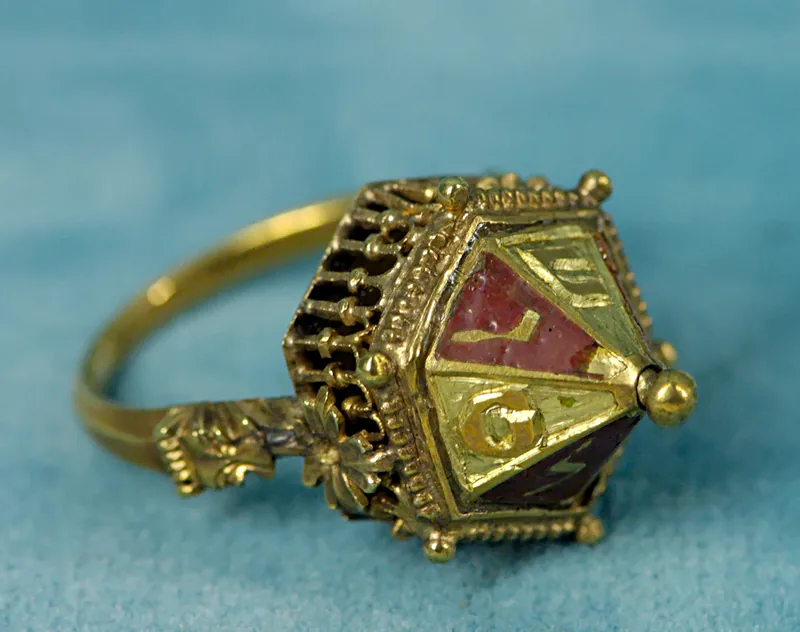
Betrothal created a full legal bond — only a divorce could undo it — but the couple did not yet live together. The second stage, nissu'in, took place later, often after a year, when the bride was brought into the groom's home. In the Middle Ages the two stages were combined into a single ceremony, as they are today, separated only by the reading of the ketubah. Polygyny remained lawful in the Talmud, but around the year 1000 a decree attributed to Rabbenu Gershom of Mainz forbade Ashkenazi Jews to take a second wife or to divorce a wife against her will. Some Sephardi, Middle Eastern and Yemenite communities continued to permit polygyny into modern times, until it was prohibited for new marriages in the State of Israel in the 1950s.
The Ketubah: The Jewish Marriage Contract§
The ketubah ("writing") is the marriage contract, written in Aramaic in a formula that has changed little since late antiquity. Rabbinic tradition credits its institution to Shimon ben Shetach in the first century BCE, who placed the wife's settlement as a lien on all her husband's property so that divorcing her would not be easy. The ketubah records the date and place, the names of the couple and the witnesses, the husband's undertaking to "work, honour, support and maintain" his wife, the sum due to her if he divorces her or dies — two hundred zuz for a first marriage according to the Mishnah — and any dowry she brings. Ketubot of the second century CE survive among the papers of Babatha, a Jewish woman whose archive was found in a cave near the Dead Sea.
Because the ketubah belongs to the bride and was often kept and displayed, it became a canvas for art. Illuminated ketubot flourished especially in Italy from the seventeenth century, decorated with zodiac signs, biblical scenes, family coats of arms and architectural frames, and similar traditions developed in the Netherlands, Persia, Morocco and Yemen. Modern couples, especially in liberal communities, often commission artistic ketubot and sometimes adapt the text to express mutual obligations.
The Jewish Wedding Ceremony and Its Customs§
Many customs surround the core legal acts. In Ashkenazi tradition the bride and groom fast on their wedding day, which is treated as a personal Day of Atonement on which their sins are forgiven. Before the ceremony the groom lowers the bride's veil (bedeken), recalling Rebecca covering herself when she met Isaac. The ceremony takes place under the chuppah, a canopy often made from a prayer shawl, symbolising the new home; in many communities the bride circles the groom seven times.
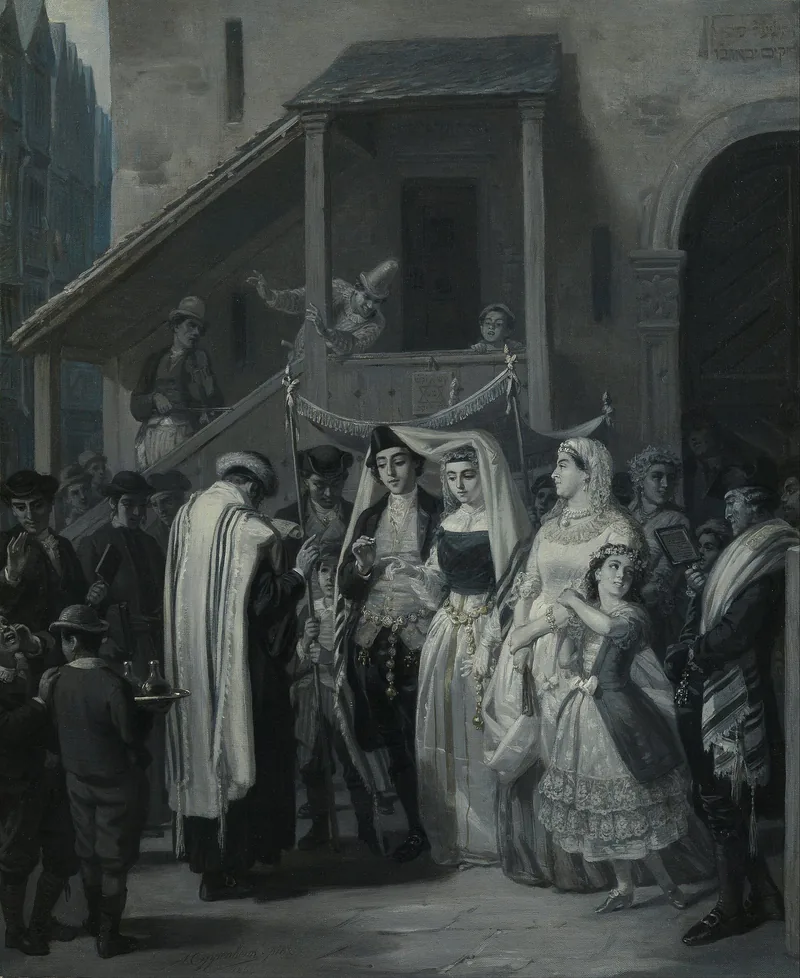
The officiant recites the betrothal blessing over a cup of wine; the groom gives the ring before witnesses; the ketubah is read aloud; and the sheva berakhot, seven blessings, are chanted over a second cup, praising God as creator of humanity and of "joy and gladness, groom and bride". At the end the groom breaks a glass underfoot. The Talmud tells of rabbis who broke costly vessels at weddings to temper excessive merriment; later tradition linked the custom to mourning for the destroyed Temple. The couple then spends a few minutes alone in a room (yichud), a vestige of the bride's entry into the groom's home. Festive meals with the seven blessings may continue for a week. Beliefs that marriages are made in heaven — the Talmud says that forty days before a child is formed a heavenly voice announces whom it will marry — gave rise to the Yiddish word bashert, "destined", and the profession of the matchmaker (shadkhan). Wider European wedding beliefs are discussed in superstitions of birth, marriage and death.
Divorce and the Get§
Jewish law regards divorce as regrettable but permitted. The Mishnah records a famous dispute over the grounds in Deuteronomy's phrase "some uncleanness": the House of Shammai allowed divorce only for sexual misconduct, the House of Hillel even if she spoiled his cooking, and Rabbi Akiva even if he found another woman more beautiful (see Hillel and Shammai). Rabbinic law followed the House of Hillel in principle, while surrounding divorce with protections for the wife, chief among them the ketubah payment.
A divorce is effected by a get, a document written by a scribe at the husband's instruction specifically for this couple, in Aramaic, in twelve lines, signed by two witnesses and handed by the husband (or his agent) to the wife, who becomes free to remarry. Today the procedure takes place before a rabbinical court (beit din), which ensures that every detail is correct, since an invalid get would make a later marriage adulterous and its children mamzerim, a status with serious legal consequences. The details of this system belong to halakha, the body of Jewish law.
The Agunah Problem and Modern Debates§
Because the get must be given by the husband of his own free will, a wife whose husband disappears, or refuses to divorce her, cannot remarry under Jewish law. Such a woman is an agunah, "chained". The Talmud allowed a court to pressure a husband in certain cases until he declared his consent, and rabbis have long relaxed the rules of evidence for women whose husbands vanished in war or at sea. In modern times the problem has grown with civil divorce. Conservative rabbis adopted a clause in the ketubah in the 1950s, associated with Saul Lieberman, binding the couple to the authority of a rabbinical court; many Orthodox couples sign prenuptial agreements imposing financial penalties for refusing a get; and Israeli rabbinical courts can impose sanctions on recalcitrant husbands.
The modern movements differ in other ways too (see modern Judaism). Reform Judaism generally recognises civil divorce, and many liberal ceremonies use double rings, egalitarian ketubot or new rituals such as the "lovers' covenant" proposed by the theologian Rachel Adler. Since the early twenty-first century the Reform, Reconstructionist and Conservative movements have created ceremonies for same-sex couples, which Orthodox Judaism does not recognise. Traditional law also prohibits marriage between a Jew and a non-Jew, and liberal rabbis differ over whether to officiate at such weddings. In the State of Israel, Jewish marriage and divorce are controlled by the Chief Rabbinate, so there is no civil marriage, and couples who cannot or will not marry under its authority often marry abroad.
Frequently asked questions§
What is a ketubah?§
A ketubah is the Jewish marriage contract, traditionally written in Aramaic, which records the husband's obligations to support his wife and the sum due to her if the marriage ends by divorce or death. It is signed by two witnesses, read aloud under the chuppah and given to the bride.
Why is a glass broken at a Jewish wedding?§
The custom goes back to Talmudic stories of rabbis breaking valuable vessels at weddings to temper excessive joy. Later tradition interpreted it as a reminder of the destruction of the Temple in Jerusalem, recalling the psalmist's vow to set Jerusalem above his chief joy.
Can a Jewish woman get a divorce?§
Under traditional law the get is given by the husband to the wife, but a wife can sue for divorce in a rabbinical court, which can order the husband to grant it and apply pressure if he refuses. The difficulty arises when a husband refuses despite such pressure, leaving his wife an agunah.
Sources and further reading§
- Jewish Marriage in Antiquity — Michael L. Satlow, 2001
- The Jewish Marriage Contract: A Study in the Status of the Woman in Jewish Law — Louis M. Epstein, 1927
- The Jewish Way in Love and Marriage — Maurice Lamm, 1980
- Ketubbah: Jewish Marriage Contracts of Hebrew Union College Skirball Museum and Klau Library — Shalom Sabar, 1990
- The Jewish Life Cycle: Rites of Passage from Biblical to Modern Times — Ivan G. Marcus, 2004
- On Women and Judaism: A View from Tradition — Blu Greenberg, 1981
- Engendering Judaism: An Inclusive Theology and Ethics — Rachel Adler, 1998