Liber III · Black & White Magic · Chapter II: Maleficium & Curses
Magic and the Law: From the Twelve Tables to the 1951 Act
How law treated magic from Rome's Twelve Tables and the Theodosian Code to the Carolina, the witchcraft acts, the Vagrancy Act and Britain's 1951 repeal.

For most of European history magic was a legal matter as well as a religious one. Roman law punished spells that harmed crops or people, late Roman emperors outlawed divination and sorcery as threats to the state, medieval and early modern courts executed witches for maleficium (harmful magic), and from the eighteenth century the law gradually turned from punishing magic as a real crime to punishing the pretence of it as fraud. In Britain that long arc ended only in 1951, when the Witchcraft Act of 1735 was repealed.
Spells in the Twelve Tables and Republican Rome§
The earliest Roman law code, the Twelve Tables of about 450 BC, survives only in quotations, but two clauses quoted by later authors concern magic. One punished whoever "enchanted away crops" (fruges excantassit), the belief being that a spell could draw the fertility of a neighbour's field into one's own. The other concerned whoever "chanted an evil song" (malum carmen incantassit). Pliny the Elder, writing in the first century AD, read both as laws against magic. Cicero, however, understood the malum carmen clause as a law against defamatory verses, and modern historians still debate whether early Rome distinguished between a curse and a public insult, since both were thought to work through the power of words.
Pliny also preserves a story that illustrates how such charges were handled. A freedman named Gaius Furius Chresimus, whose small farm yielded more than his neighbours' large estates, was accused of drawing their crops away by sorcery. At his trial he brought his strong slaves, well-made iron tools and well-fed oxen into the forum and declared that these were his spells; he was acquitted unanimously. The anecdote shows that agricultural magic was a recognised legal category and that accusations often grew out of envy between neighbours.
Veneficium: Poison, Magic and the Lex Cornelia§
The Latin word veneficium meant both poisoning and the making of potions or spells, and Roman law did not always separate them. Sulla's Lex Cornelia de sicariis et veneficis of 81 BC, a statute against assassins and poisoners, became the main legal basis for prosecuting magic under the Empire. Jurists extended it to love philtres that caused death, to "impious or nocturnal rites" intended to bewitch, and to the possession of magical books.
The Sentences attributed to the jurist Paul, compiled around AD 300, set out the penalties in their harshest form: those who performed nocturnal rites to enchant or bind someone were to be crucified or thrown to the beasts, magicians themselves were to be burned alive, and books of the magic art were to be burned publicly with their owners deported or executed according to rank. Emperors also acted against forms of knowledge that threatened them: Augustus had some two thousand books of prophecy burned, and astrologers were repeatedly expelled from Rome. The most famous surviving defence speech against a charge of magic, the Apology of Apuleius, delivered in North Africa around 158–159, answers the accusation that the author had used charms to win a wealthy widow; it shows that by the second century a charge of magia could be brought in an ordinary provincial court. The physical evidence of what such laws targeted survives in the curse tablets buried across the Roman world.
The Christian Empire and the Theodosian Code§
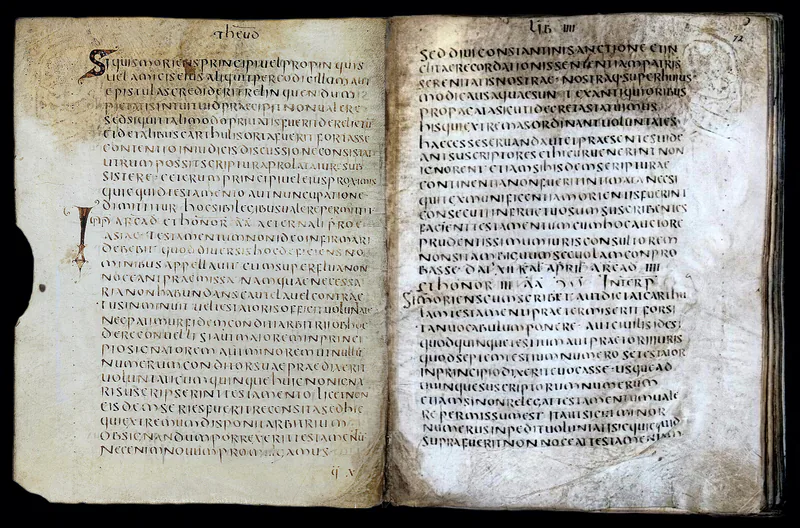
The Christian emperors inherited this legislation and sharpened it. The Theodosian Code of 438 gathers their laws under the title "On sorcerers, astrologers and others of like kind". A law of Constantine, issued around 318–321, condemned those who used magic arts against human safety or to turn chaste minds to lust, but expressly protected remedies sought for bodily illness and rural charms used to keep rain and hail from ripe grapes. This distinction between harmful and beneficial magic, written into imperial law, would echo through later debates about white magic.
Constantius II went further in 357, ordering that "the curiosity to divine" should cease for everyone, and later laws threatened soothsayers, astrologers and magicians with death. These measures were directed as much against traditional pagan rites and political prophecy, such as attempts to foretell the emperor's death, as against private sorcery. In the eastern Empire, Justinian's Code of the sixth century repeated many of them.
Early Medieval Law: Striga, Penance and the Canon Episcopi§
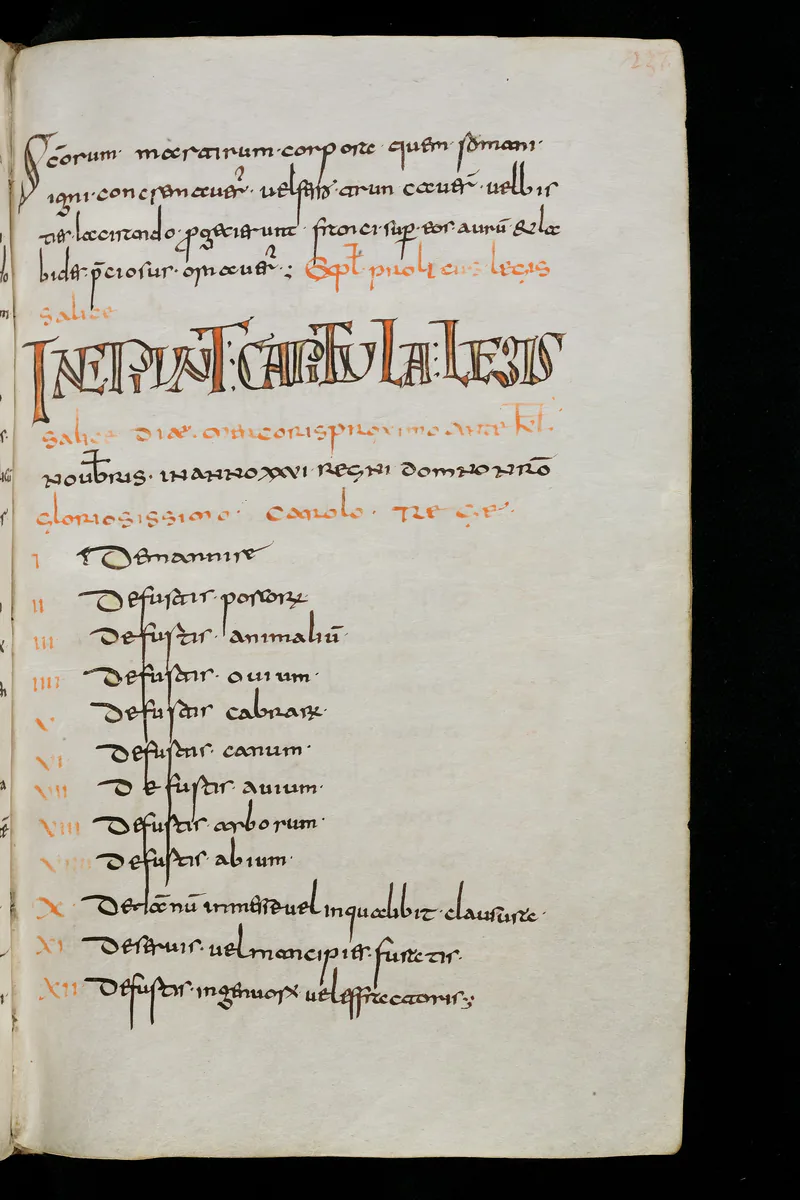
The Germanic law codes of the early Middle Ages treated witchcraft in a different spirit. The Salic law of the Franks fixed compensations both for a stria or striga, a witch believed to devour people, who was proved to have eaten a man, and for anyone who falsely called a free woman a witch. Charlemagne's capitulary for the conquered Saxons, issued in the 780s, decreed death for anyone who, "deceived by the devil" and believing a man or woman to be a man-eating witch, burned that person; the law punished the witch-killer rather than the supposed witch.
Church law in this period mostly treated magic as a sin to be corrected by penance. The penitentials and the great collections of Regino of Prüm (around 906) and Burchard of Worms (early eleventh century) assign fasts for consulting diviners, making love potions, or believing in shape-shifting. Regino preserved the text later known as the Canon Episcopi, which instructed bishops to expel sorcerers from their parishes and declared that the women who claimed to ride at night with the goddess Diana were deceived by dreams sent by the devil. For centuries this canon made belief in the witches' night flight, rather than the flight itself, the offence.
The Age of Witch Trials: The Carolina and the Witchcraft Acts§
From the fourteenth century theologians increasingly argued that all magic rested on a pact with demons, a view traced in how theologians judged demonic magic. When secular courts took up witchcraft in the fifteenth and sixteenth centuries they combined this idea with the old category of maleficium. The Holy Roman Empire's criminal code, the Constitutio Criminalis Carolina of 1532, ordered death by fire for anyone who caused harm by sorcery, while sorcery that caused no harm was to be punished according to the circumstances. The Carolina also required that torture be used only on adequate prior evidence, a rule widely ignored in the great German persecutions.
In England, a statute of 1542 made several forms of magic felonies but was repealed in 1547. The Act of 1563 made killing by witchcraft a capital crime and punished lesser harms with the pillory and imprisonment; the Act of 1604 extended the death penalty to anyone who invoked or fed evil spirits or took up corpses for use in witchcraft. Scotland's act of 1563 made both the practice of witchcraft and the consulting of witches capital offences. Under these laws the trials surveyed in European witch trials were conducted, and the theory behind them was codified in works such as the Malleus Maleficarum. The details of the English and Scottish statutes and their repeal are traced in the article on the Witchcraft Act of 1735.
From Crime to Fraud: 1682, 1735, 1824 and 1951§
The decline of witchcraft prosecution was reflected in a change of legal category. In France, after the scandal of the Affair of the Poisons, a royal edict of 1682 treated those who claimed magical powers as deceivers guilty of superstition and impiety, while reserving severe penalties for sacrilege and poisoning. In Britain the Witchcraft Act of 1735 repealed the earlier acts and made it an offence to pretend to exercise witchcraft, sorcery or fortune-telling, punishable by imprisonment of up to a year. The law had stopped asking whether a witch had harmed her neighbour and asked only whether someone had deceived the public. The last executions in Europe, such as those of Janet Horne in Scotland and Anna Göldi in Switzerland, took place in jurisdictions where the older logic survived.
The Vagrancy Act of 1824 added that anyone "pretending or professing to tell fortunes" by palmistry or similar means could be punished as a rogue and vagabond, a clause used against palmists, astrologers and mediums well into the twentieth century. The 1735 Act was itself used in 1944 to convict the Scottish medium Helen Duncan. Its repeal by the Fraudulent Mediums Act of 1951, which punished only those who claimed psychic powers fraudulently and for reward, removed the last law in Britain that named witchcraft; the 1951 Act was in turn replaced by consumer-protection regulations in 2008. Elsewhere similar provisions survived longer: Canada's Criminal Code kept an offence of pretending to practise witchcraft until 2018. In other parts of the world laws against harmful sorcery, the direct descendants of the old crime of maleficium, remain in force today.
Frequently asked questions§
What did the Twelve Tables say about magic?§
Two surviving clauses, quoted by later writers, concerned whoever "enchanted away" another person's crops and whoever chanted an evil carmen or song. Pliny the Elder read both as laws against magic, though Cicero took the second to refer to slanderous verses. The exact original wording and penalties are uncertain because the code survives only in fragments.
Did Roman law allow any kind of magic?§
Yes. A law of Constantine preserved in the Theodosian Code explicitly excused remedies for bodily illness and rural charms to protect vineyards from rain and hail, while punishing magic that threatened life or chastity. Later emperors were stricter about divination, which they saw as a political danger.
When did witchcraft stop being a crime in Britain?§
The Witchcraft Act of 1735 abolished witchcraft as a real crime, punishing only the pretence of magical powers. That Act was repealed in 1951 by the Fraudulent Mediums Act, which in turn was replaced in 2008 by general consumer-protection law.
Why was magic often linked with poisoning in law?§
Latin veneficium covered both poisoning and the making of potions or spells, and in practice both involved secret preparations meant to harm or control another person. Roman jurists therefore prosecuted magic under Sulla's law against poisoners, and the association between witchcraft and poison persisted into the early modern period.
Sources and further reading§
- Magic in the Roman World: Pagans, Jews and Christians — Naomi Janowitz, 2001
- Witchcraft and Magic in Europe: Ancient Greece and Rome — Valerie Flint, Richard Gordon, Georg Luck & Daniel Ogden, 1999
- The Theodosian Code and Novels and the Sirmondian Constitutions — Clyde Pharr, 1952
- Magic in the Middle Ages — Richard Kieckhefer, 1989
- The Witch-Hunt in Early Modern Europe — Brian P. Levack, 1987
- Witchcraft and Its Transformations, c.1650–c.1750 — Ian Bostridge, 1997
- Witchcraft, Magic and Culture 1736–1951 — Owen Davies, 1999