Liber XXXI · Taoism & Chinese Religion · Chapter X: Zhuangzi
The Liezi: Lie Yukou, Taoist Fables and the Question of Date
The Liezi, third classic of philosophical Taoism: Lie Yukou who rode the wind, the Foolish Old Man, the Yang Zhu chapter, and the debate over the book's date.

The Liezi is a Taoist classic in eight chapters attributed to Lie Yukou, a sage of the state of Zheng who appears in the Zhuangzi as a man able to ride the wind. Full of fables, dreams and dialogues, it is counted with the Tao Te Ching and the Zhuangzi as one of the three great texts of philosophical Taoism, although most scholars believe the version we have was compiled around the third or fourth century CE from older and newer material.
Who Was Lie Yukou?§
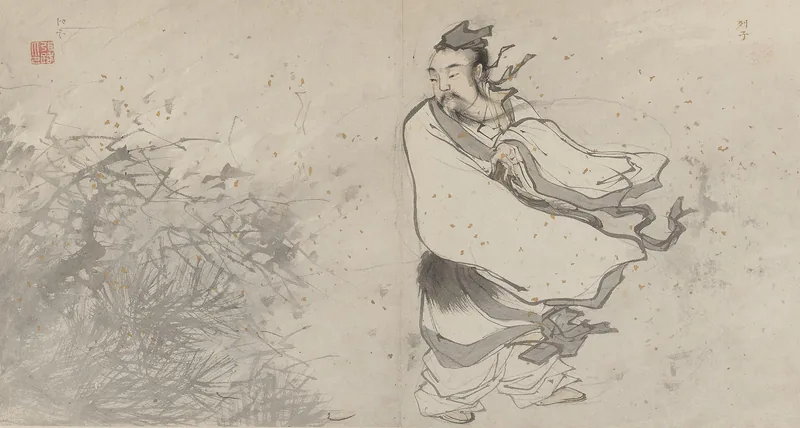
Lie Yukou, called Liezi ("Master Lie"), is known almost entirely from literature. The Zhuangzi mentions him several times. In its first chapter he rides the wind, returning after fifteen days, yet is said still to depend on something, since he needs the wind; the truly free person, by contrast, relies on nothing. Elsewhere in the Zhuangzi, Liezi is fooled by a shaman who claims to read fortunes in faces, and his teacher Huzi exposes the shaman by showing him a series of inner states. After this lesson Liezi goes home, cooks for his wife and feeds the pigs as if they were people, having given up his cleverness.
Tradition makes Liezi a native of Zheng, in the central plain, who lived quietly in poverty in the fifth or fourth century BCE. The Han dynasty catalogue of the imperial library lists a Liezi in eight sections, so a book by that name existed by the first century BCE. Whether Lie Yukou was a real teacher, a literary figure, or a real person transformed by legend, historians cannot say. In this he resembles Laozi and, to a lesser degree, Zhuang Zhou (see the Zhuangzi).
The Text and the Question of Its Date§
The Liezi we read today came down with a preface and commentary by Zhang Zhan, a scholar active in the later fourth century CE. Zhang wrote that his family had saved fragments of the book when they fled south during the collapse of the Western Jin dynasty in the early fourth century, and that he pieced the text together from these remnants. The book also carries a preface attributed to the Han librarian Liu Xiang (79–8 BCE), describing his editing of the original eight sections.
Doubts about the text are old. Song and Qing dynasty critics noted that parts of it seemed to echo Buddhist ideas, which would be impossible in a work of the fourth century BCE. In a series of studies culminating in his 1960 translation, the British sinologist A. C. Graham examined its vocabulary and grammar and concluded that the received text was largely composed around 300 CE, drawing on earlier sources. Many passages run parallel to the Zhuangzi and other pre-Han and Han books, and these may preserve older material, while other chapters, notably the "Yang Zhu" chapter, reflect the intellectual world of the third century.
Some Chinese scholars have argued that more of the book is genuinely early than Graham allowed, and the question remains open in detail. But the consensus is that the Liezi as a whole is a compilation of the Wei–Jin period, the age of "Dark Learning" (xuanxue), when scholars such as Wang Bi and Guo Xiang were writing commentaries on the Tao Te Ching and the Zhuangzi.
The Eight Chapters of the Liezi§
Following Graham's translation, the chapters may be summarised as follows:
- Heaven's Gifts (Tianrui): the origin of the world from formlessness, life and death as transformations, and Liezi's own teachings.
- The Yellow Emperor (Huangdi): the emperor's dream journey to the land of Huaxu, where people live without desire or fear; stories of skill and of the man who loved seagulls, who could no longer approach them once he meant to catch one.
- King Mu of Zhou (Zhou Mu wang): dreams and illusions, including the king's journey to the Queen Mother of the West and the tale of a woodcutter who hid a deer and forgot whether he had dreamed it.
- Confucius (Zhongni): Confucius and his disciples presented as speakers for Taoist ideas, and the limits of learning.
- The Questions of Tang (Tang wen): cosmology and marvels, the infinite universe, distant lands, and stories of craftsmen and musicians.
- Effort and Destiny (Li ming): a dialogue arguing that success and failure depend on destiny rather than human effort.
- Yang Zhu: discourses attributed to the philosopher Yang Zhu on the shortness of life and the value of following one's nature.
- Explaining Conjunctions (Shuo fu): miscellaneous anecdotes about cause and effect, perception and the right moment to act.
The book shares with the Zhuangzi a love of paradox and a refusal to take ordinary distinctions for granted, especially the distinction between dreaming and waking. Its themes of accepting fate and of following spontaneity connect it to the ideal of wu wei.
Famous Stories: the Foolish Old Man, the Automaton and the Deer§
Many of the Liezi's fables became part of the Chinese language.
The Foolish Old Man who moved the mountains§
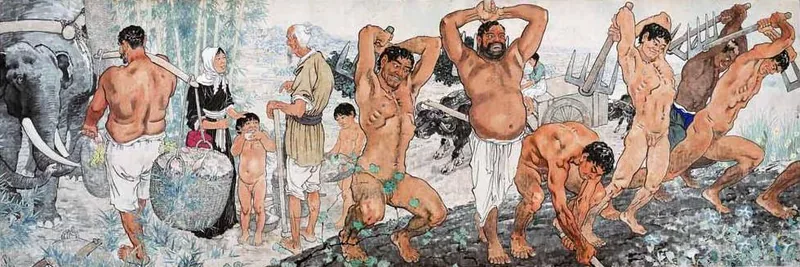
In "The Questions of Tang" an old man of ninety, called Yugong ("Foolish Old Man"), resolves to dig away two great mountains that block his door. A neighbour, the "Wise Old Man", mocks him; Yugong replies that his sons and grandsons will continue after him generation by generation, while the mountains cannot grow. Moved by his persistence, the gods carry the mountains away. In 1945 Mao Zedong retold the story in a speech, and it became one of the best-known parables of modern China.
The mechanical man§
The same chapter tells of an artificer named Yanshi who presents to King Mu of Zhou a figure that walks, sings and dances like a living man. When it winks at the royal ladies the king is enraged, until Yanshi takes it apart to show that it is made of leather, wood, glue and lacquer. The story is often cited in histories of automata and of the idea of the artificial human.
Other tales§
Other episodes include the man of Qi who worried that the sky would fall, which gave Chinese an idiom for needless anxiety; two children who confound Confucius by arguing whether the sun is nearer at dawn or at noon; the friendship of the lute player Boya and his listener Zhong Ziqi, origin of the phrase zhiyin, "one who knows the tone", for a true friend; and the man who lost his axe and found that his neighbour's son looked like a thief until he found it again.
Yang Zhu and the Problem of Hedonism§
The seventh chapter has drawn special attention. Yang Zhu was a real thinker of the fourth century BCE whom Mencius condemned for egoism, claiming he would not pluck out a single hair to benefit the whole world. His own writings are lost. The Liezi chapter in his name presents a frank philosophy of enjoyment: life is short, fame is empty, and one should satisfy the senses rather than torment oneself for reputation or posterity.
Graham argued that the chapter is not a record of the historical Yang Zhu but a third-century CE work reflecting the hedonist currents of the Wei–Jin aristocracy, and that it should be read separately from the rest of the book. Other scholars see in it a radicalised version of genuine Yangist ideas about preserving life. Either way, it sits uneasily with the more mystical chapters and shows how varied the Liezi is.
The Liezi in Religious Taoism and Later Culture§
Like the other Taoist classics, the Liezi was absorbed into the religion. In 742 the Tang emperor Xuanzong, a great patron of Taoism, granted Lie Yukou the title of "Perfected Person of Pure Emptiness" (Chongxu zhenren) and renamed his book the Perfect Scripture of Pure Emptiness; the Zhuangzi received the parallel title Nanhua zhenjing at the same time. Under the Song the title was expanded, and the book entered the Taoist canon with several commentaries. Liezi riding the wind became a stock image of the Taoist immortal in painting and poetry.
The book's description of King Mu's journey to meet the Queen Mother of the West contributed to her legend, and its marvels, including distant islands of the immortals and gigantic beings, fed later literature of the strange.
In the West, Lionel Giles published selections in 1912, Richard Wilhelm a German version in 1911, and Graham his complete translation in 1960. Because of its accessible stories, the Liezi is often recommended as an entry point to the Taoist classics alongside Laozi's Tao Te Ching.
Frequently asked questions§
Who wrote the Liezi?§
It is attributed to Lie Yukou, a Taoist sage traditionally dated to the fifth or fourth century BCE. Most modern scholars believe the received text was compiled around 300 CE, using some older material, and transmitted by Zhang Zhan in the fourth century.
Is the Liezi as important as the Tao Te Ching and the Zhuangzi?§
It is traditionally counted as the third great classic of philosophical Taoism and was honoured as a scripture under the Tang. It is less studied than the other two, partly because of doubts about its date, but it is valued for its stories and its reflections on dreams and fate.
What is the story of the Foolish Old Man?§
An old man sets out to dig away two mountains that block his way, saying his descendants will carry on the work forever. Heaven, moved by his resolve, has the mountains removed. The tale, from the fifth chapter of the Liezi, is a famous parable of perseverance.
Did Liezi really ride the wind?§
The image comes from the Zhuangzi, which uses it to make a philosophical point: even riding the wind, Liezi still depended on something. It became a favourite symbol of the free and transcendent sage in Chinese art.
Sources and further reading§
- The Book of Lieh-tzŭ — A. C. Graham, 1960
- Taoist Teachings from the Book of Lieh Tzŭ — Lionel Giles, 1912
- Lieh-tzu: A Taoist Guide to Practical Living — Eva Wong, 1995
- Disputers of the Tao: Philosophical Argument in Ancient China — A. C. Graham, 1989
- Daoism Handbook — Livia Kohn (ed.), 2000