Birth lore · Your birthday
Rock Crystal (Clear Quartz)
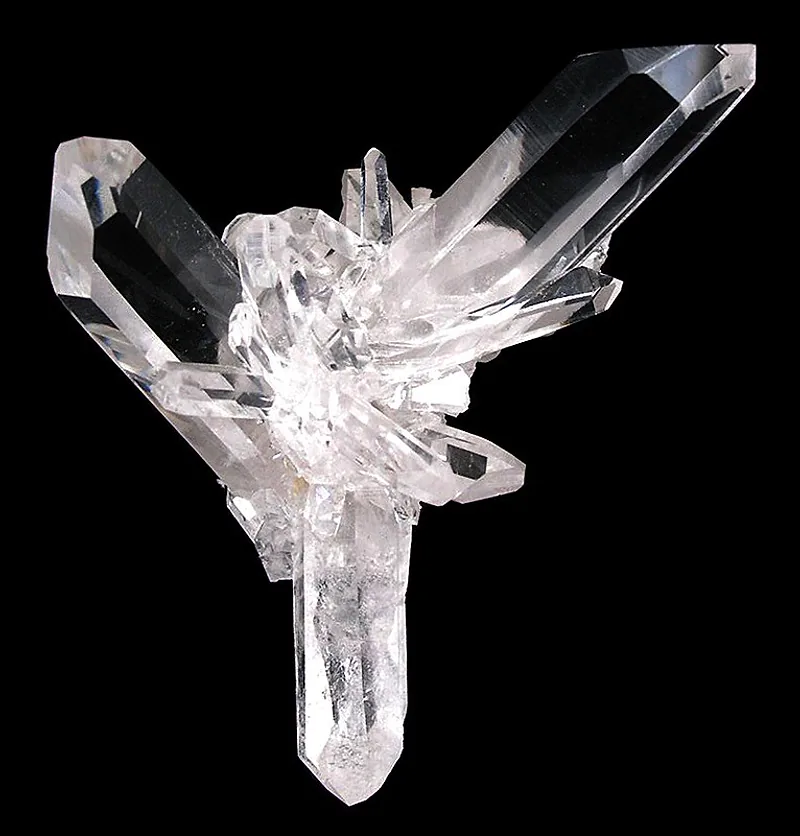
Rock crystal, colourless quartz, gave the word 'crystal' to Western languages; it was carved into Fatimid ewers and medieval reliquaries, used for scrying spheres, and today keeps time in quartz watches.
History and lore
Rock crystal gave Western languages the word "crystal". The Greek krystallos meant ice, and ancient writers, Pliny the Elder among them, believed that the clear stones found in Alpine clefts were ice frozen so hard that it could no longer melt. Pliny also records that physicians used crystal spheres to focus the sun's rays for cautery, and Roman owners prized crystal cups and vessels.
Some of the finest objects ever carved from any stone are of rock crystal. Workshops in Fatimid Egypt in the tenth and eleventh centuries hollowed whole crystals into ewers carved with birds and animals; one, inscribed for the caliph al-Aziz, is kept in the treasury of San Marco in Venice. In the Carolingian world the ninth-century Lothair Crystal, now in the British Museum, was engraved with the story of Susanna. Medieval Europe set crystal in reliquaries, crosses and book covers, and Renaissance Milanese carvers made elaborate vessels for princely collections.
Crystal spheres became the classic instrument of scrying. In the 1580s John Dee and Edward Kelley consulted a "shew-stone", among other objects, in the sessions that produced the angelic records later called Enochian magic; a crystal ball associated with Dee is in the British Museum, alongside his famous mirror of obsidian.
In the traditions
Rock crystal is not among the breastplate stones of Exodus 28, but crystal is the Bible's image of perfect clarity. Revelation describes "a sea of glass like unto crystal" before God's throne (Revelation 4:6) and the light of the holy city as "clear as crystal" (Revelation 21:11). Medieval lapidaries in Marbode's tradition repeat the old observations that crystal could kindle fire from the sun, and Renaissance correspondence tables, including Agrippa's, place clear and white stones among the things of the Moon, which is why this entry gives the Moon as its planet.
In India sphatika (crystal) is used for Shiva lingams and prayer beads, and in Buddhist texts crystal appears in many lists of the "seven treasures". Anthropologists have documented the importance of quartz crystals to healers in many Indigenous cultures, most fully for Aboriginal Australian "men of high degree". Among modern birthstone lists, a British jewellers' list usually dated to 1937 gave rock crystal as an alternative to diamond for April; the American lists do not include it. Today's crystal shops call clear quartz a "master healer" and assign it to every zodiac sign, a recent idea for which scientific studies have found no evidence.
Meaning and symbolism
Clarity, purity, light and transparency have always been rock crystal's meanings. Medieval theologians used the image of sunlight passing through crystal or glass without breaking it as an emblem of the virginal conception, and the scryer's sphere stood for sight beyond the ordinary. In modern symbolic language crystal suggests an amplifier or clear lens for intention.
The mineral
Rock crystal is pure silicon dioxide crystallised as six-sided prisms with pyramidal ends. It grows in veins, pegmatites and geodes; well-known sources include Brazil, Madagascar, the Alps, the Himalaya and Arkansas in the United States. Inclusions produce distinctive varieties: golden needles in rutilated quartz, ghostly "phantoms", and trapped liquid in enhydros. Quartz is piezoelectric, producing a tiny voltage under pressure, which is why (synthetic) quartz oscillators keep time in watches and electronics.
Hardness is 7, with a shell-like conchoidal fracture. Glass is the usual imitation: it feels warmer to the touch, often shows rounded bubbles and swirls, and is singly refractive, whereas a line viewed through a quartz sphere usually appears doubled. "Crystal" tableware is lead glass, not quartz. Rock crystal is easy to care for, but one warning matters: a clear sphere left in a sunny window can focus sunlight and start a fire.
Sources and further reading
- Revelation 4 and 21 — King James Bible, 1611
- Natural History, Book 37 — Pliny the Elder, c. 77 CE
- De lapidibus — Marbode of Rennes, c. 1090
- Three Books of Occult Philosophy — Heinrich Cornelius Agrippa, 1533
- Aboriginal Men of High Degree — A. P. Elkin, 1945
- The Curious Lore of Precious Stones — George Frederick Kunz, 1913
- Gems: Their Sources, Descriptions and Identification (6th ed.) — Michael O'Donoghue (ed.), 2006