Birth lore · Your birthday
Smoky Quartz
Smoky quartz is brown to black quartz darkened by natural radiation, famous as the Scottish cairngorm and the prize of Alpine crystal hunters.
History and lore
Smoky quartz is quartz in shades from pale smoky tan to deep brown and nearly opaque black. Its colour is a gift of the earth's own radioactivity: aluminium atoms standing in for silicon in the crystal create sites that, after long exposure to natural radiation from the surrounding granite, absorb light and darken the stone. Because it grows as well-formed crystals, sometimes very large, it has been a favourite of mineral collectors as well as of jewellers.
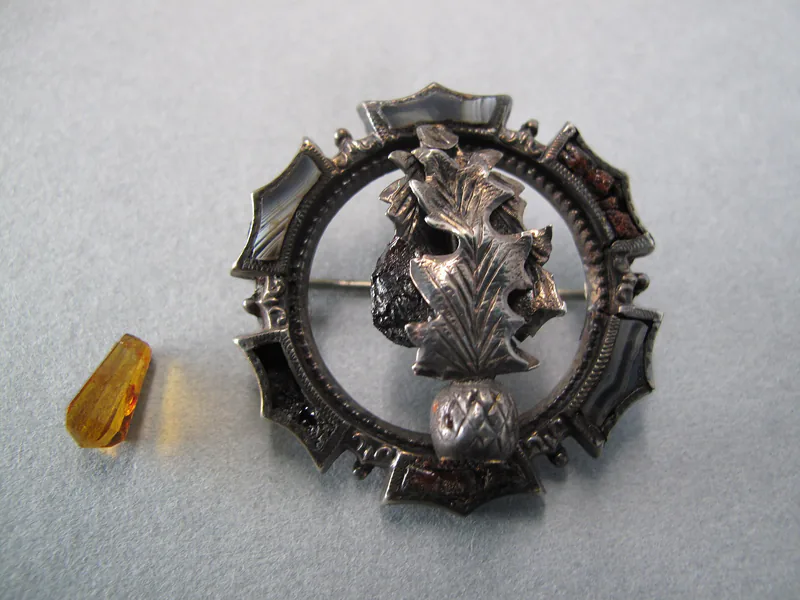
In Scotland it is the cairngorm, named after the Cairngorm mountains, where it was once found in the granite. Highland jewellers set it in brooches, kilt pins and the hilts of the sgian-dubh, and the Victorian romance of the Highlands, encouraged by Queen Victoria's love of Balmoral, made cairngorm jewellery fashionable across Britain; most stones sold as cairngorms since the nineteenth century have in fact come from Brazil. In the Swiss Alps the crystal hunters called Strahler have searched clefts in the granite for centuries, and a celebrated find at the Tiefen Glacier in 1868 yielded great dark crystals of smoky quartz, many now in the Natural History Museum in Bern.
The black variety is called morion, a name usually traced to a misreading of a dark stone that Pliny calls mormorion. A story often repeated in gem books says that judges in medieval China wore spectacles of smoky quartz to hide their expressions in court; it is plausible but poorly documented and should be treated with caution.
In the traditions
Smoky quartz cannot be securely identified among the stones of the High Priest's breastplate or the foundations of Revelation, and it is not one of the Navaratna. In classical and medieval lapidaries quartz appears mainly as crystallus, clear rock crystal, which ancient writers thought was ice hardened beyond melting; the smoky variety earned little separate comment. In Scotland the cairngorm became a national stone, worn with Highland dress as an emblem of place and clan, and some later writers describe it as a luck-bringing ornament for travellers and soldiers, though such folk beliefs are thinly recorded. Its spiritual meanings today come mainly from the modern crystal movement (see crystals, auras and energy).
Meaning and symbolism
Modern crystal writers treat smoky quartz as a grounding and protective stone that turns heavy emotions into calm, linking it with the root chakra and with steadiness in difficult times; its dark transparency suggests clarity within shadow. It is a popular stone for meditation and for carrying through stressful periods (see protective magic). These meanings are symbolic; scientific studies have not found that quartz crystals alter mood or health beyond the effect of expectation.
The mineral
Smoky quartz forms in granites, granite pegmatites and Alpine-type clefts. Sources include Brazil, Madagascar, Switzerland, Scotland, the Ural Mountains, Colorado and New Hampshire, which has adopted it as its state gem. At 7 on the Mohs scale it is durable and easy to wear.
A great deal of smoky quartz on the market is clear quartz darkened artificially by irradiation, which is safe but can produce an unnaturally even, very dark colour. Heating has the opposite effect, turning smoky quartz yellowish or colourless, and some heated material is sold as citrine. Brown glass is the common imitation, and the trade name "smoky topaz" is misleading, since the stone is not topaz. Prolonged strong sunlight can lighten it. Clean it with warm soapy water.
Sources and further reading
- Natural History, Book 37 — Pliny the Elder, c. 77 CE
- The Curious Lore of Precious Stones — George Frederick Kunz, 1913
- Gemstones of the World — Walter Schumann, 1977
- Gems: Their Sources, Descriptions and Identification — Robert Webster, 1962