Birth lore · Your birthday
Labradorite
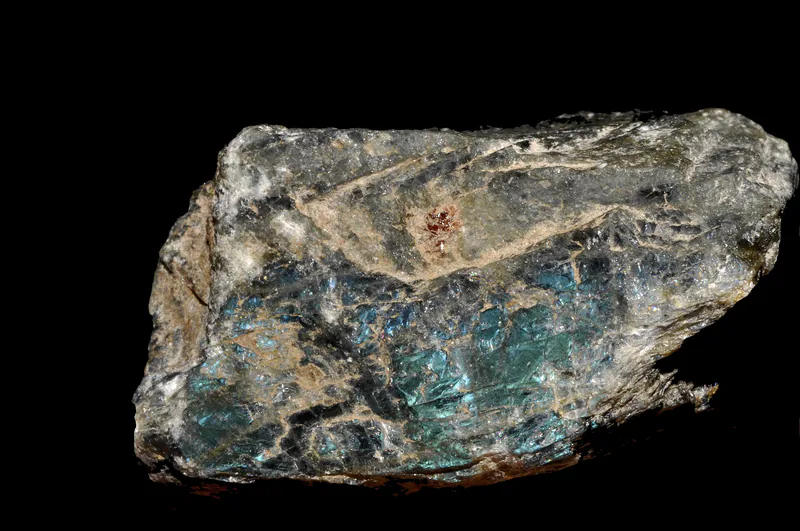
Labradorite is a grey feldspar that flashes blue, green and gold; discovered on the Labrador coast around 1770, it owes its spiritual reputation entirely to the modern crystal movement.
History and lore
Labradorite is a young stone in the history of gem lore. It takes its name from the Labrador coast of Canada, where Moravian missionaries working among the Inuit near Nain came upon it around 1770. Specimens reached Europe in the following years and caused a stir: a dull grey rock that, turned in the light, flashes peacock blue, green, gold and sometimes orange. It enjoyed a period of fashion for small ornaments and inlays in the late eighteenth and nineteenth centuries before settling into a quieter place among ornamental stones.
A story now widely told says that an Inuit warrior once struck the rock with his spear and freed the northern lights, leaving some of their colours trapped in the stone. The tale is attractive, but it is known mainly from modern gem and crystal writing and does not appear in early ethnographic records, so it is best treated as modern lore rather than an ancient Inuit legend.
In the 1940s, workers digging defensive works in south-eastern Finland found an exceptionally vivid labradorite near Ylämaa; marketed as spectrolite, it remains the benchmark for full-spectrum colour.
In the traditions
Because it entered European knowledge only in the eighteenth century, labradorite has no place in the High Priest's breastplate of Exodus 28, the foundations of the New Jerusalem in Revelation 21, the medieval lapidaries of Marbode of Rennes or Albertus Magnus, or Agrippa's tables of planetary stones. Nor is it part of the Indian Navaratna or classical Chinese gem lore. Its spiritual reputation is a creation of the late twentieth-century crystal movement (see crystals, auras and energy), which grew out of earlier Theosophical and New Age ideas about colour, light and subtle energy (see the New Age).
Meaning and symbolism
Modern crystal writers call labradorite a "stone of magic" or "stone of transformation". The image behind this is easy to read: a plain grey surface that hides a sudden blaze of colour, like an inner life or a hidden gift revealed only at the right angle. It is described as protecting the aura, sharpening intuition and steadying a person through change, and it is often recommended to those beginning meditation or esoteric study. Some writers link it with the third-eye and throat chakras, a correspondence that belongs to the modern Western chakra system rather than to the Hindu tantric texts in which the chakras originate (see the history of the chakras). These are symbolic meanings; scientific studies have not found that crystals affect health or energy.
The mineral
Labradorite is a calcium-rich plagioclase feldspar formed in igneous rocks such as anorthosite, gabbro and basalt. Its play of colour, called labradorescence, is not pigment. As the crystal cooled slowly over geological time, it separated into extremely thin alternating layers of slightly different composition, and light reflected from these layers interferes as it does in a soap film, producing a strong colour that changes with the angle of view. The effect shows best in one direction, so cutters must orient each piece carefully.
Important sources include Labrador and Newfoundland, Finland, Madagascar, Norway, Russia and India; Oregon yields a transparent golden labradorite with copper flecks, sold as sunstone. Labradorite is 6 to 6.5 on the Mohs scale and has two good cleavages, so it can chip or split if knocked. Coated glass imitations exist, but natural labradorite flashes only at particular angles and often contains dark needle-like inclusions. Clean it with warm soapy water, and avoid ultrasonic cleaners and sudden heat.
Sources and further reading
- Gemstones of the World — Walter Schumann, 1977
- Gems: Their Sources, Descriptions and Identification — Robert Webster, 1962
- Feldspar Minerals — Joseph V. Smith and William L. Brown, 1988
- The Curious Lore of Precious Stones — George Frederick Kunz, 1913