Birth lore · Your birthday
Obsidian
Obsidian is natural volcanic glass: the blade and mirror of the ancient world, sacred to the Aztec god Tezcatlipoca, and the material of the mirror associated with John Dee.
History and lore
Obsidian is natural glass, formed when silica-rich lava cools so quickly that crystals have no time to grow. Its curved, shell-like fracture produces edges sharper than steel, and for most of human history it was a material for blades long before it was an ornament. Obsidian from Anatolian volcanoes and from the Aegean island of Melos was traded across the Neolithic Near East and Mediterranean, and at Çatalhöyük in central Anatolia people ground and polished it, around 6000 BCE, into some of the oldest known mirrors.
The name comes from Pliny the Elder, who describes a glassy black stone found in Ethiopia by a man named Obsius. Later copyists turned obsianus into obsidianus, so the modern word preserves a scribal slip.
In the traditions
No culture gave obsidian a deeper religious role than those of ancient Mesoamerica. The great city of Teotihuacan controlled the green-gold obsidian of the Pachuca region, and blades were made in enormous numbers across the region. For the Aztecs (Mexica), obsidian, itztli, was a sacred substance. Tezcatlipoca, the powerful and unpredictable lord of fate and sorcery, takes his name from the "smoking mirror" of polished obsidian, and he is often painted with a mirror in place of a foot; Itzpapalotl, "Obsidian Butterfly", was a fearsome goddess of the Chichimec past; and obsidian knives figure in the sacrificial rites described by Spanish chroniclers such as Bernardino de Sahagún. Polished mirrors were used by diviners to see what was hidden (see Mesoamerican religion).
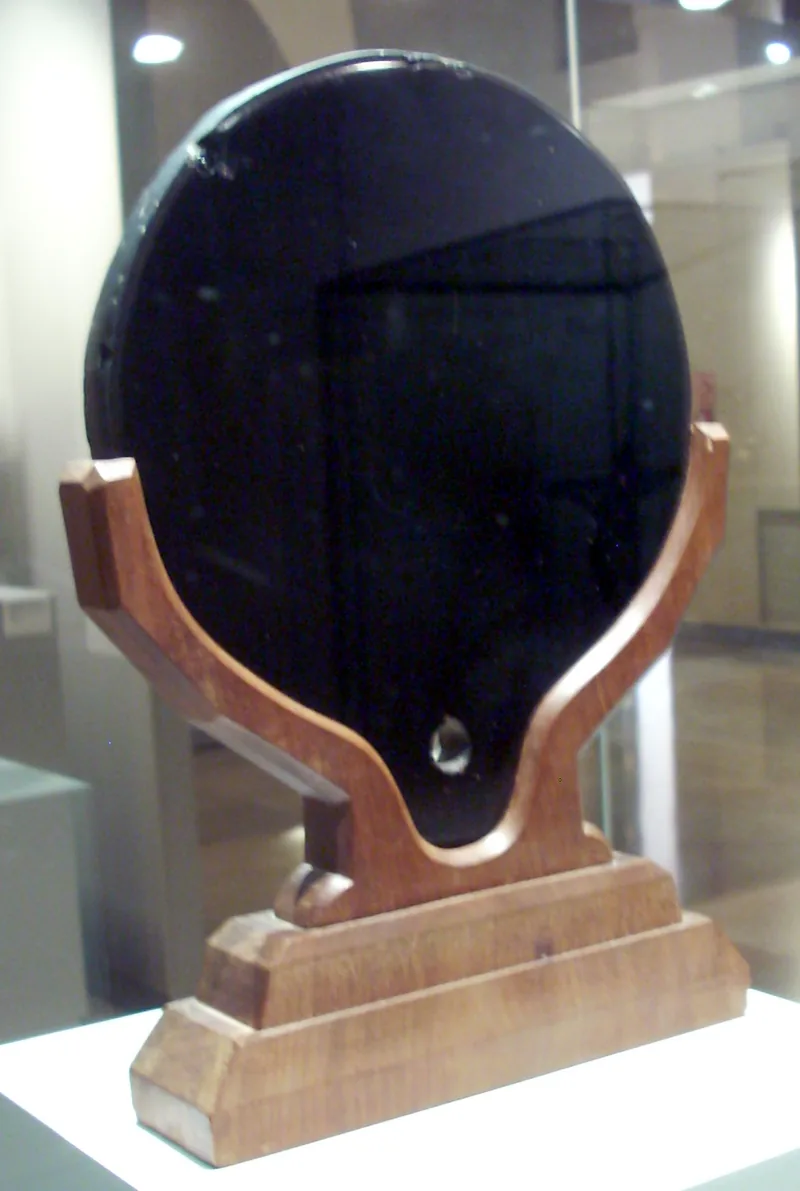
One such mirror crossed the Atlantic. The British Museum holds an Aztec obsidian mirror that, according to a note by Horace Walpole, who owned it in the eighteenth century, was once used by the Elizabethan magus John Dee. The attribution cannot be proven, but Dee and Edward Kelley certainly used "shew-stones" in their angelic conversations (see Enochian magic).
Obsidian has no part in the biblical breastplate, receives little attention in the medieval lapidaries and is not one of the Navaratna. "Apache tears", small rounded nodules from the American Southwest, are linked with a legend of grieving women whose tears turned to stone; the story appears to be a twentieth-century one.
Meaning and symbolism
Through the mirror, obsidian has become a stone of seeing, especially of seeing into darkness. Modern scryers use black mirrors in the footsteps of the Aztec diviners and Dee, and modern crystal books call obsidian protective and grounding, a stone for facing hard truths, sometimes described as "shadow work". These are symbolic and ritual uses; scientific research has not found that obsidian or other crystals have healing or protective powers.
The mineral
Obsidian is about 5 to 5.5 on the Mohs scale and breaks into razor-sharp edges, so rough pieces should be handled with care. Most is black, coloured by tiny magnetite crystals; oxidised iron gives red-brown "mahogany" obsidian, white clusters of cristobalite give "snowflake" obsidian, and aligned bubbles or microscopic crystals produce gold, silver or rainbow sheen. Major sources include Mexico, the western United States, Armenia, Turkey, Iceland and the Lipari islands of Italy.
Bright blue, green or purple "obsidian" sold in shops is almost always man-made glass. Natural obsidian usually shows flow banding, specks or sheen and is rarely perfectly clear. Because it is glass, it scratches and chips more easily than quartz; clean it with water and a soft cloth and store it separately.
Sources and further reading
- Natural History, Book 36 — Pliny the Elder, c. 77 CE
- General History of the Things of New Spain (Florentine Codex) — Bernardino de Sahagún, c. 1577
- The Aztecs — Richard F. Townsend, 1992
- John Dee's Conversations with Angels — Deborah E. Harkness, 1999