Birth lore · Your birthday
Gemstones · Birthstone of October
Opal
The gem that shows every colour at once, praised by Pliny, feared as unlucky after a novel of Walter Scott, and transformed by the Australian opal fields; October's birthstone.
History and lore
Opal's name comes from the Latin opalus, possibly borrowed from the Sanskrit upala, "stone", though the link is uncertain. Pliny the Elder gave it one of his most admired descriptions: in the opal, he says, are the fire of the carbuncle, the purple of the amethyst and the sea green of the emerald, all shining together. He also tells of the senator Nonius, who chose exile rather than surrender his opal to Mark Antony. Pliny says opals came from India, but most ancient and medieval European opal probably came from deposits in what is now eastern Slovakia, long called "Hungarian opal".
Medieval writers sometimes called opal ophthalmios, the "eye stone", believing it sharpened sight, and a later belief claimed it could make its wearer invisible. Its reputation for bad luck is largely modern. Walter Scott's novel Anne of Geierstein (1829) features an enchanted opal whose fire dies when touched by holy water, and many historians of jewellery think the book encouraged a nineteenth-century superstition against the stone. Queen Victoria, who liked opals and gave them as gifts, helped to restore its fashion. The great change came from Australia: precious opal was found there in the mid-nineteenth century, black opal at Lightning Ridge in the early twentieth century, and the Coober Pedy field from 1915. Australia adopted opal as its national gemstone in 1993.
In the traditions
Opal does not appear in the Bible's lists, the Navaratna or the main medieval planetary tables, although some medieval lapidaries describe it. In modern Vedic practice white opal is often offered as a less costly substitute for diamond, the stone of Venus, which is the source of its common modern planetary link (see diamond). Some Aboriginal Australian stories about the creation of opal are told today, but they are the cultural property of particular communities and are often retold loosely in gem literature.
Meaning and symbolism
Opal is the October birthstone in both the old and modern lists, now shared with tourmaline (see October). It symbolises hope, creativity, imagination and changeability. Its unlucky reputation persists in folklore, but it is a superstition with a mostly literary origin, and there is no evidence that opal, or any gem, affects luck or health.
The mineral
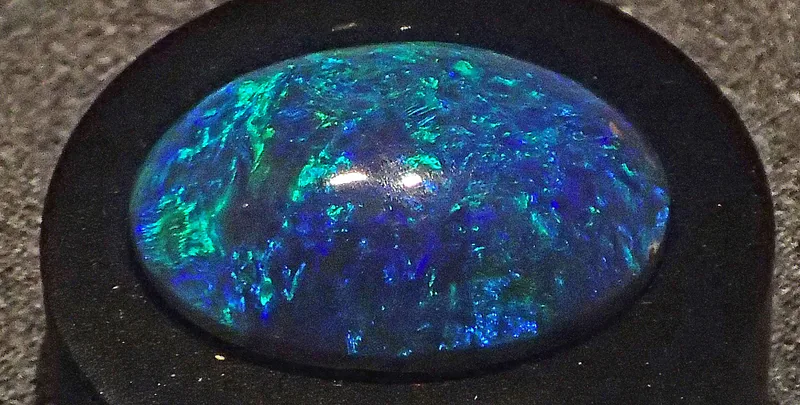
Opal is silica containing water, usually around 3 to 10 per cent, with no crystal structure. In precious opal, tiny silica spheres are stacked in regular arrays that diffract light into flashes of spectral colour, called play-of-colour; this structure was revealed by electron microscopy in the 1960s. Common opal lacks the ordered spheres. The main types are white or light opal, black opal (with a dark body), boulder opal (in ironstone), Mexican fire opal (transparent orange) and the hydrophane opal of Ethiopia, found in quantity from 2008.
Opal is soft (5.5 to 6.5) and can craze or crack if it dries out or meets sudden temperature changes; Ethiopian opal may absorb water and change appearance temporarily. Thin slices are often backed as doublets or capped with quartz as triplets, and laboratory-made opal has been sold since the 1970s. Store opal away from heat and harder gems, and clean only with a soft damp cloth.
Sources and further reading
- Natural History, Book 37 — Pliny the Elder, c. 77 CE
- Anne of Geierstein — Walter Scott, 1829
- The Curious Lore of Precious Stones — George Frederick Kunz, 1913
- Gems: Their Sources, Descriptions and Identification — Robert Webster, 1962 (6th ed., ed. Michael O'Donoghue, 2006)
- Gemstones of the World — Walter Schumann, 1977 (later editions)