Birth lore · Your birthday
Gemstones · Birthstone of April
Diamond
The hardest natural substance, mined only in India for some two thousand years, the 'unconquerable' adamas of the Greeks, the vajra of Buddhist and Hindu thought and the Navaratna stone of Venus; April's birthstone.
History and lore
For most of recorded history diamonds came only from India, from alluvial gravels along rivers such as the Krishna and from the region later known by the trading town of Golconda. The Sanskrit treatise on statecraft attributed to Kautilya, the Arthashastra (dated variously between about the third century BCE and the early centuries CE), already grades diamonds by source, colour and shape. The Greek word adamas, "unconquerable", first named hard metal before it settled on the diamond. Pliny the Elder, who calls the adamas the most valuable of all things, repeats the belief that it could be softened only by fresh, warm goat's blood.
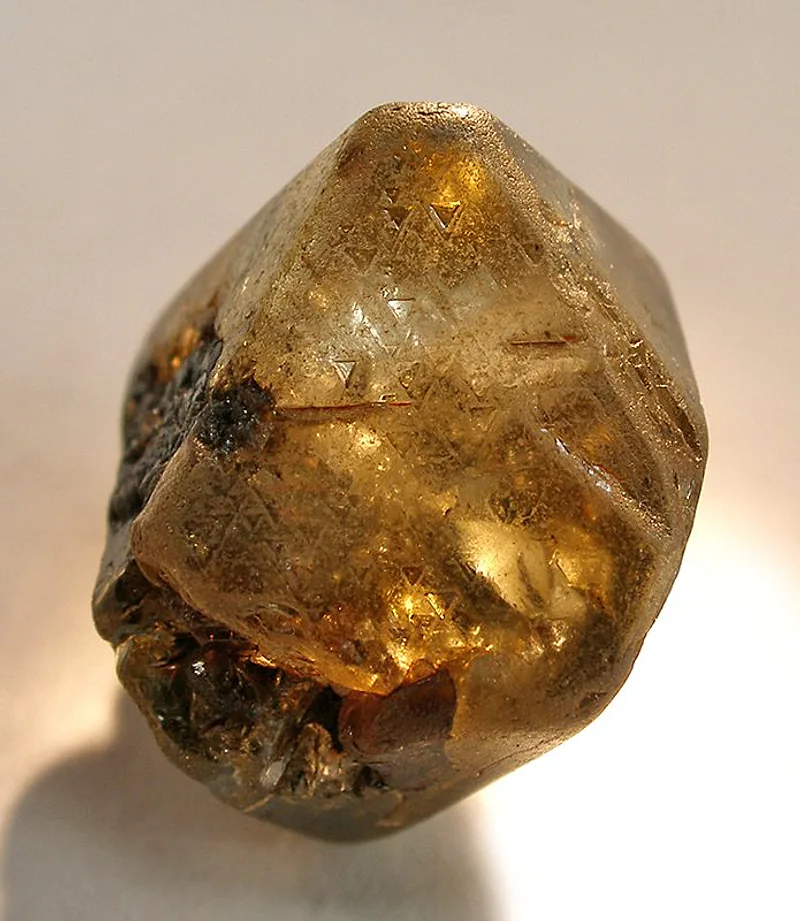
Diamonds remained largely uncut until the late Middle Ages, prized for their hardness and natural octahedral form more than their sparkle. Cutting with diamond powder developed in Venice, Bruges and Antwerp in the fourteenth and fifteenth centuries. The betrothal ring that Archduke Maximilian of Austria gave Mary of Burgundy in 1477 is usually cited as an early diamond engagement ring. Brazil overtook India in the 1720s, and the finds at Kimberley in South Africa from 1867 changed the trade completely. The idea that a diamond is the necessary engagement stone owes much to twentieth-century advertising, especially the De Beers slogan "A Diamond Is Forever" of 1947. Famous stones such as the Koh-i-Noor, which passed through Mughal, Persian, Afghan and Sikh hands before reaching the British crown in 1849, carry long and often violent histories.
In the traditions
In the King James Version the third stone of the second row of the breastplate (Exodus 28:18) is a "diamond", translating the Hebrew yahalom; this is almost certainly wrong, since diamond could not be engraved with the names of the tribes using the tools of the period, and the true stone is unknown.
In Indian astrology the diamond (hira or vajra) is the Navaratna stone of Venus, Shukra (see Vedic astrology). The Brihat Samhita of Varahamihira (sixth century) devotes a section to judging diamonds. In Buddhist thought vajra means both thunderbolt and diamond, the indestructible clarity of awakened mind that gives the Vajrayana its name. Medieval European lapidaries held that diamond guarded against poison, fear and madness, and Agrippa listed it among the stones of Mars.
Meaning and symbolism
Diamond is the April birthstone in both traditional and modern lists (see April), and the stone of the sixtieth and seventy-fifth wedding anniversaries. Its symbolism of invincibility, constancy and purity follows from its hardness and clarity. These are cultural meanings; there is no evidence that diamonds affect health or fortune.
The mineral
Diamond is pure carbon crystallised under great pressure about 150 to 200 kilometres below the surface, often more than a billion years ago, and brought up by rare volcanic pipes of kimberlite or lamproite. It is the hardest natural material (10 on the Mohs scale) but can still cleave along certain planes when struck. Major modern producers include Russia, Botswana, Canada, the Democratic Republic of the Congo and Australia; the Kimberley Process, launched in 2003, aims to keep conflict diamonds out of trade.
Laboratory-grown diamonds, first made reliably in 1954 and now produced in large numbers, are real diamond and need specialist instruments to detect. Simulants are different materials: cubic zirconia is heavier and less bright; moissanite shows doubled facet edges and can fool a simple thermal tester. Clean diamonds with warm soapy water; they attract grease, which dulls their fire.
Sources and further reading
- Natural History, Book 37 — Pliny the Elder, c. 77 CE
- The Arthashastra — attributed to Kautilya, trans. R. P. Kangle, 1960–65
- Brihat Samhita — Varahamihira, 6th century
- The Curious Lore of Precious Stones — George Frederick Kunz, 1913
- Koh-i-Noor: The History of the World's Most Infamous Diamond — William Dalrymple and Anita Anand, 2017
- Diamond: A Journey to the Heart of an Obsession — Matthew Hart, 2001