Birth lore · Your birthday
Gemstones · Birthstone of October
Tourmaline
A family of boron-bearing silicates that grows in almost every colour, tourmaline was sold for centuries as ruby, emerald or sapphire before mineralogists recognised it; it is a modern October birthstone.
History and lore
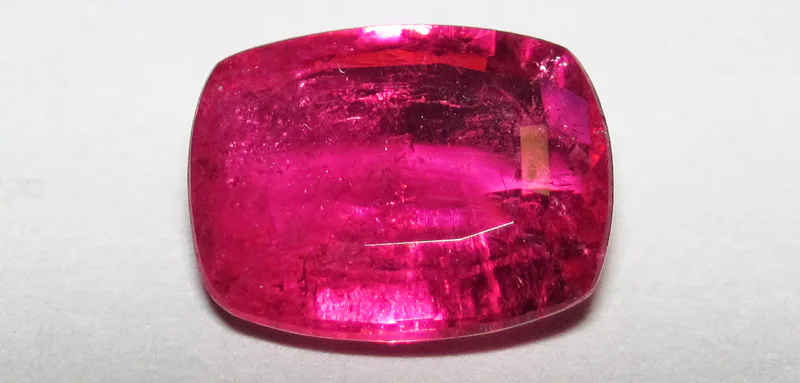
Tourmaline is a late arrival in the Western gem cabinet, not because it is rare but because it was so seldom recognised. For centuries its red crystals passed as rubies, its green ones as emeralds, and its many intermediate shades under whatever name a merchant found convenient. The word reached Europe through Dutch traders working from Ceylon (Sri Lanka) from the seventeenth century, and is usually traced to the Sinhalese turmali or thoramalli, a term applied to assorted coloured stones from the island's gem gravels.
The Dutch noticed a curious property. A crystal warmed in the sun or by the hearth first attracted and then repelled light ash, and in the Netherlands the stone was nicknamed aschentrekker, "ash-puller", reportedly used to clear the bowls of tobacco pipes. Eighteenth-century natural philosophers, then absorbed by the new science of electricity, studied this behaviour closely; the German physicist Franz Aepinus wrote on it in the 1750s and 1760s. The effect is now called pyroelectricity.
With modern mineralogy came famous re-identifications. A red pendant in the Russian imperial treasury, long known as "Caesar's Ruby" and by tradition a gift to Catherine the Great, is now generally identified as red tourmaline (rubellite). At the end of the nineteenth century pink tourmaline from San Diego County, California, found an eager market in China, where the Empress Dowager Cixi was among its best-known admirers; much of that Californian production was carved into snuff bottles and ornaments, and the trade collapsed after her death in 1908 and the fall of the Qing dynasty.
In the traditions
Because tourmaline was not distinguished as a species until the eighteenth century, it has no named place in the classical lapidaries, in the High Priest's breastplate of Exodus 28, in the twelve foundations of Revelation 21, or in the planetary stones of Agrippa's Three Books of Occult Philosophy. Some red or green stones described in older texts may physically have been tourmaline, but the texts themselves cannot tell us.
Its standing as a birthstone is modern. The 1912 list of the American National Association of Jewelers gave tourmaline as an alternative to opal for October, and it has remained there; its usual link with Libra and Scorpio follows simply from that date. Twentieth-century crystal literature then built an elaborate symbolism on the stone's colours: black tourmaline (schorl) is widely described today as "protective" or "grounding", pink as a stone of affection. These ideas have no ancient pedigree, and scientific studies have not found that crystals heal or shield their wearers.
Meaning and symbolism
What tourmaline has stood for, historically, is variety and hidden identity. The Victorian critic John Ruskin famously remarked that its chemistry looked more like a medieval physician's prescription than the recipe for a respectable mineral. Bi-coloured "watermelon" crystals, pink at the core and green at the rim, record changes in the fluids that fed the growing crystal, and collectors read them as an image of change within continuity. Modern birthday lore gives the October stone to people described as sensitive and many-sided, a reading that follows the gem's own range of colour.
The mineral
Tourmaline is not one mineral but a group of more than thirty related borosilicates. Most gem material is elbaite, the lithium-rich member that supplies pinks, reds, greens and blues; dravite is brown, and schorl, the commonest member, is black. Crystals grow as long prisms with a rounded triangular cross-section and striated sides, chiefly in granite pegmatites. Important sources include Brazil (especially Minas Gerais), Afghanistan, Pakistan, Nigeria, Mozambique, Madagascar, Namibia, Sri Lanka and the United States (California and Maine). Vivid copper-bearing "Paraíba" tourmaline, found in the Brazilian state of that name in the late 1980s, has since also come from Nigeria and Mozambique.
Tourmaline has a hardness of 7–7.5 and strong pleochroism: a crystal usually looks darker along its length than across it, which cutters exploit. It is doubly refractive, which helps separate it from glass, and a gemmologist's refractometer readings (about 1.62–1.64) distinguish it from most look-alikes. Pinks are sometimes irradiated or heated, and fractured stones may be filled. Clean it with warm soapy water; avoid ultrasonic cleaners for included or filled stones and protect it from sudden heat.
Sources and further reading
- Natural History, Book 37 — Pliny the Elder, c. 77 CE
- The Curious Lore of Precious Stones — George Frederick Kunz, 1913
- Gems and Precious Stones of North America — George Frederick Kunz, 1890
- Gems: Their Sources, Descriptions and Identification (6th ed.) — Michael O'Donoghue (ed.), 2006
- Gemstones of the World — Walter Schumann, 1977