Birth lore · Your birthday
Rose Quartz
Rose quartz is the soft pink form of quartz, carved in Qing China and made the world's best-known 'love stone' by the twentieth-century crystal movement.
History and lore
Rose quartz is the pale to medium pink form of quartz, usually found not as pointed crystals but in massive, milky veins in granite pegmatites. Because it is plentiful and rarely transparent, it has had a modest place in the history of gems: polished beads and small carvings appear in several cultures, but it was never one of the classical precious stones. Its great fame is recent, the product of the twentieth-century crystal movement, which made it the best-known "love stone" in the world.
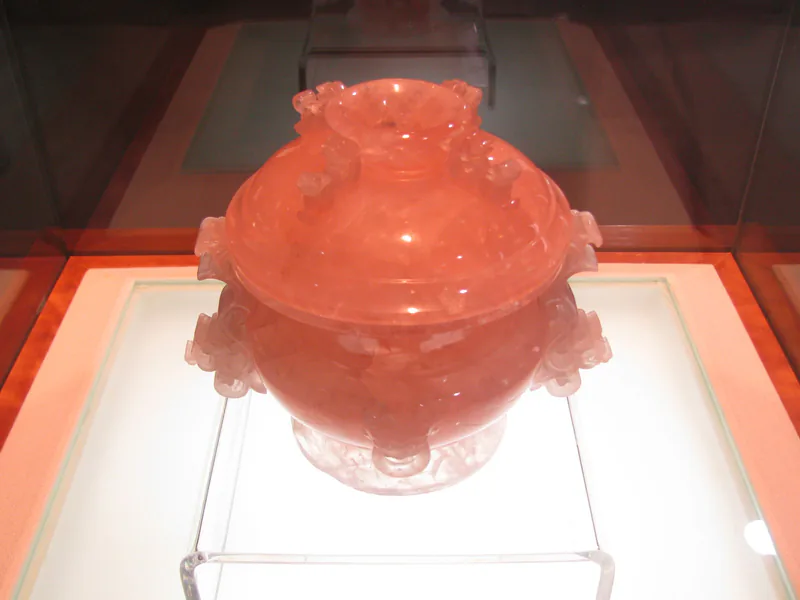
Its most notable historical use was in China. Carvers of the Qing dynasty, especially in the eighteenth and nineteenth centuries, worked rose quartz into snuff bottles, vases, incense vessels, ornamental flowers and figures of Guanyin and other deities. European lapidaries also used it for small decorative objects.
Online articles often claim that rose quartz was used in ancient Egyptian face masks, or that a Greek myth tells how it was coloured by the blood of Adonis and Aphrodite. No ancient source supports these stories; they are modern inventions that circulate as if they were old lore.
In the traditions
Rose quartz does not appear, under any identifiable name, among the stones of the High Priest's breastplate in Exodus 28 or the foundations of the New Jerusalem in Revelation 21, and it is not one of the Navaratna. Classical and medieval lapidaries treated quartz chiefly as crystallus, clear rock crystal, which Pliny and others believed to be ice frozen too hard to melt; pink varieties were not singled out.
The planetary and emotional meanings attached to rose quartz today come from modern correspondence systems. Its colour and its role as a stone of love place it under Venus, and modern crystal books accordingly pair it with Taurus and Libra, the signs Venus rules. It is also linked with the heart chakra (anāhata), whose colour in the modern Western scheme is green or pink, a scheme that is itself a twentieth-century development (see the history of the chakras).
Meaning and symbolism
In contemporary practice rose quartz is the stone of unconditional love, self-love, reconciliation and comfort in grief. It is given to new parents, placed beside beds, used in love charms and carried by people recovering from heartbreak. Its soft colour and cloudy translucency make it an easy symbol of tenderness. Within the logic of crystal practice it is said to calm and open the heart; outside that logic, scientific studies have not found that crystals affect emotions or health beyond the effect of expectation. Its real gift may be that of any cherished object: a reminder of an intention (see crystals, auras and energy).
The mineral
Rose quartz is silicon dioxide, 7 on the Mohs scale. Research published around 2000 showed that the colour of most massive rose quartz comes from microscopic fibres of a pink borosilicate mineral related to dumortierite, not from dissolved titanium or manganese as had long been assumed. The fibres also scatter light, which causes the typical haziness, and under a strong point light some polished spheres and cabochons show a six-rayed star. Rare transparent pink crystals, found mainly in Brazil, owe their colour to a different, radiation-related cause.
The main sources are Brazil, Madagascar, India, Mozambique, Namibia and South Dakota. Imitations include pink glass, which often shows bubbles and a too-even colour, and dyed quartz, in which colour gathers along cracks. Some rose quartz fades in strong sunlight, so display it away from bright windows. Clean it with warm soapy water.
Sources and further reading
- Fibrous nanoinclusions in massive rose quartz: the origin of rose coloration — Julia S. Goreva, Chi Ma and George R. Rossman, 2001
- Gemstones of the World — Walter Schumann, 1977
- Gems: Their Sources, Descriptions and Identification — Robert Webster, 1962
- Natural History, Book 37 — Pliny the Elder, c. 77 CE