Birth lore · Your birthday
Gemstones · Birthstone of December
Tanzanite
Tanzanite is a blue-violet zoisite found in a single small area of northern Tanzania, discovered in 1967 and added as a December birthstone in 2002; it has no premodern lore at all.
History and lore
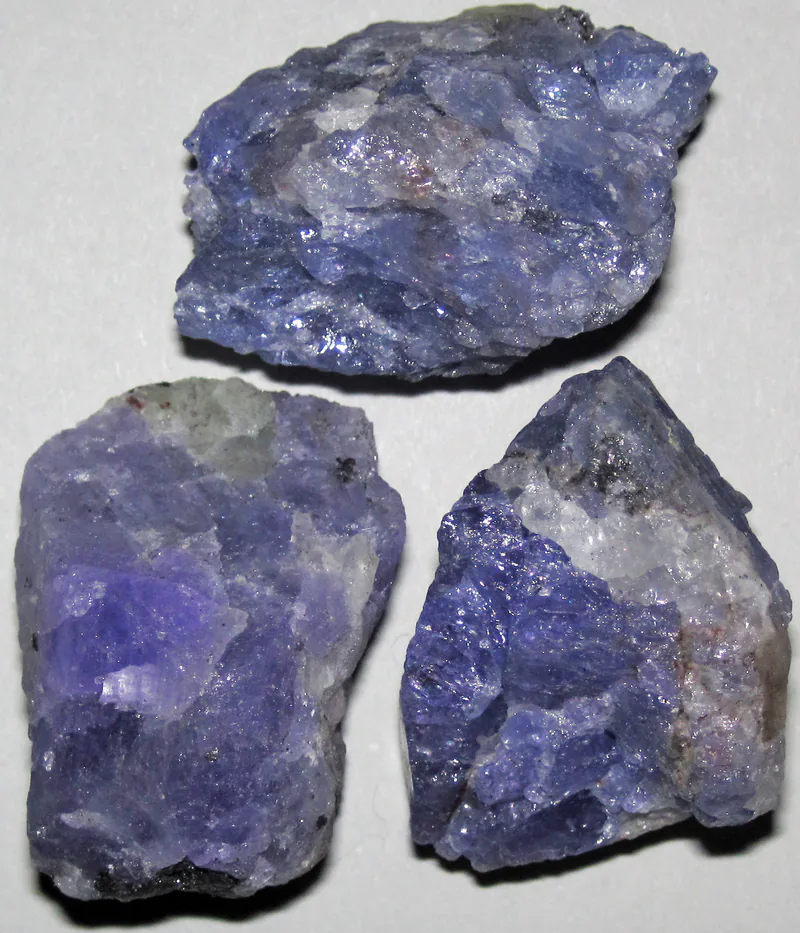
Tanzanite is the youngest gem in this collection. Transparent blue-violet crystals of the mineral zoisite were identified in 1967 in the Merelani Hills, in the Manyara region of northern Tanzania, in sight of Mount Kilimanjaro. Accounts of the discovery differ: the Goan tailor and prospector Manuel de Souza is often credited with recognising and registering the find, while other accounts give a role to local Maasai herders who knew of the bright crystals. In 1968 the New York jeweller Tiffany & Co. began to market the stone under the new name "tanzanite", reportedly because "blue zoisite" sounded too much like "suicide" and because the name advertised its single source.
A story often told in the trade says that brown crystals lying on the surface were turned blue when lightning set the dry grass alight. Heat does turn much rough tanzanite blue, so the story is plausible in principle, but its origin is hard to trace and it may be no older than the stone's marketing. The deposit itself is tiny, a strip of land only a few kilometres long, divided into mining blocks worked both by a large company and by thousands of small-scale miners. In 2018 the Tanzanian government enclosed the area with a perimeter wall to control smuggling.
In the traditions
Because it was unknown before 1967, tanzanite has no place in any traditional source: it does not appear in the High Priest's breastplate of Exodus 28, the foundations of Revelation 21, the medieval lapidaries, Agrippa's planetary stones or the Vedic Navaratna, and it has no classical planet. Anything said of it in those terms is a modern attribution. Its standing as a birthstone also dates from our own time. In 2002 the American Gem Trade Association added tanzanite as a December stone beside turquoise and zircon, the first change to the American list since 1952; its usual link with Sagittarius and Capricorn follows from that date.
Late twentieth-century crystal-healing literature quickly gave tanzanite meanings of its own, often connecting it with intuition and with the throat or "third eye" chakras. Those colour-to-chakra correspondences are themselves a modern Western development (see the history of the chakras), and scientific studies have not found that crystals heal or awaken anything. Advertising has sometimes attributed Maasai customs to the stone; such claims are difficult to trace to Maasai sources and are best treated with caution.
Meaning and symbolism
What tanzanite genuinely symbolises is rarity and a sense of place: every natural stone comes from one hillside in one country. Its shifting blue, violet and burgundy tones have made it, in modern jewellery language, an emblem of twilight and changing perspective. Some modern trade lists also assign it to the twenty-fourth wedding anniversary, and it is a popular gift for the birth of a child.
The mineral
Zoisite is a calcium aluminium silicate of the epidote group. The Merelani deposit formed in metamorphic rocks altered by heat and pressure during the mountain-building events that shaped East Africa several hundred million years ago; traces of vanadium supply the colour. Tanzanite is strongly trichroic, showing blue, violet and, in unheated stones, a brownish or bronze third colour in different directions. Most rough is gently heated, which removes the brownish component and leaves the familiar blue-violet; this treatment is standard, stable and undetectable.
With a hardness of 6–6.5 and perfect cleavage in one direction, tanzanite is more fragile than sapphire and needs protective settings, especially in rings. Imitations include synthetic forsterite, which shows strong doubling of facet edges, glass, and coated stones. Clean tanzanite only with warm soapy water; never use ultrasonic or steam cleaners, and avoid sudden changes of temperature.
Sources and further reading
- Gems: Their Sources, Descriptions and Identification (6th ed.) — Michael O'Donoghue (ed.), 2006
- Gemstones of the World — Walter Schumann, 1977