Birth lore · Your birthday
Gemstones · Birthstone of February
Amethyst
The violet quartz of February, named by the Greeks as the stone 'not drunk', set in the High Priest's breastplate and the foundations of the New Jerusalem, and long associated with the rings of bishops.
History and lore
The Greek amethystos means "not intoxicated", and from antiquity the stone was linked with sobriety. Pliny the Elder records the belief, credited to the Persian magi, that amethyst kept its wearer from drunkenness, and he treats it with his usual scepticism about the magi. A popular story tells of a nymph named Amethyste turned to white stone by Diana to escape Bacchus, who then stained the stone purple with wine. This tale is not ancient: it comes from the French poet Rémy Belleau, who published it in 1576 in a cycle of poems about precious stones.
Amethyst was cut in Egypt and the Near East long before the Greeks named it, and it was popular for Roman intaglios and early medieval jewellery. Until the nineteenth century it was costly, ranked with ruby and sapphire among the precious stones. The discovery of large deposits in Brazil and Uruguay brought the price down, and amethyst became the most widely worn of coloured gems.
In the traditions
In Exodus 28:19 the ninth stone of the High Priest's breastplate, the Hebrew achlamah, is translated "amethyst" in the King James Version, following the Greek Septuagint. As with most breastplate stones the identification is a translation tradition rather than a certainty; the Hebrew word may be related to a root meaning "dream", and later Jewish lore linked the stone with dreaming. Revelation 21:20 names amethyst as the twelfth foundation stone of the heavenly Jerusalem.
Medieval Christian writers made amethyst a stone of humility and spiritual sobriety, and it is often said to have been favoured for the rings of bishops, giving it the name "bishop's stone". Marbode of Rennes included it in his eleventh-century verse lapidary. Agrippa, in his Three Books of Occult Philosophy (1533), appears to place amethyst among the stones of Mars, while modern correspondence tables usually give it to Saturn or Jupiter; some present-day Vedic astrologers offer it as a lower-priced substitute for blue sapphire, the stone of Saturn (see sapphire). See also Agrippa's three books.
Meaning and symbolism
Amethyst is the February birthstone in both the traditional and the modern American lists (see February). Its symbolism of sobriety, calm and clear judgement descends directly from its Greek name. In modern crystal practice it is among the most popular stones for meditation and sleep. These are traditional and modern associations; research has not shown that crystals have healing effects, and amethyst should never stand in for medical care.
The mineral
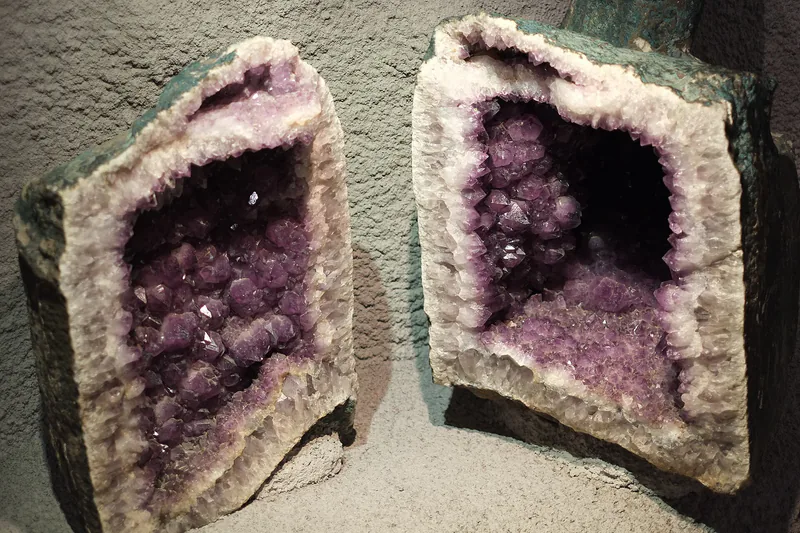
Amethyst is quartz coloured violet by traces of iron that have been altered by natural radiation in the rock. It grows as pointed crystals lining cavities, above all the great gas-bubble geodes in the basalt lavas of southern Brazil and northern Uruguay. Other important sources are Zambia, which yields deep, slightly bluish stones, Madagascar, Mexico and the Ural Mountains, whose fine dark "Siberian" amethyst gave its name to a colour grade.
Heating turns most amethyst yellow or orange, and much commercial citrine is heated amethyst. A natural mixture of the two colours in one crystal, ametrine, comes chiefly from Bolivia. Amethyst is often colour-zoned, with bands of deeper purple. Synthetic quartz grown by the hydrothermal method is widely used and can be hard to tell from natural stone without laboratory testing; violet glass is softer, warmer to the touch and often contains gas bubbles. At hardness 7, amethyst wears well, but strong sunlight can fade it over time, so store it in the dark.
Sources and further reading
- Natural History, Book 37 — Pliny the Elder, c. 77 CE
- The Curious Lore of Precious Stones — George Frederick Kunz, 1913
- Marbode of Rennes' De lapidibus — ed. John M. Riddle, 1977
- Three Books of Occult Philosophy — Heinrich Cornelius Agrippa, 1533
- Les Amours et nouveaux eschanges des pierres precieuses — Rémy Belleau, 1576
- Gemstones of the World — Walter Schumann, 1977 (later editions)