Birth lore · Your birthday
Gemstones · Birthstone of August
Sardonyx
Layered red and white chalcedony, the Roman seal-stone par excellence and the material of the greatest ancient cameos, the fifth foundation stone of the New Jerusalem and a birthstone of August.
History and lore
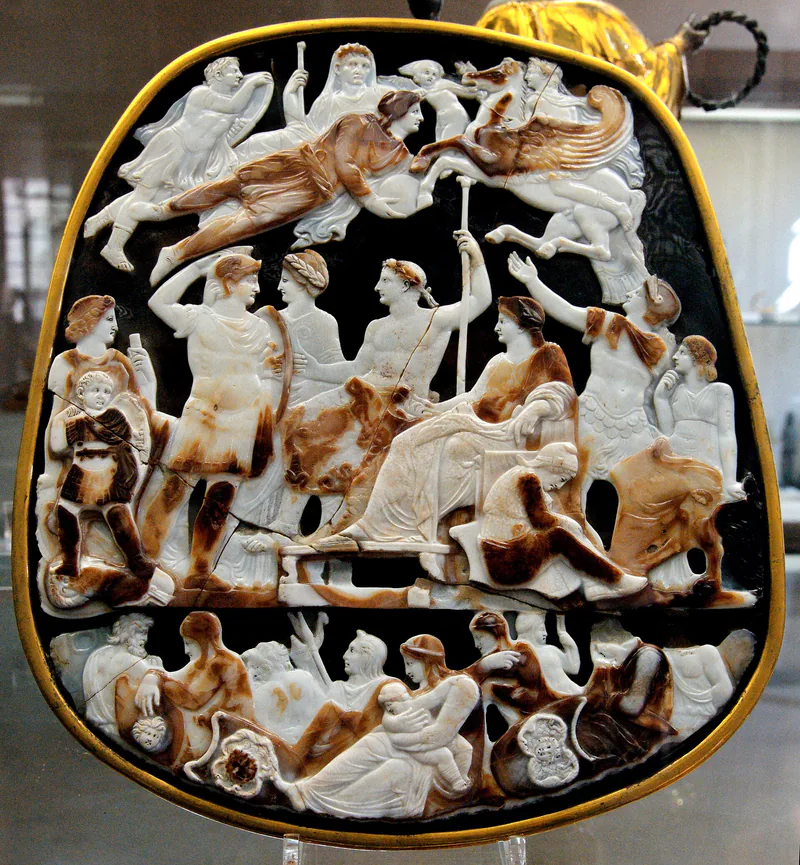
Sardonyx joins two names: sard, the brownish red chalcedony that ancient writers associated with Sardis in Lydia, and onyx, Greek for "fingernail", used for chalcedony banded in contrasting layers. Sardonyx is the variety in which red-brown and white bands alternate. Its value lay in those layers. A carver could cut a design in the white band and leave the dark layer as background, producing the cameo, or cut the design into the stone to make an intaglio seal.
Rome loved it. Pliny the Elder says that Scipio Africanus was the first Roman to wear a sardonyx, and that the stone was much in demand for signet rings because it did not pull away the sealing wax. He also reports that the famous ring of Polycrates of Samos, thrown into the sea and returned inside a fish, was a sardonyx, though Herodotus, the older source, calls it an emerald set in gold. The greatest surviving ancient cameos are carved from layered sardonyx or onyx, among them the Great Cameo of France, a five-layered sardonyx of the early first century CE now in the Bibliothèque nationale, and the Gemma Augustea in Vienna. The art was revived in Renaissance Italy and again in the eighteenth and nineteenth centuries.
In the traditions
Revelation 21:20 names sardonyx as the fifth foundation stone of the heavenly Jerusalem and sardius as the sixth. In the High Priest's breastplate, the King James "sardius" (Hebrew odem, "red") opens the first row (Exodus 28:17), and the Hebrew shoham, rendered "onyx", appears both in the fourth row and on the two shoulder stones engraved with the names of the tribes (Exodus 28:9). Ancient translators rendered shoham in several ways, so whether it was onyx, sardonyx, carnelian or another stone is debated.
Medieval lapidaries such as Marbode of Rennes describe sardonyx as a stone of humility, modesty and chastity, and Christian commentators read its layers allegorically. It has no clear place in Agrippa's planetary lists or in the Navaratna. For related stones see carnelian, onyx and agate.
Meaning and symbolism
Sardonyx is the August stone of the old "Gregorian" list and was kept in the American list of 1912 alongside peridot; spinel was added in 2016 (see August). It stands for steadfastness, honest speech, protection and happy marriage. These are traditional associations rather than proven effects.
The mineral
Sardonyx is chalcedony, quartz made of microscopic fibrous crystals, deposited layer by layer from silica-rich water in cavities of volcanic rock. Iron oxides give the sard layers their red and brown; pure chalcedony gives the white. India was the main ancient source; today most material comes from Brazil and Uruguay.
Because natural layers are often dull, much commercial sardonyx and onyx is agate that has been dyed, a practice known since Roman times; it is stable but should be disclosed. Plastic and glass imitations lack the fine, slightly irregular banding of natural stone. Sardonyx is tough and fairly hard (6.5 to 7) and needs only warm soapy water.
Sources and further reading
- Natural History, Book 37 — Pliny the Elder, c. 77 CE
- The Histories, Book 3 — Herodotus, c. 430 BCE
- Marbode of Rennes' De lapidibus — ed. John M. Riddle, 1977
- The Curious Lore of Precious Stones — George Frederick Kunz, 1913
- Gemstones of the World — Walter Schumann, 1977 (later editions)