Birth lore · Your birthday
Gemstones · Birthstone of August
Spinel
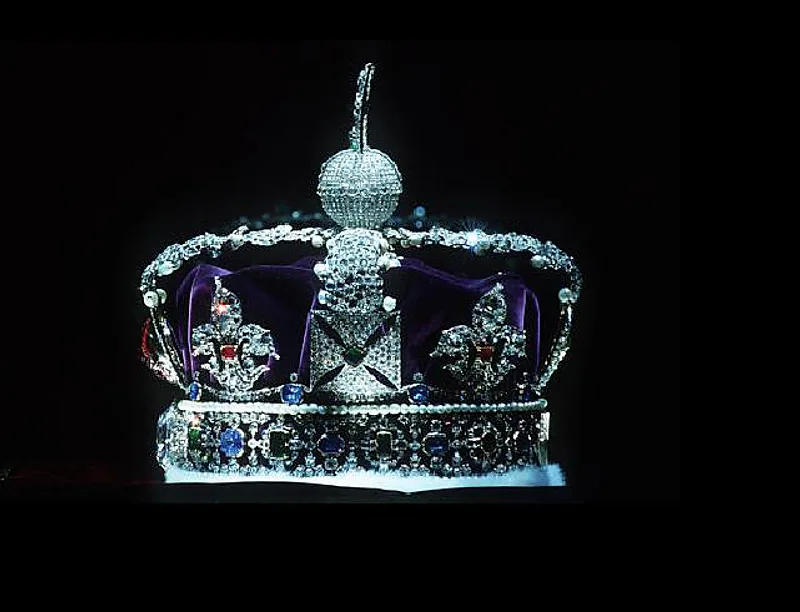
The great impostor of history: the red stone behind the Black Prince's Ruby, the Timur Ruby and Catherine the Great's crown, mined in Badakhshan as the 'balas ruby' and added to August's birthstones in 2016.
History and lore
For centuries red spinel was simply treated as a kind of ruby. Persian and Central Asian writers called it la'l and distinguished it from the yaqut (ruby), and the finest came from mines in Badakhshan, in the valley of the Panj River on the border of present-day Afghanistan and Tajikistan. From the name of that region medieval Europe took the term "balas ruby". Marco Polo, describing Badakhshan in the late thirteenth century, mentions its precious "balas" stones and the king's control of the mines.
Several of the most celebrated red gems in the world are spinels. The Black Prince's Ruby, set at the front of the Imperial State Crown of the United Kingdom, is a large, irregular red spinel; tradition says Pedro of Castile gave it to Edward the Black Prince in 1367, though its early history is uncertain. The Timur Ruby, presented to Queen Victoria in 1851, is a spinel of about 352 carats engraved with the names of Mughal emperors and earlier owners. The Great Imperial Crown made for Catherine the Great in 1762 is topped by a red spinel of about 398 carats. Only in the late eighteenth century, through the crystallographic work usually credited to Jean-Baptiste Romé de l'Isle, was spinel clearly separated from ruby.
In the traditions
Spinel does not appear by name in the Bible, the classical lapidaries or Agrippa, but because the old categories of "carbuncle" and "ruby" swept up red spinels, some of what ancient and medieval writers said about ruby was in practice said about spinel too. Persian and Mughal culture valued la'l above many other stones, and Mughal rulers inscribed their names on large spinels as heirlooms of the dynasty.
Spinel is not one of the Navaratna, but in present-day Indian gem practice red spinel is sometimes offered as a less costly substitute for ruby, the stone of the Sun (see Vedic astrology). Modern Western crystal writers associate it with renewal and energy.
Meaning and symbolism
In 2016 the American Gem Trade Association and Jewelers of America added spinel to the August birthstones, alongside peridot and sardonyx (see August). It has no month in the older traditional lists. Spinel's modern meanings, renewal, vitality and hope, are recent associations, and there is no evidence that it affects health or fortune.
The mineral
Spinel is a magnesium aluminium oxide that crystallises in sharp octahedra, often found in marble alongside ruby, which is why the two were confused for so long. Chromium makes it red or pink, iron and cobalt blue; vivid cobalt-blue spinel is especially rare. The Mogok region of Myanmar, Badakhshan, Sri Lanka, Vietnam and the Mahenge area of Tanzania are important sources.
Spinel is singly refractive, unlike ruby, which separates the two under the polariscope or a dichroscope. It is rarely treated, a point in its favour with collectors. Ironically, synthetic spinel, made by flame fusion since the early twentieth century, has itself been widely used to imitate other gems, especially aquamarine and blue sapphire. At hardness 8, spinel is durable and needs only warm soapy water.
Sources and further reading
- The Curious Lore of Precious Stones — George Frederick Kunz, 1913
- The Travels of Marco Polo — Marco Polo and Rustichello da Pisa, c. 1300
- The Crown Jewels — Claude Blair (ed.), 1998
- Gems: Their Sources, Descriptions and Identification — Robert Webster, 1962 (6th ed., ed. Michael O'Donoghue, 2006)
- Ruby & Sapphire: A Gemologist's Guide — Richard W. Hughes, 2017