Liber XXXI · Taoism & Chinese Religion · Chapter IV: Feng Shui
The Luopan: History and Rings of the Feng Shui Compass
The luopan or feng shui compass: the Han diviner's board, the magnetic needle in Song China, its rings of trigrams and Twenty-Four Mountains, three plates.

The luopan is the Chinese geomantic compass used by feng shui masters to determine the orientation of graves, houses and temples. It consists of a magnetic needle set in the centre of a round wooden disc inscribed with concentric rings of trigrams, directions, stars and cycles, mounted on a square base; its ancestors include the cosmic diviner's boards of the Han dynasty, and it is one of the earliest known uses of the magnetic compass anywhere in the world.
What Is a Luopan?§
The name is usually explained as "a plate (pan) that encompasses (luo) all things", or as a plate netted with lines like a web. A typical luopan has three parts. At the centre is the Heaven Pool (tianchi), a small well containing a magnetic needle, with a red line beneath it marking the north-south axis. Around it turns a round disc of wood or lacquer bearing the rings (ceng). The disc sits in a square base, and two red threads stretched across the base at right angles form a crosshair from which bearings are read.
To use it, the geomancer places the edge of the square base against the wall, coffin or doorway to be aligned, turns the disc until the needle lies along the red line in the Heaven Pool, and reads the rings beneath the threads. This gives the "sitting" and "facing" directions of the site, which are then interpreted according to the doctrines of feng shui and often matched against the birth data of the people concerned and the days of the Chinese almanac.
Ancestors of the Compass: The Diviner's Board and the South-Pointing Spoon§
The luopan's design goes back to the diviner's board or cosmograph (shi) of early China. Examples excavated from Han-dynasty tombs, among them one from the tomb of a marquis at Shuanggudui in Anhui, closed around 165 BCE, consist of a round plate representing heaven, with the Northern Dipper at its centre, turning on a square plate representing earth. Both are marked with the heavenly stems, earthly branches, lunar mansions and other cycles. Diviners turned the heaven plate to the present time and read the correspondences, a practice related to the cosmology of yin, yang and the Five Phases.

The philosopher Wang Chong, writing in the first century CE, mentions a "south-pointer" (sinan) which, when thrown on the ground, points south. Joseph Needham and others interpreted this as a spoon carved from lodestone, spinning on a bronze board; twentieth-century reconstructions of such a spoon are now displayed in many museums. Other historians note that no such object has been excavated and that the text may describe something else, so the existence of a Han magnetic spoon remains debated.
The Magnetic Needle in Song China§
The first clear descriptions of magnetic direction-finders come from the Song dynasty. A military manual of 1044 describes a thin iron "south-pointing fish", magnetised by heating and cooling, floated on water. Around 1088 the polymath Shen Kuo, in his Dream Pool Essays, described needles rubbed with lodestone and ways of mounting them, by floating, balancing on a fingernail or the rim of a bowl, or hanging from a single silk thread. He also observed that the needle points slightly east of true south, one of the earliest known records of magnetic declination.
A text written around 1119 records compasses in use on ships sailing from Guangzhou, and the first European reference to the magnetic compass, by Alexander Neckam, dates from about 1190. Needham argued that the compass was probably used by geomancers for siting graves and buildings before it was adopted by sailors, a view many historians accept, though the early geomantic texts are hard to date. By the Ming dynasty the dry-pivot needle in a small well had become standard, and the luopan took on its familiar form.
How the Luopan Is Made: Heaven Pool, Rings and Baseplate§
Luopans range from pocket instruments with a handful of rings to masters' compasses more than a foot across with forty rings or more. The disc is turned on a lathe, divided by hand or, today, printed, and lacquered; the inscriptions are in black, red and gold. The rings are read outward from the Heaven Pool, and no two schools arrange them in exactly the same way, which makes the luopan a record of the particular tradition its maker served.
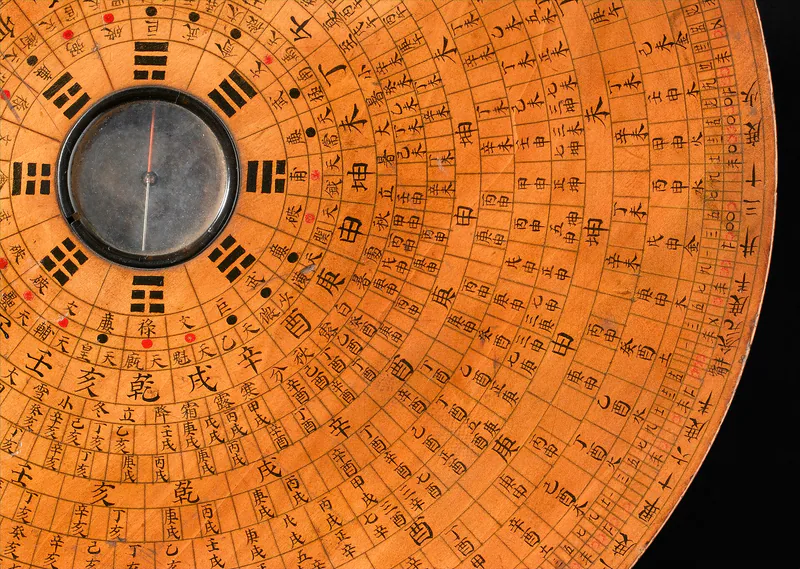
Stephan Feuchtwang's 1974 study of Chinese geomancy describes a luopan ring by ring, and remains one of the best guides in English. Earlier, the missionary Ernest Eitel's Feng-Shui (1873) offered Western readers one of the first accounts of the instrument, though with the condescension of its time.
Reading the Rings: Trigrams, Twenty-Four Mountains and Stars§
Among the most common rings are:
- The eight trigrams of the Book of Changes, usually in both the "Former Heaven" arrangement attributed to Fuxi and the "Later Heaven" arrangement attributed to King Wen, which associate each direction with an element, a family member and a season.
- The Twenty-Four Mountains (ershisi shan), the core ring, which divides the horizon into twenty-four sectors of fifteen degrees each. They are named by the twelve earthly branches, eight of the ten heavenly stems and four of the trigrams placed at the intercardinal points; the two stems belonging to the centre are left out.
- The sixty-cycle of stems and branches, used to refine directions into smaller divisions, often called "dragons", and to link them with the Five Phases.
- The Nine Stars and the numbers of the Luo Shu magic square, used in the "flying stars" calculations of later feng shui.
- The twenty-eight lunar mansions, the Chinese constellations along the equator, in unequal sectors that follow the sky.
Other rings record the twelve animals of the Chinese zodiac, the solar terms, auspicious and inauspicious degrees, and the 360 or 365 degrees of the circle.
Three Needles and the Schools of Compass Feng Shui§
Many luopans carry the Twenty-Four Mountains three times, each ring offset from the others by half a sector, seven and a half degrees. Tradition calls them the Earth Plate (the "correct needle"), used to determine the orientation of a site; the Human Plate (the "middle needle"), turned to the west and used for the surrounding hills; and the Heaven Plate (the "seam needle"), turned to the east and used for watercourses. They are attributed to famous geomancers, including the Tang master Yang Yunsong and the Song master Lai Wenjun, though these attributions are traditional. Needham suggested that the offsets preserve the magnetic declinations observed at different periods, an attractive but not universally accepted explanation.
Different schools favour different instruments. The San He ("Three Harmonies") luopan, associated with the classical combinations of the Five Phases, and the San Yuan ("Three Cycles") luopan, associated with the reckoning of time in twenty-year periods and the flying stars, are the two main types, and combined compasses serve both. In the broad division of feng shui into a Form School concerned with landscape and a Compass School concerned with direction and time, the luopan is the defining tool of the latter.
Luopan Makers and the Compass Today§
The most famous centre of luopan making is Wan'an, a town in Xiuning county in the old prefecture of Huizhou, Anhui, where family workshops have made compasses since at least the eighteenth century; the local craft is now officially protected as intangible cultural heritage. Fujian and Guangdong also had renowned makers, and in the twentieth century production spread to Hong Kong and Taiwan.
Under the People's Republic feng shui was long condemned as superstition, and luopan making declined, but it revived from the 1980s with renewed interest in traditional culture and with the international growth of feng shui. Today mass-produced luopans are sold worldwide, while masters prize hand-made instruments from established workshops. Historians of science value the luopan as a link in the history of magnetism, and anthropologists as a key to the Chinese understanding of space, time and fate. As with other divinatory arts, consulting a luopan is a cultural practice and not a substitute for professional advice on building, health or finance.
Frequently asked questions§
What is a luopan used for?§
A luopan is used in feng shui to measure the orientation of a building, grave or room and to relate it to the trigrams, the Five Phases, the sixty-cycle and the stars. Practitioners use the readings to judge whether a site and its timing are auspicious.
How is a luopan different from an ordinary compass?§
Its magnetic needle works like any compass, but around it are rings of Chinese cosmological symbols instead of simple degrees. It also has a square base and crossed threads for taking bearings from walls and doorways.
Did the Chinese invent the compass for feng shui?§
Chinese sources describe magnetic needles by the eleventh century, and many historians, following Joseph Needham, think geomancers used them before sailors did. The earliest history is uncertain, especially the nature of the Han "south-pointer".
Sources and further reading§
- An Anthropological Analysis of Chinese Geomancy — Stephan D. R. Feuchtwang, 1974
- Feng-Shui: or, The Rudiments of Natural Science in China — Ernest J. Eitel, 1873
- Science and Civilisation in China, Volume 4, Part 1: Physics — Joseph Needham, 1962
- Fengshui in China: Geomantic Divination between State Orthodoxy and Popular Religion — Ole Bruun, 2003
- Fortune-tellers and Philosophers: Divination in Traditional Chinese Society — Richard J. Smith, 1991
- The Riddle of the Compass: The Invention that Changed the World — Amir D. Aczel, 2001