Liber XXI · New Religions · Chapter V: Latter-day Saints
Plural Marriage in Latter-day Saint History: Nauvoo to 1890
Plural marriage in Latter-day Saint history: Joseph Smith's revelation, polygamy in Utah, the federal campaign, the 1890 Manifesto and fundamentalists.

Plural marriage, the practice of a man being married to more than one wife, was taught and practised by the Church of Jesus Christ of Latter-day Saints from the early 1840s until 1890, first secretly in Nauvoo, Illinois, under Joseph Smith and then openly in Utah under Brigham Young and his successors. The church regarded it as a restoration of the marriages of the biblical patriarchs and a means to exaltation in the life to come. After decades of conflict with the United States government, President Wilford Woodruff's Manifesto of 1890 ended the authorisation of new plural marriages; the church today excommunicates members who practise polygamy, while several independent fundamentalist groups continue it.
Joseph Smith and the Origins of Plural Marriage in Nauvoo§
According to Latter-day Saint tradition, Joseph Smith learned of the principle of plural marriage in the early 1830s while revising the Bible, as he asked why God had permitted Abraham, Jacob, David and Solomon to have many wives. Historians generally date his first plural marriage to the mid-1830s in Kirtland, Ohio, though the evidence for it is fragmentary, and place the systematic introduction of the practice in Nauvoo, Illinois, from 1841. The founding events of the church are described in The Latter-day Saints.
On 12 July 1843 Smith dictated a revelation, now section 132 of the Doctrine and Covenants, concerning "the new and everlasting covenant" of marriage. It taught that marriages sealed by the proper priesthood authority endure beyond death, that such eternal marriage is necessary for the highest degree of glory, and that plural marriage, as practised by Abraham, is sanctioned by God; it cites the example of Sarah giving Hagar to Abraham in Genesis 16. The practice was confined to a small circle of trusted leaders and was publicly denied.
The church has acknowledged in its own historical essays that Smith married many women, perhaps thirty to forty, some of whom were already married to other men and at least one of whom was fourteen. The nature of these relationships is debated by historians: some marriages appear to have been for eternity only, others included marital relations. His wife Emma Smith strongly opposed the practice for much of the time and denied after his death that he had taught it. Internal dissent over plural marriage contributed to the publication in June 1844 of the Nauvoo Expositor, a newspaper by disaffected members; Smith and the city council ordered its press destroyed, which led to his arrest and to his killing by a mob at Carthage jail on 27 June 1844.
Public Acknowledgement and Polygamy in Utah§
Under Brigham Young, who had himself entered plural marriage in Nauvoo, the practice spread among the leadership during the migration west. On 29 August 1852, at a conference in Salt Lake City, the apostle Orson Pratt publicly announced and defended it as a religious principle. Thereafter it was taught as an ideal for faithful members, especially leaders, though the church never required all men to enter it and most Latter-day Saints remained monogamous.
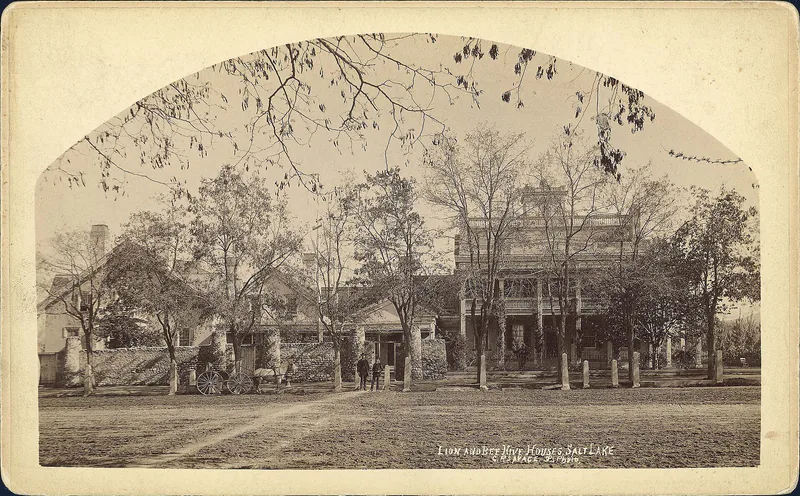
Historians such as Kathryn Daynes have reconstructed the system from census and church records. The proportion of people living in plural households varied widely by place and period; estimates for the peak years in the 1850s and 1860s commonly range from about a fifth to a third of the population in many communities, with higher figures in some settlements. Most plural husbands had two wives; a few leaders had many more, and Brigham Young had over fifty wives, many in marriages that appear to have been for eternity only. Women entered plural marriage for religious conviction, family pressure and economic security, and their experiences ranged from deep satisfaction to bitter unhappiness.
The historian Laurel Thatcher Ulrich has shown that Utah women were also among the most politically active in the nation. Utah territory granted women the vote in 1870, and many plural wives publicly defended their marriages as a matter of religious liberty, organised mass meetings and edited the newspaper Woman's Exponent, at the same time as critics in the East portrayed them as victims of a form of slavery.
The Federal Campaign Against Polygamy§
From the 1850s polygamy made the Latter-day Saints a national scandal. The Republican Party's platform of 1856 condemned "those twin relics of barbarism—Polygamy, and Slavery". Congress passed the Morrill Anti-Bigamy Act in 1862, though it was little enforced at first. In Reynolds v. United States (1879), the Supreme Court upheld the conviction of George Reynolds, Brigham Young's secretary, ruling that the First Amendment protected religious belief but not actions such as polygamy that the law prohibited. The case remains a foundational precedent in American law on religious freedom.
The Edmunds Act of 1882 made "unlawful cohabitation" a crime that was easier to prove, and barred polygamists from voting and holding office. Hundreds of men were imprisoned, and church leaders went into hiding on the "underground". The Edmunds–Tucker Act of 1887 disincorporated the church, authorised the confiscation of its property above a certain value, and revoked the vote of Utah's women. Sarah Barringer Gordon's The Mormon Question (2002) shows how these struggles shaped American ideas about marriage, democracy and the limits of religious tolerance.
The 1890 Manifesto and Its Aftermath§
Facing the loss of its temples, President Wilford Woodruff issued a statement in September 1890, now canonised as Official Declaration 1 and known as the Manifesto, declaring his intention to submit to the laws and advising members to refrain from contracting new plural marriages. Woodruff later explained that he acted after seeing in vision what would happen to the church if it did not. Utah became a state in 1896, with a constitution that permanently prohibited polygamy.

The transition was neither immediate nor complete. Existing plural families often continued to live together, and historians such as B. Carmon Hardy and D. Michael Quinn have documented that some apostles authorised new plural marriages, especially in Mexico and Canada, after 1890. The issue resurfaced during the Senate hearings of 1904–1907 on whether the apostle Reed Smoot should be seated as a senator from Utah. In 1904 President Joseph F. Smith issued a "Second Manifesto" making new plural marriages grounds for excommunication, and the church thereafter enforced the ban firmly. Today the church teaches that monogamy is God's standard unless he commands otherwise, while eternal marriage sealed in the temple remains central to its theology.
Mormon Fundamentalism Today§
Some Latter-day Saints rejected the Manifesto as a capitulation. In the 1920s and 1930s men such as Lorin Woolley claimed that President John Taylor had in 1886 secretly authorised them to continue plural marriage, and a fundamentalist movement formed, independent of and excommunicated by the main church. Its best-known centre was Short Creek, on the Utah–Arizona border, now the towns of Hildale and Colorado City. In July 1953 Arizona police raided the community and took many children into state custody, an action that provoked public sympathy for the families and was widely judged a failure; Martha Sonntag Bradley has written its history.
Fundamentalism is not a single body. The largest groups include the Fundamentalist Church of Jesus Christ of Latter-day Saints (FLDS), the Apostolic United Brethren, and the Kingston family's organisation, alongside many independent families. The FLDS drew international attention under Warren Jeffs, who was convicted in Texas in 2011 of sexual assault of children in connection with underage "spiritual marriages" and sentenced to life imprisonment; Texas authorities had raided the group's ranch in 2008. Other fundamentalists, who emphasise that they marry only consenting adults, have sought legal tolerance, and in 2020 Utah reduced bigamy between consenting adults to an infraction. The Church of Jesus Christ of Latter-day Saints regularly asks the media not to call these groups "Mormon".
Other churches descended from Joseph Smith took different positions. The Reorganized Church of Jesus Christ of Latter Day Saints, now the Community of Christ, long denied that Smith had practised polygamy and attributed it to Brigham Young, a view its historians have since revised. Debate over the meaning of Smith's marriages continues among Latter-day Saint and other historians, as part of the wider study of the movement surveyed in The Book of Mormon and What Is a New Religious Movement?.
Frequently asked questions§
Do members of the Church of Jesus Christ of Latter-day Saints practise polygamy today?§
No. The church ended new plural marriages with the 1890 Manifesto and since 1904 has excommunicated members who enter them. Groups that practise polygamy today are separate fundamentalist churches or independent families.
How many wives did Joseph Smith have?§
Historians estimate that Joseph Smith was married to perhaps thirty to forty women, though the exact number and the nature of some marriages are debated. Most of these marriages were kept secret during his lifetime.
Why did the Latter-day Saints practise plural marriage?§
They believed it was commanded by God as part of the restoration of ancient practices, following the example of the biblical patriarchs. It was linked to the teaching that marriages sealed by priesthood authority last for eternity and lead to exaltation.
Sources and further reading§
- Mormon Polygamy: A History — Richard S. Van Wagoner, 1986
- Solemn Covenant: The Mormon Polygamous Passage — B. Carmon Hardy, 1992
- Kidnapped from That Land: The Government Raids on the Short Creek Polygamists — Martha Sonntag Bradley, 1993
- In Sacred Loneliness: The Plural Wives of Joseph Smith — Todd Compton, 1997
- More Wives Than One: Transformation of the Mormon Marriage System, 1840–1910 — Kathryn M. Daynes, 2001
- The Mormon Question: Polygamy and Constitutional Conflict in Nineteenth-Century America — Sarah Barringer Gordon, 2002
- Joseph Smith: Rough Stone Rolling — Richard Lyman Bushman, 2005
- A House Full of Females: Plural Marriage and Women's Rights in Early Mormonism, 1835–1870 — Laurel Thatcher Ulrich, 2017