Liber XXI · New Religions · Chapter V: Latter-day Saints
Joseph Smith: Life of the Latter-day Saint Prophet, 1805–1844
Joseph Smith's life from Vermont farm boy to prophet: seer stones, the First Vision, the Book of Mormon, Kirtland, Nauvoo and his death at Carthage in 1844.

Joseph Smith (1805–1844) was the founder of the Latter Day Saint movement, revered by millions as a prophet, seer and revelator who restored the original church of Jesus Christ. Born to a struggling farming family in Vermont, he published the Book of Mormon in 1830, organised a church the same year and, over the next fourteen years, led his followers from New York to Ohio, Missouri and Illinois while issuing revelations that reshaped Christian ideas of God, scripture, priesthood and the afterlife. He was killed by a mob at Carthage Jail, Illinois, on 27 June 1844, at the age of thirty-eight.
Early Life in Vermont and the Burned-over District§
Joseph Smith Jr. was born on 23 December 1805 in Sharon, Vermont, the fifth child of Joseph Smith Sr. and Lucy Mack Smith. Crop failures, a failed ginseng venture and the cold "year without a summer" of 1816 pushed the family westward to Palmyra, in western New York, where they later took up a farm in neighbouring Manchester.
Western New York was then known as the burned-over district because waves of revival had swept it so often. Methodists, Presbyterians and Baptists competed for converts, and the region would soon produce the Millerites and Spiritualism. The Smiths were seekers rather than committed members of any one church: Lucy and some of the children joined the Presbyterians, while Joseph Sr. leaned towards Universalism and distrusted organised religion. The wider religious ferment is described in Adventist and Restorationist Movements.
Seer Stones, Treasure-Seeking and the Folk-Magic Background§
Alongside revivalism, the rural Northeast preserved a lively culture of folk magic: divining rods, protective charms, astrological almanacs and the use of "peep stones" or seer stones to find lost objects and buried treasure. As a young man Smith was known locally for looking into a stone placed in a hat, and in 1825 he was hired by Josiah Stowell of South Bainbridge, New York, to search for a legendary Spanish silver mine. In March 1826 he was brought before a justice of the peace in Chenango County on a complaint, apparently as a "disorderly person" for glass-looking; the surviving records are fragmentary and their outcome is debated.

While boarding with the Hale family during the Stowell venture he met Emma Hale, whom he married in January 1827 against her father's wishes. Smith later distanced himself from money-digging, but he continued to use a seer stone, alongside the "interpreters" he said were found with the plates, in producing the Book of Mormon. Historians such as D. Michael Quinn, in Early Mormonism and the Magic World View (1987), and John L. Brooke have argued that this magical culture, along with hermetic and radical Protestant currents, shaped early Mormon ideas. Others, including Richard Bushman, accept the treasure-seeking evidence but stress Smith's biblical and revivalist frame. Seer stones in their broader setting appear in Folk Magic.
The First Vision, Moroni and the Book of Mormon§
Smith left several accounts of an experience now called the First Vision. The earliest written account, from 1832, describes a youthful search for forgiveness answered by a vision of the Lord; the canonical 1838 account, published in the Pearl of Great Price, tells how in the spring of 1820, moved by the words "If any of you lack wisdom, let him ask of God" (James 1:5), he prayed in a grove near his home and saw two personages, God the Father and Jesus Christ, who told him to join none of the existing churches. Critics stress the differences between accounts; Latter-day Saint historians read them as complementary memories.
According to Smith, on the night of 21 September 1823 an angel named Moroni appeared and told him of a record engraved on golden plates buried in a nearby hill. After annual visits he said he received the plates on 22 September 1827. With Emma, Martin Harris and later Oliver Cowdery acting as scribes, he dictated the translation, mostly in an intense period in the spring of 1829. The Book of Mormon was printed by E. B. Grandin in Palmyra in March 1830, with testimonies of three and then eight witnesses who said they had seen the plates. On 6 April 1830 Smith and a handful of followers formally organised the Church of Christ at Fayette, New York. The text and the debates over its origin are treated in The Book of Mormon.
Kirtland and Missouri: Building Zion§
Missionaries quickly won converts in northeastern Ohio, including the former Campbellite preacher Sidney Rigdon and much of his congregation, and in early 1831 Smith moved the church to Kirtland, Ohio. A revelation that year designated Jackson County, Missouri, as the site of Zion, the city of the last days, so the movement had two centres. In Kirtland Smith received a stream of revelations later gathered in the Doctrine and Covenants (first published 1835), began a revision of the Bible, introduced a lay priesthood with Aaronic and Melchizedek orders, and organised a First Presidency and a Quorum of Twelve Apostles. The Kirtland Temple, dedicated in March 1836, was the scene of reported visions and spiritual gifts.
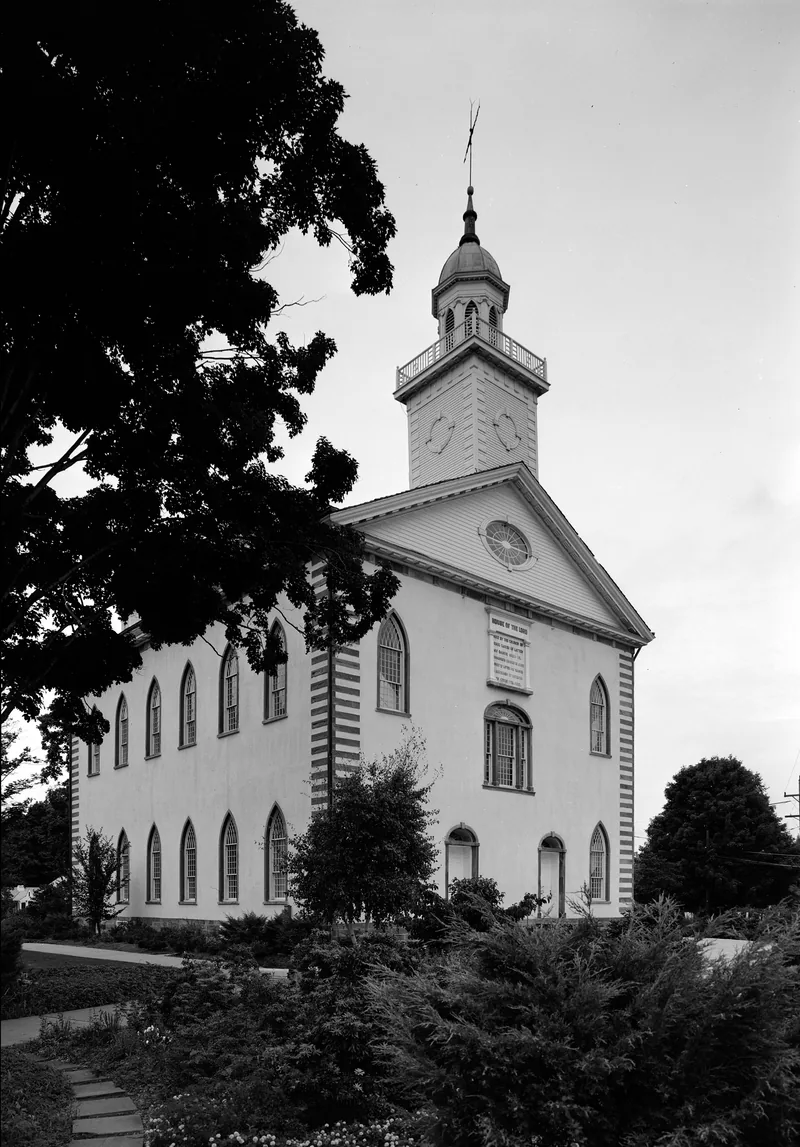
Both centres ended in crisis. Settlers in Jackson County drove the Mormons out in 1833, and the failure of the church-sponsored Kirtland Safety Society in the national panic of 1837 provoked bitter dissent; Smith left Ohio for Missouri in January 1838. There, tensions with neighbours escalated into the so-called Mormon War of 1838. Governor Lilburn Boggs issued an executive order on 27 October declaring that the Mormons must be "exterminated or driven from the State", and seventeen Latter-day Saints were killed at Haun's Mill three days later. Smith surrendered and spent the winter of 1838–39 in Liberty Jail, where he wrote letters later canonised in part as scripture. He escaped custody in April 1839 and joined his people in Illinois.
Nauvoo: Temple, Endowment and Expanding Doctrine§
On a bend of the Mississippi the Saints built Nauvoo, which grew rapidly in the early 1840s. A generous city charter gave it its own courts and militia, the Nauvoo Legion, with Smith as mayor and lieutenant-general. Converts arrived from Britain, and work began on a stone temple.
Nauvoo was also the setting for Smith's most distinctive teachings. He introduced baptism for the dead, allowing the living to be baptised as proxies for deceased relatives. He published the Book of Abraham (1842), presented as a translation of Egyptian papyri bought with mummies in 1835; fragments rediscovered in 1966 were identified by Egyptologists as ordinary funerary texts, a point Latter-day Saint scholars answer in various ways. In March 1842 he became a Freemason, and in May he introduced the temple endowment, a ritual of washing, anointing, instruction and covenant whose form shows parallels with Masonic ceremony, a relationship discussed in Freemasonry. He also taught eternal marriage and, privately, plural marriage, covered in Plural Marriage in Latter-day Saint History. In the King Follett discourse of April 1844 he taught that God had once been a man and that human beings might progress towards godhood.
Carthage Jail and the Succession Crisis§
By 1844 Smith was campaigning for the presidency of the United States and had formed a Council of Fifty to prepare for a political kingdom of God. Dissenters, angered in part by plural marriage, published a newspaper, the Nauvoo Expositor, on 7 June 1844. The city council, with Smith's support, declared it a public nuisance and had the press destroyed. Charged with riot and then treason, Smith surrendered to state authorities and was held at Carthage, the county seat. On 27 June 1844 a mob of men with blackened faces, many of them local militia, stormed the jail and shot Joseph and his brother Hyrum dead.
His death left no undisputed successor. Most of the Saints in Nauvoo followed Brigham Young and the Quorum of the Twelve, who led the exodus to the Great Basin from 1846; their story continues in The Latter-day Saints. Others followed Sidney Rigdon, James J. Strang or other claimants. In 1860 Smith's son Joseph Smith III became president of the Reorganized Church of Jesus Christ of Latter Day Saints, now the Community of Christ, which Emma Smith supported and which rejected plural marriage.
Joseph Smith in History and Memory§
For believers Smith is the prophet of the restoration, comparable in his calling to Moses. For nineteenth-century critics he was an impostor; Fawn Brodie's biography No Man Knows My History (1945) portrayed a gifted, self-persuaded storyteller. Later scholarship has moved beyond the choice between saint and fraud. Richard Bushman's Joseph Smith: Rough Stone Rolling (2005) took both faith and evidence seriously, and the Joseph Smith Papers project, publishing his documents since 2008, has made the sources widely available. Sociologists such as Rodney Stark have cited the movement Smith founded as a rare example of a new world religion in the making, a theme discussed in What Is a New Religious Movement?.
Frequently asked questions§
When and how did Joseph Smith die?§
He was shot by an armed mob that attacked the jail in Carthage, Illinois, on 27 June 1844, where he was awaiting trial after the destruction of the Nauvoo Expositor press. His brother Hyrum was killed with him, and Latter-day Saints honour both as martyrs.
Did Joseph Smith use a seer stone?§
Yes. Contemporary sources and the church's own historians agree that he used a seer stone in treasure-seeking in the 1820s and, together with the interpreters, while dictating the Book of Mormon. The Church of Jesus Christ of Latter-day Saints published photographs of a seer stone associated with him in 2015.
How many accounts of the First Vision are there?§
Four accounts written or dictated by Smith survive, from 1832, 1835, 1838 and 1842, along with several secondhand reports. They differ in detail and emphasis, and the 1838 version is the one canonised in the Pearl of Great Price.
Sources and further reading§
- Joseph Smith: Rough Stone Rolling — Richard Lyman Bushman, 2005
- Joseph Smith and the Beginnings of Mormonism — Richard L. Bushman, 1984
- No Man Knows My History: The Life of Joseph Smith — Fawn M. Brodie, 1945
- Early Mormonism and the Magic World View — D. Michael Quinn, 1987
- The Refiner's Fire: The Making of Mormon Cosmology, 1644–1844 — John L. Brooke, 1994
- Mormon Enigma: Emma Hale Smith — Linda King Newell and Valeen Tippetts Avery, 1984
- Mormonism: The Story of a New Religious Tradition — Jan Shipps, 1985