Liber XXIV · Satanism · Chapter VI: Theistic Satanism & Luciferianism
Stanisław Przybyszewski: Decadent Writer and Early Satanist
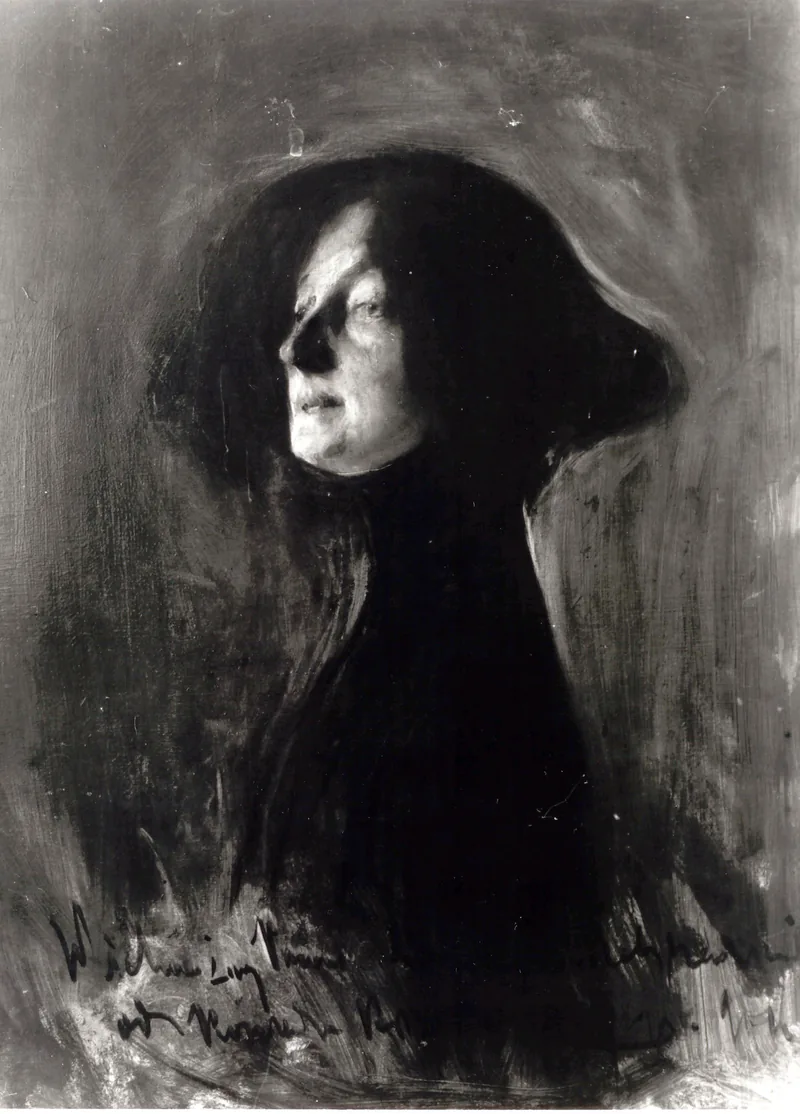
Stanisław Przybyszewski (1868–1927), Decadent writer and author of The Synagogue of Satan, often called the first to set out a Satanist philosophy.

Stanisław Przybyszewski (1868–1927) was a Polish writer who first made his name in the German-language bohemia of 1890s Berlin and then led the Young Poland movement in Kraków. In novels, prose poems and above all in Die Synagoge des Satan (The Synagogue of Satan, 1897), he presented Satan as the principle of rebellion, sexuality and evolution, and historians such as Per Faxneld regard him as perhaps the first author to set out a systematic Satanist worldview, decades before any Satanist religion existed.
Early Life and the Berlin Bohemia§
Przybyszewski was born on 7 May 1868 in Łojewo, near Inowrocław in the Prussian partition of Poland, the son of a village schoolteacher. After attending German-language secondary schools he went to Berlin in 1889 to study architecture and then medicine, developing a strong interest in psychology and the physiology of the nervous system. For a time he also edited a Polish socialist newspaper for the city's Polish workers.
In the early 1890s he became a central figure of the Scandinavian and German bohemian circle that met at the Berlin wine tavern nicknamed "Zum schwarzen Ferkel" ("The Black Piglet"). Its members included the Swedish dramatist August Strindberg, the Norwegian painter Edvard Munch, the Swedish writer Ola Hansson and the poet Richard Dehmel. Przybyszewski, a gifted pianist known for his playing of Chopin, impressed them with his intensity and erudition and was nicknamed "the brilliant Pole". In 1893 he married the Norwegian writer Dagny Juel, who was close to Munch and the subject of several of his portraits; she was killed in Tbilisi in 1901.
"In the Beginning Was Sex": Early German Writings§
Przybyszewski's first publications were two essays under the title Zur Psychologie des Individuums (1892), one on Chopin and Nietzsche and one on Ola Hansson, in which he explored genius, neurosis and the unconscious. His prose poem Totenmesse ("Requiem Mass", 1893) opens with the declaration "In the beginning was sex", a deliberate rewriting of the opening of the Gospel of John that summed up his conviction that sexual desire was the primal, cosmic force behind all life and art.
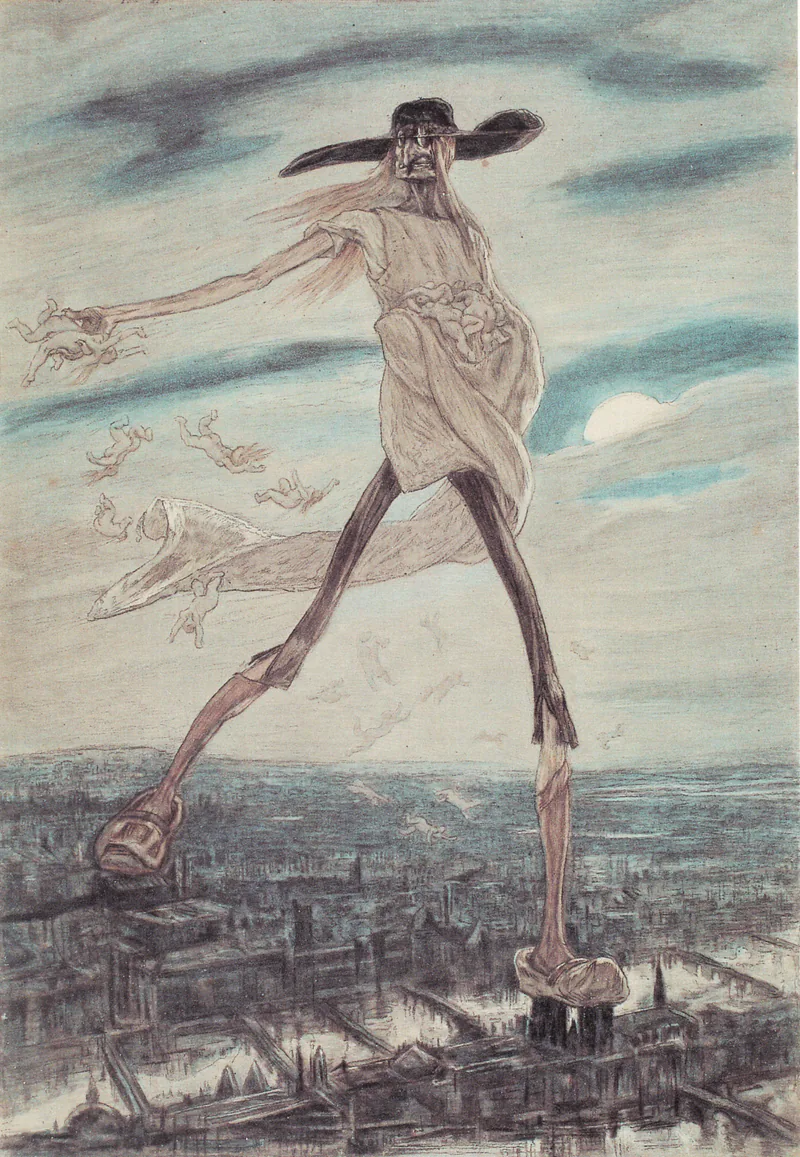
Later works, among them Vigilien (1894–1895), De profundis (1895) and the novel cycle Homo Sapiens (1895–1898), developed the figure of the tormented modern individual driven by instinct and guilt. Przybyszewski called the deepest layer of the psyche the "naked soul", a realm beneath reason and social convention which, he believed, the true artist must expose. His interest in the Belgian artist Félicien Rops, whose erotic and diabolic etchings he admired and wrote about, shows how closely his literary Satanism was tied to the visual culture of the Decadence.
The Synagogue of Satan (1897)§
Die Synagoge des Satan, subtitled as a study of the origin and cult of the witches' sabbath, of Satanism and of the Black Mass, appeared in Berlin in 1897 after serial publication. Drawing heavily on Jules Michelet's La Sorcière, on the records of the witch trials and on contemporary French writing, including Huysmans's Là-bas, it offered a history of Satanism from the dualist heresies through the medieval sabbath to the sacrilegious masses of the Affair of the Poisons. The background to those episodes is set out in The Black Mass.
Przybyszewski's history was not neutral. He argued that Satan had always been the god of the oppressed and the rebellious, the patron of everything the Church condemned: the body, sexuality, science, pride and free thought. Witches and heretics, in his telling, were revolting against a life-denying religion, and their rites expressed suppressed human instincts. The scholarship of the book was second-hand and its claims often fanciful, but its tone of sympathy with the Devil was new and startling.
Satan as Principle: Przybyszewski's Satanist Philosophy§
Per Faxneld has argued that, in The Synagogue of Satan and related essays, Przybyszewski went beyond the poetic sympathy of the Romantics to formulate a coherent Satanist ideology. Satan, for him, was the principle of evolution and becoming: the restless force that drives life upward through conflict, desire and destruction, as against the static order of the Christian God. This view blended Darwinian evolutionism, Nietzsche's critique of Christian morality, the anarchist rhetoric of revolt and Decadent fascination with evil.
Przybyszewski also gave a prominent place to women in his account of Satanism. Like Michelet, he portrayed the witch as the priestess of Satan, and Faxneld's study of "Satanic feminism" analyses how this image of the demonic woman simultaneously celebrated female power and reflected the misogynistic anxieties of the fin de siècle. In this respect his work belongs to the larger nineteenth-century reworking of the Devil described in Romantic Satanism.
It is important to be precise about what Przybyszewski was. He did not found a Satanist group, perform rituals or worship Satan as a being; his Satanism was a philosophical and aesthetic stance expressed through literature. Yet he used the word in an affirmative sense and identified with it, which historians of religion such as Ruben van Luijk see as a significant step towards the self-conscious Satanism of the twentieth century.
Kraków, Young Poland and the "Naked Soul"§
In 1898 Przybyszewski moved to Kraków, then in Austrian Galicia, to edit the literary weekly Życie ("Life"). His arrival made him the leading figure of the Young Poland (Młoda Polska) movement, and in his programme essay Confiteor (1899) he proclaimed art as an absolute value free from any social, moral or national purpose, the expression of the naked soul. He became a celebrated and scandalous presence in Kraków's cafés and salons and influenced a generation of Polish writers and painters.
His fame faded in the following decades. He lived in Lviv, then for many years in Munich, and after the First World War in Poznań, where he was associated with the Expressionist journal Zdrój, and in Gdańsk and Warsaw, where he worked in the civil service of the new Polish state. He published his memoirs, Moi współcześni ("My Contemporaries"), in the 1920s and died at Jaronty, near his birthplace, on 23 November 1927. Czesław Miłosz's history of Polish literature presents him as a powerful catalyst of modernism whose own writing has dated more than his influence.
Legacy: Przybyszewski in the History of Satanism§
For literary historians, Przybyszewski matters as a mediator between Scandinavian, German and Polish modernism and as a friend and subject of Munch, who painted his portrait in the mid-1890s. For historians of religion, his importance lies in The Synagogue of Satan. Faxneld and van Luijk place him alongside the French Decadents and the anarchist "Satanists" of the nineteenth century as part of the long prehistory of religious Satanism, which became organised only with the groups discussed in Theistic Satanism and Luciferianism and with the Church of Satan in 1966.
His work has also been rediscovered by modern Satanists and occultists. English translations of The Synagogue of Satan in the twenty-first century have made it accessible to readers who see it as an early manifesto of the movement. Scholars caution that its historical claims about medieval Satanism are unreliable, but as a document of how a fin-de-siècle intellectual could embrace Satan as a symbol of liberation, it is unique. An overview of the wider phenomenon is given in What Is Satanism?, and the artistic setting of the period in Occult Literature and Art.
Frequently asked questions§
Who was Stanisław Przybyszewski?§
He was a Polish writer (1868–1927) who wrote first in German in Berlin and then in Polish in Kraków, where he led the Young Poland movement. He is best known in the history of Satanism for The Synagogue of Satan (1897).
What is The Synagogue of Satan about?§
It is a history of witchcraft, the witches' sabbath and the Black Mass written from a sympathetic viewpoint. Przybyszewski presents Satan as the god of rebels, sexuality and progress, opposed to a repressive Church.
Was Przybyszewski a Satanist?§
He described and embraced Satanism as a philosophical and artistic position, and historians often call him the first to formulate a systematic Satanist worldview. He did not, however, found a religious group or practise Satanic worship.
What did Przybyszewski mean by the "naked soul"?§
It was his term for the deepest, pre-rational layer of the psyche, the seat of instinct and sexual desire. He held that true art should reveal this layer without regard to morality or social usefulness.
Sources and further reading§
- The Synagogue of Satan — Stanisław Przybyszewski, 1897
- The Devil's Party: Satanism in Modernity — Per Faxneld and Jesper Aagaard Petersen (eds), 2013
- Satanic Feminism: Lucifer as the Liberator of Woman in Nineteenth-Century Culture — Per Faxneld, 2017
- Children of Lucifer: The Origins of Modern Religious Satanism — Ruben van Luijk, 2016
- Satanism: A Social History — Massimo Introvigne, 2016
- Satanism: A Reader — Per Faxneld and Johan Nilsson (eds), 2023
- The History of Polish Literature — Czesław Miłosz, 1969
- Edvard Munch: Behind the Scream — Sue Prideaux, 2005