Liber XXIV · Satanism · Chapter VI: Theistic Satanism & Luciferianism
Ben Kadosh: The Danish Occultist and the 1906 Luciferian Pamphlet
Ben Kadosh (Carl William Hansen, 1872–1936): the Danish occultist whose 1906 pamphlet Den ny Morgens Gry is among the earliest Luciferian texts.

Ben Kadosh was the pen name of Carl William Hansen (1872–1936), a Danish occultist and fringe Freemason who in 1906 published a short pamphlet, Den ny Morgens Gry ("The Dawn of the New Morning"), proclaiming the return of Lucifer as the divine "World Architect". Ignored in its own time, the text has been rediscovered by historians as one of the earliest surviving documents of a positive, religious Luciferianism, and it has since found new readers among modern Luciferian groups.
Carl William Hansen and the Danish Occult Milieu§
Carl William Hansen was born in 1872 and was active mainly in Copenhagen. Little is documented about his private life; what survives shows a man of wide esoteric interests, including alchemy, astrology, Kabbalah and the history of secret societies. Like many self-taught occultists of his generation, he wrote for small audiences, corresponded with like-minded seekers abroad and sought initiation in a succession of orders.
Denmark around 1900 had a lively, if small, alternative religious scene. Spiritualism had arrived in the nineteenth century, the Theosophical Society had a Scandinavian presence, and Copenhagen's bohemian circles, like those of Berlin and Kristiania (Oslo), were open to Decadent and anti-clerical ideas. It was in Berlin in the 1890s that the Polish writer Stanisław Przybyszewski, who also moved in Scandinavian artistic circles, had developed a Satanism of his own. Hansen's work belongs to this broad northern European atmosphere, though there is no evidence that he was part of the literary avant-garde.
Fringe Freemasonry, Martinism and the Name Ben Kadosh§
Hansen's chosen name joined the Hebrew ben, "son", to kadosh, "holy". To readers familiar with Masonic high grades it also evoked the Knight Kadosh, the thirtieth degree of the Ancient and Accepted Scottish Rite, a chivalric grade associated with Templar legends and with the theme of vengeance for the death of Jacques de Molay. The degree's history is outlined in The Scottish Rite. By taking this name, Hansen presented himself as an initiate of the most secret levels of the Masonic tradition.

In practice his Freemasonry lay outside the regular Danish lodges. Around the turn of the century a network of so-called irregular or "fringe" rites, such as the Egyptian rites of Memphis and Misraïm, circulated charters and titles across Europe, often through the German occultist Theodor Reuss and the French Martinist leader Papus, whose movement is described in Papus and the Martinist Order. Faxneld's research shows that Hansen sought and claimed authority from several of these bodies and tried to establish Danish branches of them. As with many figures in this world, it is not always possible to verify which charters he genuinely held, and how much activity lay behind the titles.
Den ny Morgens Gry (1906): The Luciferian Pamphlet§
Hansen's best-known work is Den ny Morgens Gry: Verdensbygmesterens Genkomst ("The Dawn of the New Morning: The Return of the World Architect"), a pamphlet of a few dozen pages published in Copenhagen in 1906. It announces the return of a god whom Hansen calls Lucifer and identifies with the "World Architect" or "Master Builder" of Masonic symbolism, with Baphomet and with the principle of light and life in nature.
In the pamphlet Lucifer is not the enemy of humanity but its true benefactor: the bringer of knowledge, the force behind matter and generation, and the god whom the churches had slandered. Hansen draws on the image of the Sabbatic goat popularised by Eliphas Lévi, on the Masonic legend of the master builder, and on alchemical language about the transformation of matter. The tone is prophetic: a new age is dawning in which the hidden god will be openly recognised, and initiates are called to prepare for it.
Scholars stress that the pamphlet is idiosyncratic and at times obscure, and that it reached very few readers when it appeared. Its significance lies less in its influence on contemporaries than in its date and its directness. Here, in 1906, a writer who saw himself as an initiate addressed Lucifer as a god to be honoured, not as a literary symbol or a figure of Romantic rebellion.
Lucifer around 1900: Lévi, Blavatsky, Taxil and Pike§
Hansen's Lucifer did not appear from nowhere. Over the nineteenth century several currents had given the name a new range of meanings, which are surveyed in Theistic Satanism and Luciferianism.
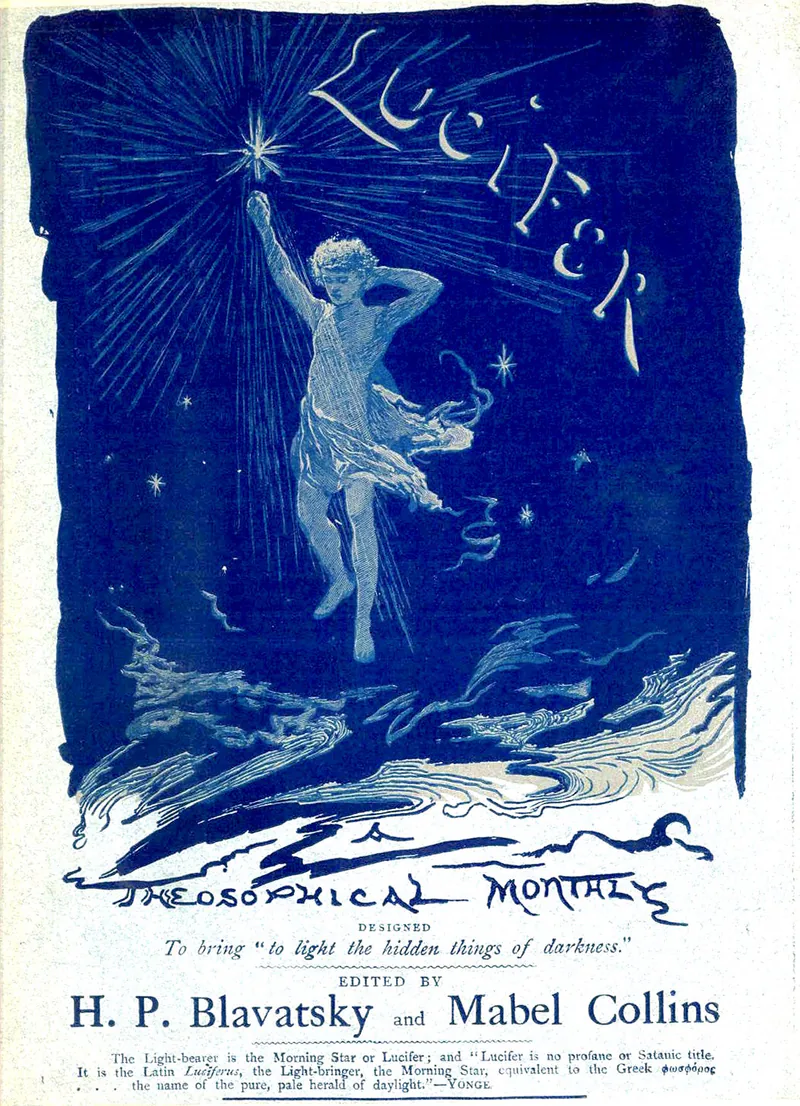
Eliphas Lévi had treated Lucifer as the "light-bearer", a name for the astral light that could serve good or evil, and had published the famous image of Baphomet in 1856. Helena Blavatsky, founder of the Theosophical Society, named her London journal Lucifer (from 1887) and argued in The Secret Doctrine (1888) that the serpent and the light-bringer of Genesis had been a benefactor of humanity before theologians turned him into a devil; her ideas are introduced in Helena Blavatsky.
At the same time, a very different Lucifer had been invented by the enemies of Freemasonry. In the 1890s the French hoaxer Léo Taxil claimed that high-grade Masons secretly worshipped Lucifer as the good god in a "Palladist" rite, and he attributed Luciferian instructions to the American Masonic leader Albert Pike. The hoax, described in Léo Taxil, was exposed in 1897, but the idea of a Masonic Luciferian cult remained in circulation. Historians have noted the irony that Hansen, a fringe Mason, came close to embodying the Masonic Luciferianism that Taxil had invented; whether he was directly inspired by the hoax literature is debated.
Why Ben Kadosh Matters to the History of Satanism§
Historians of Satanism distinguish between "Satanists" in the accusations of opponents and people who themselves embraced Satan or Lucifer as a positive religious figure. For most of history only the first category is well attested. Even in the nineteenth century, Romantic poets and Decadent writers usually admired Satan as a symbol of rebellion rather than as a being to be venerated.
Hansen's pamphlet therefore stands out. Per Faxneld, Ruben van Luijk and Massimo Introvigne all discuss it as one of the earliest surviving texts in which an author, writing within an esoteric framework, presents Lucifer as an object of religious reverence and prophecy. Together with Przybyszewski's writings in the 1890s and Maria de Naglowska's circle in Paris in the 1930s, it belongs to a small set of precedents for the organised religious Satanism that appeared after 1966 with the Church of Satan.
The case also illustrates how fluid the boundaries were between Freemasonry, occultism and Satanism around 1900. Hansen built his Luciferian theology from materials that were widely available in esoteric literature: Masonic symbolism, Lévi's Baphomet, Theosophical rehabilitations of Lucifer and alchemical imagery. What was new was his willingness to combine them into an open proclamation.
Rediscovery and Modern Luciferianism§
Hansen died in 1936, and for decades his work was virtually unknown outside a few Danish collectors of esoterica. Interest revived at the end of the twentieth century, when historians began to write the prehistory of modern Satanism. Faxneld's Swedish-language study of early Satanism (2006) and his later article on "the strange case of Ben Kadosh" placed the pamphlet in its historical context.
In parallel, the pamphlet gained a new audience among contemporary Luciferian and left-hand path groups, particularly in Scandinavia, some of whom reprinted or translated it and treated Hansen as a forerunner. Faxneld has described this as a "renaissance" in which a marginal text acquired a symbolic importance its author never enjoyed. For modern readers looking for an older lineage, Ben Kadosh offers an early example of a Luciferian voice speaking in its own name, though historians caution that there is no continuous tradition linking him to present-day groups.
Frequently asked questions§
Who was Ben Kadosh?§
Ben Kadosh was the pen name of Carl William Hansen (1872–1936), a Danish occultist and member of irregular Masonic and Martinist bodies. He is remembered for his 1906 pamphlet proclaiming Lucifer as a returning god of light and nature.
What is Den ny Morgens Gry?§
It is a short Danish pamphlet of 1906 whose title means "The Dawn of the New Morning", subtitled "The Return of the World Architect". It presents Lucifer, identified with Baphomet and the Masonic master builder, as humanity's true benefactor.
Was Ben Kadosh a Satanist?§
He described his god as Lucifer rather than Satan and framed his ideas in Masonic and alchemical terms, so he is usually called a Luciferian. Historians nevertheless treat him as an important precursor of modern theistic Satanism and Luciferianism.
Is there a link between Ben Kadosh and modern Luciferian groups?§
There is no continuous organisational lineage. Some modern Luciferian groups have rediscovered and republished his pamphlet and regard him as a forerunner, which Per Faxneld has called the text's modern renaissance.
Sources and further reading§
- Mörkrets apostlar: Satanism i äldre tid — Per Faxneld, 2006
- Children of Lucifer: The Origins of Modern Religious Satanism — Ruben van Luijk, 2016
- Satanism: A Social History — Massimo Introvigne, 2016
- The Invention of Satanism — Asbjørn Dyrendal, James R. Lewis and Jesper Aa. Petersen, 2016
- Satanic Feminism: Lucifer as the Liberator of Woman in Nineteenth-Century Culture — Per Faxneld, 2017
- Transcendental Magic: Its Doctrine and Ritual — Eliphas Lévi, 1856
- The Secret Doctrine — Helena P. Blavatsky, 1888