Liber XXI · New Religions · Chapter III: Christian Science & New Thought
Mary Baker Eddy and Science and Health: Life, Book and Legacy
Mary Baker Eddy and Science and Health: her life, the 1866 healing, the teaching of her textbook, the Quimby and animal magnetism disputes, and her legacy.

Mary Baker Eddy (1821–1910) was the American religious leader who founded Christian Science and wrote its textbook, Science and Health with Key to the Scriptures, first published in 1875. After years of chronic illness she reported a sudden recovery in 1866 while reading of one of Jesus' healings, and she spent the rest of her life teaching that God is infinite Mind and that sickness and sin yield to a spiritual understanding of God's perfect creation. She was one of the most influential and most contested American women of her century, at once a religious founder, an author, an organiser and the creator of a respected international newspaper.
Early Life in New Hampshire: Illness and Seeking§
Mary Morse Baker was born on 16 July 1821 on a farm at Bow, New Hampshire, the youngest of six children of Mark and Abigail Baker, strict Congregationalists. As a girl she rebelled against the Calvinist doctrine that some souls are predestined to damnation, a struggle she later recalled as formative. Her education was irregular because of frequent illness, but she read widely and wrote poetry for local newspapers.
Her adult life was marked by misfortune. In 1843 she married George Washington Glover, a builder, who died of yellow fever in North Carolina the following year, a few months before the birth of their son. Poor and often bedridden, she was unable to keep the boy, who was raised by others and moved west; mother and son would meet again only decades later. A second marriage in 1853, to the itinerant dentist Daniel Patterson, was unhappy and ended in divorce in 1873. In these years she tried the remedies of her time, including homeopathy, dietary regimes and water cures, and became convinced that the patient's beliefs played a large part in illness and healing.
Quimby, the Fall in Lynn and the Discovery of 1866§
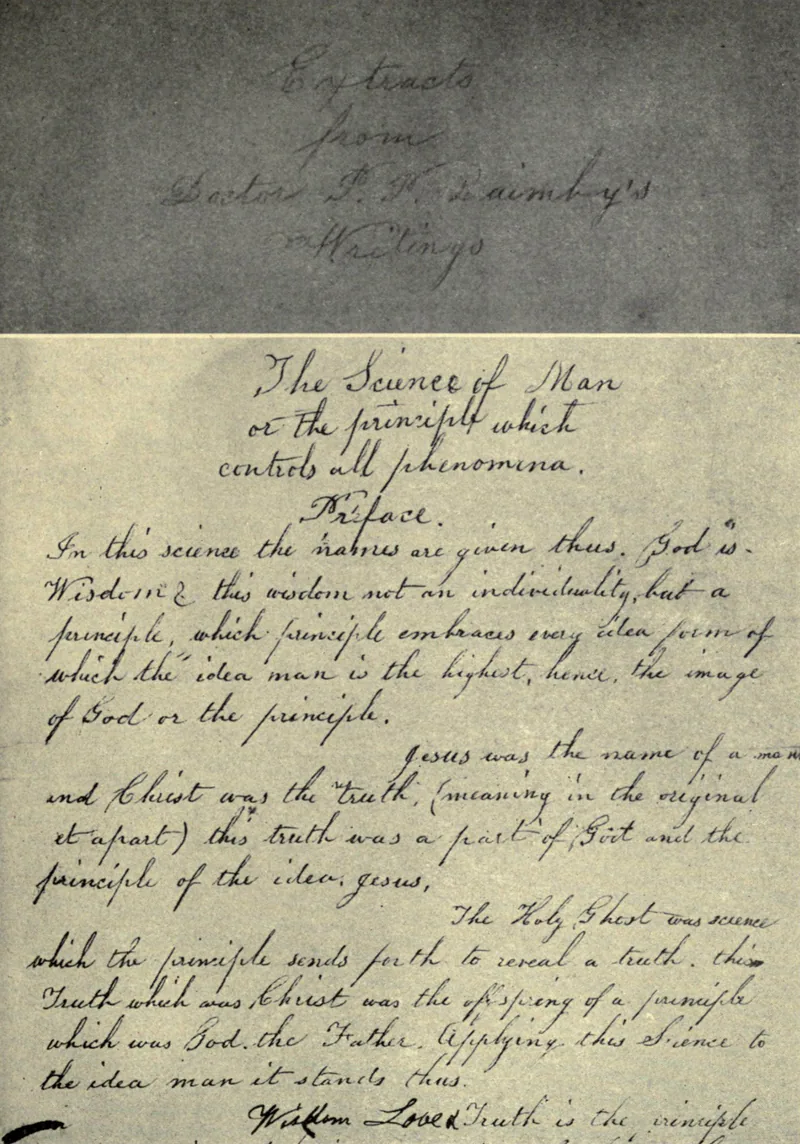
In 1862 she sought treatment in Portland, Maine, from Phineas Parkhurst Quimby, a former clockmaker who had moved from mesmerism, described in Mesmerism and Animal Magnetism, to a method of healing by explaining to patients that disease was an error of belief. She improved under his care, wrote enthusiastic letters and articles about him, and studied his ideas closely until his death in January 1866.
On 1 February 1866 she fell on an icy pavement in Lynn, Massachusetts, and was carried home seriously injured. A few days later, according to her own account, she read the story of Jesus healing the paralysed man in Matthew 9 and rose from her bed healed. She later dated her discovery of Christian Science to this moment, while saying that it took years of study of the Bible to understand and articulate what she had experienced. Through the late 1860s she lived in rented rooms in New England towns, teaching small groups and writing.
Writing Science and Health with Key to the Scriptures§
Science and Health was first published in Boston on 30 October 1875 in an edition of a thousand copies, financed by two of her students. It was a dense, passionate book that won few readers at first, but Eddy revised it continually: the chapter "Key to the Scriptures", a spiritual interpretation of Genesis and Revelation with a glossary of biblical terms, was added in 1883, and she worked on the text until the final revision of 1910. By then the book had gone through hundreds of printings and sold hundreds of thousands of copies; it has since been translated into many languages and reprinted continuously.
In 1877 she married Asa Gilbert Eddy, one of her students and a sewing-machine salesman, who became one of her most devoted practitioners and organisers; he died in 1882. Eddy designated Science and Health, together with the Bible, as the permanent "pastor" of her church, so that in Christian Science services sermons are replaced by readings from the two books.
The Teaching of Science and Health: God, Mind and Healing§
The book's central claim is metaphysical. God is wholly good, infinite and the only true cause; Eddy names God through seven synonyms, Mind, Spirit, Soul, Principle, Life, Truth and Love, and speaks of God as Father-Mother. Since God is all and is Spirit, matter has no real existence. Her "scientific statement of being", read at the close of Sunday services, opens: "There is no life, truth, intelligence, nor substance in matter. All is infinite Mind and its infinite manifestation." Sickness, sin and death are therefore the products of mortal mind, the false belief in a life separate from God.
Healing follows from the correction of this false belief through prayer that perceives each person as God's spiritual and perfect idea. Eddy distinguished this sharply from both medicine and the mental healing of her contemporaries: Christian Science, she insisted, does not substitute the human will or positive suggestion for drugs, but relies on divine Mind. Jesus is presented as the "Way-shower", the supreme example of this spiritual understanding, while "Christ" is the divine idea manifest in him. Eddy also reinterpreted traditional doctrines: heaven and hell are states of thought rather than places, and the atonement is a demonstration of humanity's unity with God rather than a payment for sin. Her teaching on the equality of men and women before God, and her own example, gave women unusual roles as practitioners, teachers and church officers. How these ideas compare with the wider mind-cure movement is discussed in Christian Science and New Thought.
Founder, Leader and Controversial Figure§
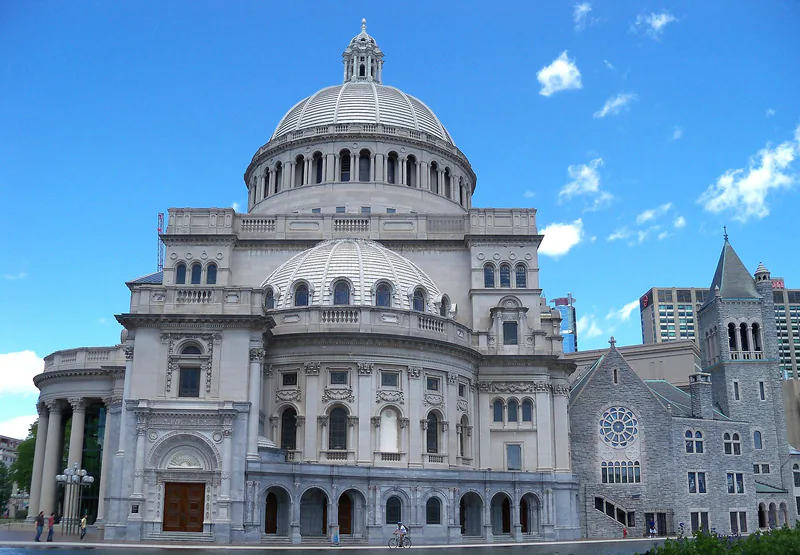
Eddy founded the Church of Christ, Scientist in 1879, chartered the Massachusetts Metaphysical College in 1881, and in 1892 reorganised the church around The Mother Church in Boston, governed by a self-perpetuating Board of Directors and the Manual she wrote. From 1889 she lived in increasing seclusion, first at Pleasant View in Concord, New Hampshire, and from 1908 at Chestnut Hill near Boston, directing the movement through letters and trusted secretaries. In 1908 she founded The Christian Science Monitor. She died at Chestnut Hill on 3 December 1910.
Her authority provoked conflicts. Several students broke away in the 1880s; Emma Curtis Hopkins, a former editor of the Christian Science Journal, became the "teacher of teachers" of the New Thought movement. Eddy also taught that hostile human thought could act harmfully on others, which she called malicious animal magnetism. In 1878 a student brought a suit in Salem against a former follower, Daniel Spofford, for injuring a woman by mental means; the court dismissed it, and newspapers called it the "Ipswich witchcraft trial". Critics treated the doctrine as superstition; sympathetic historians read it as her way of naming the power of fear and malice, which she believed could be resisted only by prayer.
The Quimby controversy began in the 1880s, when Quimby's former patients Julius and Annetta Dresser claimed that Eddy had taken her ideas from his manuscripts; their son Horatio Dresser published Quimby's papers in 1921. Eddy acknowledged Quimby's kindness but insisted that his method was mesmeric and material, while hers was spiritual and biblical. In 1907 the newspaper New York World backed the "Next Friends" lawsuit, in which her son and other relatives sought to have her declared incompetent to manage her affairs; it collapsed after she was interviewed by court-appointed masters. In the same years McClure's Magazine serialised a hostile biography credited to Georgine Milmine, largely written by the young Willa Cather, and Mark Twain published Christian Science (1907), a satire mixing ridicule with grudging admiration for her organising genius.
Legacy and Historical Assessments§
Eddy's reputation long depended on which camp wrote about her: church-authorised biographies presented a near-saintly figure, while hostile accounts portrayed her as hysterical and grasping. Later twentieth-century scholarship has been more balanced. Robert Peel's three-volume biography (1966–1977) used the church's archives extensively; Stephen Gottschalk placed her thought in the context of American religion and science; and Gillian Gill's 1998 biography reassessed her as a resilient woman who overcame illness, poverty and the limits placed on women of her time. Historians of medicine have meanwhile studied the conflicts over Christian Science healing and children's medical care.
Her influence reaches beyond her church. The mind-cure ideas of her era fed the New Thought movement, the "positive thinking" of the twentieth century and the Law of Attraction, though Christian Scientists reject these as forms of human will-power. She is often compared with other nineteenth-century founders who drew on, or reacted against, Spiritualism and mesmerism. The Mary Baker Eddy Library in Boston, opened in 2002, holds her papers and makes them available to researchers.
Frequently asked questions§
What is Science and Health about?§
Science and Health with Key to the Scriptures explains Mary Baker Eddy's teaching that God is infinite, wholly good Mind and that matter, sickness and sin belong to a false material sense. It describes healing through prayer, interprets the Bible spiritually and serves, with the Bible, as the pastor of the Church of Christ, Scientist.
Did Mary Baker Eddy copy Phineas Quimby?§
This has been debated since the 1880s. Quimby's followers argued that her ideas came from him; Eddy and her church maintain that her teaching is fundamentally different, being based on God rather than on the patient's mind. Most modern historians accept that Quimby influenced her early thinking but that her mature theology developed in a distinct, religious direction.
What is malicious animal magnetism?§
It was Eddy's term for the harmful influence she believed human thought could exert on others, derived from the language of mesmerism. She taught that such influence has no real power before God and can be overcome through prayer and spiritual understanding.
Sources and further reading§
- Science and Health with Key to the Scriptures — Mary Baker Eddy, 1875
- The Life of Mary Baker G. Eddy and the History of Christian Science — Georgine Milmine, 1909
- Christian Science — Mark Twain, 1907
- Mary Baker Eddy: The Years of Discovery — Robert Peel, 1966
- The Emergence of Christian Science in American Religious Life — Stephen Gottschalk, 1973
- Mary Baker Eddy — Gillian Gill, 1998
- Rolling Away the Stone: Mary Baker Eddy's Challenge to Materialism — Stephen Gottschalk, 2006