Liber IX · Gnosticism · Chapter II: Cathars & Bogomils
The Secret Supper (Interrogatio Iohannis): A Bogomil Gospel
The Interrogatio Iohannis or Secret Supper: the Bogomil apocryphon used by the Cathars, its myth of Satan's fall and creation, manuscripts and meaning.

The Interrogatio Iohannis ("Questions of John"), also known as the Secret Supper or the Secret Book of the Cathars, is a medieval apocryphal dialogue in which the apostle John, resting on Jesus's breast at the Last Supper, asks about the fall of Satan, the making of the world and the end of time. Of Bogomil origin, it was brought from Bulgaria to the Cathar church of Concorezzo in northern Italy in the late twelfth century and survives only in two Latin copies. It is the most important narrative source for the dualist myth shared by Bogomils and Cathars.
Manuscripts and Discovery of the Interrogatio Iohannis§
Unlike most knowledge of the Cathars, which comes from their opponents, the Interrogatio Iohannis was a text the dualists themselves used. It survives in two Latin versions. One is in a manuscript of the Austrian National Library in Vienna. The other was preserved in the archives of the Inquisition at Carcassonne, from which the Dominican Jean Benoist printed it in 1691 in his history of the Albigensians and Waldensians; the manuscript itself has since been lost.
The Carcassonne copy ended with a note identifying the work as the "secret" of the heretics of Concorezzo, a Cathar church centred near Milan, and stating that their bishop Nazarius had brought it from Bulgaria. Other inquisitorial writers, including the former Cathar Rainerius Sacconi in his Summa of 1250, report that Nazarius claimed to have received his teachings from the bishop and "elder son" of the Bulgarian church about sixty years earlier. This places the transmission of the text around 1190, at a time when Italian Cathar churches looked to the Balkans for the validity of their ordinations.
The original was presumably in Greek or Old Church Slavonic, though no copy in those languages survives. Its themes match what Byzantine writers report about the Bogomils, especially the description in the Dogmatic Panoply of Euthymius Zigabenus, compiled around 1100 after the trial of the Bogomil leader Basil in Constantinople.
Setting and Form: John at the Last Supper§
The work opens with John recalling that he was reclining on the Lord's breast at the supper in the kingdom of heaven, an echo of John 13, and asking him a series of questions. The format is that of the revelation dialogue, a genre already familiar from early Christian apocrypha such as the Apocryphon of John found at Nag Hammadi. There is no evidence of direct dependence on those ancient texts.
The questions run in rough chronological order: what Satan was before his fall, how he fell, how the world and human beings came to be, how the patriarchs and prophets were deceived, why Christ came, and what will happen at the judgement. Throughout, canonical texts are reread: phrases from the Gospel of John, Isaiah, Luke and Revelation are given new meanings within the dualist myth.
The Fall of Satan and the Seduction of the Angels§
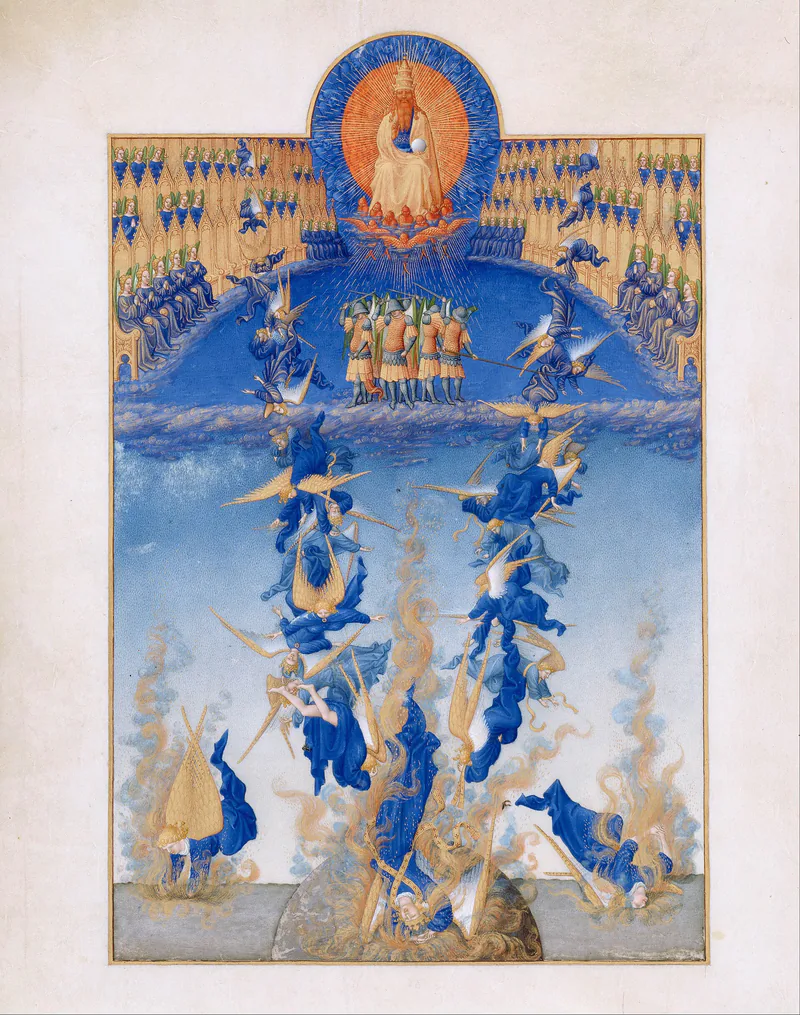
In the Interrogatio, Satan was originally a glorious being who ruled with the Father and administered all things, sitting beside the throne and governing the powers of the heavens. Desiring to set his own throne above the clouds and to be like the Most High, an echo of Isaiah 14, he descended through the heavens and began to seduce the angels.
He did so by imitating the unjust steward of Luke 16. Going to the angels of each heaven, he asked how much they owed their lord and reduced their debts, writing "fifty" where they owed a hundred measures of oil. Through this false generosity he drew a portion of the angels to his side. The Father then cast him out with those who followed him, and took away the glory and light of his face.
Byzantine sources on the Bogomils add a related detail: the fallen angel was called Satanael, and when he fell he lost the divine ending -el from his name and became simply Satan. The Latin Interrogatio does not use this etymology, but the underlying story is the same. Our article on the history of Satan and the Devil traces how such legends developed from older Jewish and Christian traditions.
Satan as Creator: The Visible World and the Human Body§
Cast down, Satan begged the Father for patience, and was allowed to do as he wished for a time. He then made the visible world. He set the firmament in place, divided the waters, brought forth dry land, and made the creatures of earth, sea and air. The shaping of the world in this account follows Genesis, but its author is the fallen steward rather than the good God.
Satan then made the human body out of clay in his own likeness and commanded an angel of a higher heaven to enter it; from part of that body he made a second, the woman, and commanded another angel to enter it. The angels wept on finding themselves clothed in mortal flesh. Satan planted a paradise, and through the serpent he seduced Eve, introducing carnal desire, so that the human race would perpetuate the imprisonment of angelic spirits in bodies. Procreation, in this view, serves Satan's purposes.
The myth then retells sacred history. Satan took Enoch up to the firmament, showed him his divinity, and had him write books which taught sacrifice and the worship of the false god. He gave Moses the Law and the tablets, and the prophets spoke in his service. When the Father sent his Son, Satan sent his angel, the prophet Elijah, to be born as John the Baptist, who baptised with water.
This structure makes the Interrogatio a text of what scholars call "moderate" or "monarchian" dualism. Satan is not an eternal evil principle co-equal with God, but a created being who rebelled. The contrasting "absolute" dualism of some Cathar churches is expressed in the Italian treatise The Book of the Two Principles (c. 1250), associated with John of Lugio, which argued for two eternal principles of good and evil. The broader history of the creator figure in dualist thought, from Plato to the Cathars, is traced in our article on the demiurge.
Christ's Descent, Baptism and the Last Judgement§
The Son's mission is described in docetic terms. The Father sent an angel, named Mary, to receive the Son; he entered through her ear and came out through her ear, so that he did not truly take flesh from the creation of Satan. This idea that Christ only appeared to have a human body echoes much older debates, including the teaching of Marcion and some Gnostic groups.
Christ teaches that the baptism of John with water belongs to Satan, while the true baptism is that of the Spirit. The Cathars identified this spiritual baptism with their own rite, the consolamentum, performed by the laying on of hands and the Gospel of John, which is discussed in our article on the Cathars and Bogomils. Marriage and the procreation of children are presented as the devil's work.
The text ends with an apocalypse drawing on Revelation and the synoptic gospels. At the end of the age, Satan will be bound with all his host and cast into a pool of fire; the sinners will follow him; and the just will shine like the sun in the kingdom of the Father, which Christ will establish. The created world itself will pass away.
The Interrogatio and Cathar Scripture§
The Interrogatio was not the only apocryphon the Cathars valued. Inquisitorial sources report that they also used the Vision of Isaiah, a Latin version of part of the early Christian Ascension of Isaiah, which describes the prophet's ascent through seven heavens and the descent of the Beloved through them in disguise. Both texts gave narrative form to beliefs that Cathar preachers otherwise defended from the canonical scriptures, especially the Gospel of John, which they read in Latin and in Occitan translation.
Scholars debate how widely the Interrogatio circulated. Its Italian connection is secure, and the existence of a copy at Carcassonne shows that inquisitors in Languedoc knew it. But the Occitan Cathars may have relied more on preaching and on scriptural exegesis than on such a narrative. The text should therefore be read as one witness among several to a diverse movement, rather than as a creed accepted by all.
Interpreting the Secret Supper§
Historians use the Interrogatio to answer a long-standing question: how were the medieval dualists related to ancient Gnosticism? The parallels are obvious, a lower creator, the human soul as a divine being trapped in matter, a docetic Christ, and a hostile view of procreation. Yet the Interrogatio lacks the Gnostic pleroma, the aeons and the figure of Sophia, and its story of the fallen steward is built from biblical and medieval angelology rather than ancient myth.
Most scholars, including Dmitri Obolensky, Bernard Hamilton and Yuri Stoyanov, see Bogomilism as a Balkan development of the tenth century, drawing on Byzantine dualist movements such as the Paulicians and on Jewish and Christian apocrypha, rather than a direct survival of ancient Gnostic groups. The Interrogatio shows these dualists as creative interpreters of the Bible.
Frequently asked questions§
Why is it called the Secret Supper?§
The dialogue is set at the Last Supper, where John asks Jesus questions while resting on his breast. Inquisitors described it as the "secret" of the heretics, and modern scholars often call it the Cathars' secret book or secret supper.
Was the Interrogatio Iohannis written by the Cathars?§
It appears to have been composed among the Bogomils in the Balkans and brought to Italy by the Cathar bishop Nazarius around 1190. The surviving versions are Latin translations used by Cathar communities.
Who creates the world in the Interrogatio Iohannis?§
Satan, a fallen steward who once governed under the Father, shapes the visible world and the human body after his expulsion from heaven. Angelic spirits are imprisoned in these bodies, and salvation consists in their release.
Is the Interrogatio a Gnostic text?§
It shares several features with ancient Gnostic myths, including an inferior creator and a docetic Christ, but it lacks their system of aeons and Sophia. Most historians regard it as a medieval dualist work rather than a survival of ancient Gnosticism.
Sources and further reading§
- Le livre secret des Cathares: Interrogatio Iohannis, apocryphe d'origine bogomile — Edina Bozóky, 1980
- Heresies of the High Middle Ages — Walter L. Wakefield and Austin P. Evans, 1969
- Christian Dualist Heresies in the Byzantine World, c. 650–c. 1450 — Janet Hamilton and Bernard Hamilton, 1998
- The Bogomils: A Study in Balkan Neo-Manichaeism — Dmitri Obolensky, 1948
- The Other God: Dualist Religions from Antiquity to the Cathar Heresy — Yuri Stoyanov, 2000
- The Cathars: Dualist Heretics in Languedoc in the High Middle Ages — Malcolm Barber, 2000