Liber XXXI · Taoism & Chinese Religion · Chapter VII: Mo Pai & Neigong
The Levels of Mo Pai Neigong: Yin Qi, Yang Qi and the Dantian
The levels of Mo Pai neigong as Kosta Danaos describes them: yang qi in the dantian, its union with yin qi, the higher levels, and their roots in neidan.

The levels of Mo Pai neigong are the graded stages of training that Kosta Danaos describes in The Magus of Java (2000) and Nei Kung (2002): first the accumulation and condensing of yang qi in the lower dantian, then the drawing in of yin qi and its union with yang, and finally higher levels concerned with spirit and immortality. Known only from Danaos's outlines, the scheme adapts the long-established language of Taoist internal alchemy (neidan) to a distinctive, closely guarded system.
A Graded Path: The Idea of Levels§
Chinese self-cultivation has always thought in stages. The neidan tradition describes the work as a sequence: laying the foundation, refining essence into qi, refining qi into spirit, and returning spirit to emptiness. Buddhist meditation has its ladders of absorption, and Chinese martial arts often speak of levels of skill. Danaos's Mo Pai belongs to this pattern, but in a particularly formalised way. In his account, the system is divided into a long series of numbered levels, sometimes said to be seventy-two, each of which must be completed before the next can begin, and passage from one level to the next is marked by a recognisable change in the practitioner's qi.
Only the lower levels are described with any specificity. The higher ones are mentioned in general terms, as stages that Danaos himself had not reached and that his teacher would discuss only allusively. This structure, a clear beginning and an increasingly secret summit, is itself typical of esoteric traditions, in which the most important teachings are reserved for those who have proved themselves.
Yang Qi and Yin Qi in Mo Pai Teaching§
The key to the Mo Pai scheme, as Danaos presents it, is a distinction between two kinds of qi. In Chinese thought, yin and yang are complementary aspects of everything: shade and sunlight, rest and movement, cold and heat, earth and heaven. Qi itself, the vital breath, has yin and yang aspects in Chinese medicine, which speaks of the body's yin and yang being in balance or out of balance. The general background is set out in yin-yang and the five phases.
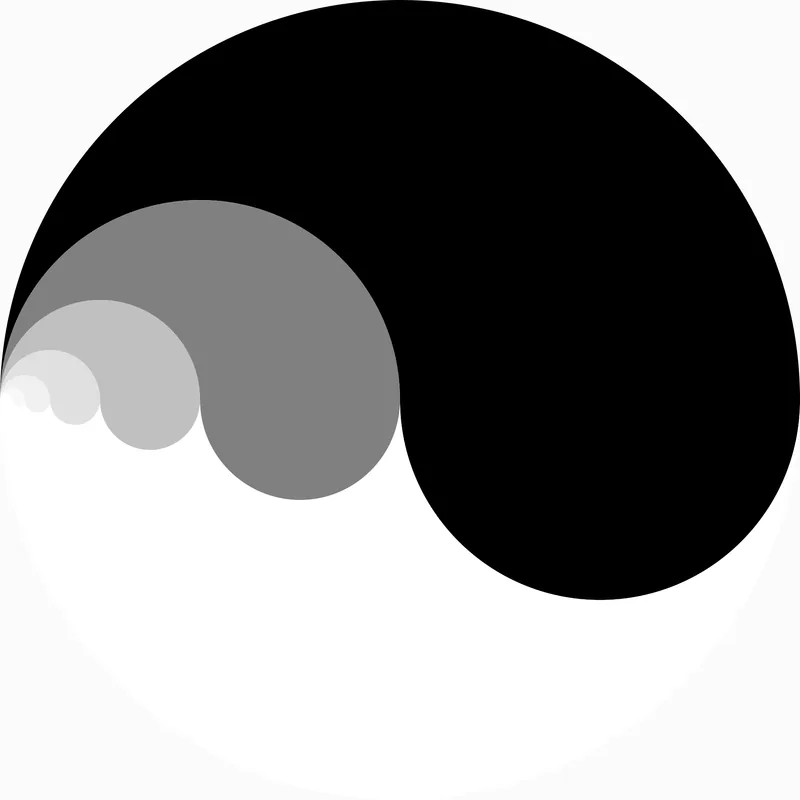
Mo Pai, in Danaos's telling, makes this distinction more concrete. Yang qi is the warm, active energy produced within a living body and accumulated through training. Yin qi is cooler and comes from the environment, from the earth and from living things, and at the higher levels it is linked with the realm of death and of spirits. Each kind is said to be incomplete without the other, and the training proceeds by first strengthening yang and only then admitting yin. Danaos's own explanations sometimes translate these ideas into the language of electrical polarity, positive and negative charge; this is a modern gloss rather than part of the Chinese vocabulary.
The First Levels: Filling the Lower Dantian§
The first stage of Mo Pai training, as described in the books, is a sitting meditation centred on the lower dantian, the "elixir field" a few finger-widths below the navel that is the main focus of neidan and of most Chinese internal arts. Its aim is to gather yang qi there until the dantian is, in Danaos's metaphor, full, a process said to take months or years of daily practice. Subsequent levels are said to condense and strengthen this store, so that the qi becomes denser and more stable. Danaos describes the sensations of heat, pressure and movement that accompany this work and the decisive changes that mark the end of a level.
Like much Chinese internal training, the early levels are also said to demand a disciplined life: regular practice, moderation and, as in many neidan texts, care to conserve the body's sexual essence (jing) during the foundational stages. These rules are presented as practical conditions of success, not as moral judgements.
The books are deliberately incomplete about method, and readers who have tried to reconstruct the first level from them have produced varying versions on internet forums. None can be confirmed as authentic, and this library does not reproduce or endorse any of them.
Level Four and the Union of Yin and Yang§
The stage that attracts most attention in Danaos's account is the one at which yin qi is first brought in to meet the stored yang qi, usually discussed as the fourth level. The union is described as powerful and potentially dangerous: once yin and yang combine, the practitioner is said to be able to produce the effects that made John Chang famous, the current felt by those he touched and the heat he directed into objects.
Danaos treats this stage as the threshold between ordinary self-cultivation and the extraordinary. He also presents it as the point at which mistakes become serious and the guidance of a teacher indispensable. Whether or not one accepts the account, this caution reflects a concern found throughout Chinese internal practice, where texts and teachers have long warned of the disturbances, known in modern Chinese as zouhuo rumo, that can follow forceful or poorly guided cultivation.
The Higher Levels: Spirit, Immortality and Secrecy§
Above the fourth level, Danaos's descriptions become increasingly general. The higher stages are said to move the work from the lower dantian towards the spirit, to involve deeper interaction with yin, and to lead towards the formation of a body of spirit that can survive death. Danaos describes his teacher's own attainment as lying well beyond the fourth level, and the summit of the system as the condition traditionally called immortality.
These ideas belong to a very old Chinese stream. The pursuit of the xian, the transcendent or immortal, goes back at least to the Warring States and Han periods, and neidan from the Song dynasty onward spoke of gestating an "immortal embryo" that emerges from the crown of the head. The history of these ideas is traced in Taoist immortality: the xian and the elixir. Mo Pai's emphasis on dealings with spirits at the higher levels also recalls the place of ghosts and ancestors in Chinese popular religion.
Parallels in Neidan, Qigong and Chinese Medicine§
Placed beside the classical tradition, the Mo Pai scheme looks both familiar and unusual. Familiar are the centrality of the lower dantian, the goal of reversing the body's depletion, the language of yin and yang, and the idea that cultivation proceeds through stages to an immortal spirit. These are the staples of Taoist internal alchemy and of many modern qigong and internal arts.
Less familiar is the sharp division between internally produced yang qi and externally absorbed yin qi as successive stages, the numbered sequence of levels, and above all the emphasis on demonstrable physical power as proof of attainment. Classical neidan writers generally treated paranormal abilities as side effects at best and distractions at worst. The idea of qi as a quasi-electrical force, measurable in principle, owes more to twentieth-century debates, including China's "qigong fever" of the 1980s, than to medieval texts.
Why the Books Warn Against Solo Practice§
Both of Danaos's books state plainly that Mo Pai must be learned from a qualified teacher who can monitor the student's progress, and that attempting the levels from written descriptions is unwise. This is consistent with Chinese tradition, in which internal methods were passed on orally within a teacher-student relationship, and with modern medical experience of qigong-related psychological disturbances.
For readers curious about Chinese internal cultivation, the practical lesson is to look for openly taught traditions, such as established schools of qigong, taijiquan or Taoist meditation, with experienced teachers, and to stop and seek qualified advice if practice produces persistent distress. The history and reception of Mo Pai itself are discussed in Mo Pai: The Neigong School of John Chang and in Mo Pai, Evidence and Scepticism.
Frequently asked questions§
How many levels does Mo Pai have?§
Danaos's account describes a long series of numbered levels, sometimes given as seventy-two, but only the first few are described in any detail. The higher levels are mentioned only in general terms.
What is Mo Pai level 1?§
In the books, the first level is a seated meditation aimed at gathering yang qi in the lower dantian until it is "full". The books do not give a complete method, and versions circulating online cannot be verified.
What is the difference between yin qi and yang qi in Mo Pai?§
As Danaos describes it, yang qi is generated within the body and gathered in the dantian, while yin qi is drawn from the environment and introduced only at a later level. Their union is said to produce the electric-like effects attributed to John Chang.
Is it safe to practise Mo Pai from the books?§
The books themselves advise against it. Chinese tradition and modern clinical reports both note that intense, unsupervised internal practice can cause physical and psychological disturbances.
Sources and further reading§
- The Magus of Java: Teachings of an Authentic Taoist Immortal — Kosta Danaos, 2000
- Nei Kung: The Secret Teachings of the Warrior Sages — Kosta Danaos, 2002
- Taoist Meditation: The Mao-shan Tradition of Great Purity — Isabelle Robinet, 1993
- Taoist Meditation and Longevity Techniques — Livia Kohn (ed.), 1989
- Chinese Healing Exercises: The Tradition of Daoyin — Livia Kohn, 2008
- Taoist Yoga: Alchemy and Immortality — Lu K'uan Yü (Charles Luk), 1970
- Great Clarity: Daoism and Alchemy in Early Medieval China — Fabrizio Pregadio, 2006