Liber XI · Herbal Magick · Chapter II: Entheogens & Sacred Plants
The Blue Lotus of Egypt: Sacred Flower of the Sun and Rebirth
The blue lotus (Nymphaea caerulea) in ancient Egypt: creation myth, the god Nefertem, banquet scenes, rebirth and the debate over its use as an intoxicant.

The blue lotus of Egypt is the blue water lily, Nymphaea caerulea, a flower that opens with the morning sun on the pools and canals of the Nile. For the ancient Egyptians it was a symbol of creation, of the sun's daily rebirth and of renewed life after death: the sun god was born from a lotus, the god Nefertem embodied its perfume, and tomb paintings show the living and the dead holding it to their noses. In recent decades the flower has also been at the centre of a debate over whether Egyptians used it as a mild intoxicant, a question on which scholars remain divided.
Blue Water Lily or Lotus? Naming the Plant§
Two native water lilies grew in ancient Egypt: the blue water lily (Nymphaea caerulea), with pointed pale-blue petals and a sweet scent, which opens in the morning and closes in the afternoon, and the white water lily (Nymphaea lotus), which blooms at night. Egyptian texts called such flowers seshen, the source, through Coptic and Hebrew, of the name Susanna. Greek writers called them lotos, and the English "lotus" has stuck, although botanically they are water lilies.
The pink sacred lotus of India, Nelumbo nucifera, central to Hindu and Buddhist symbolism and to texts such as the Lotus Sutra, is a different plant. It seems to have been introduced into Egypt only in the Late or Persian period, perhaps around the fifth century BCE, and it became common in Ptolemaic and Roman art. The "lotus-eaters" of Homer's Odyssey, whose fruit made men forget their homes, are different again: their plant is usually identified with a North African shrub such as the jujube. Keeping these flowers apart is the first step to understanding Egyptian sources.
The Lotus of Creation: Sun God and Primeval Waters§
Egyptian cosmogonies imagined the world beginning in Nun, the dark, limitless waters before creation. In several traditions, especially those associated with Hermopolis, the first act of creation was the rising of a lotus from these waters; when its petals opened, the young sun god appeared within it, and light entered the world. The image is perfectly suited to the blue water lily, which rises above the water and opens to the morning sun.
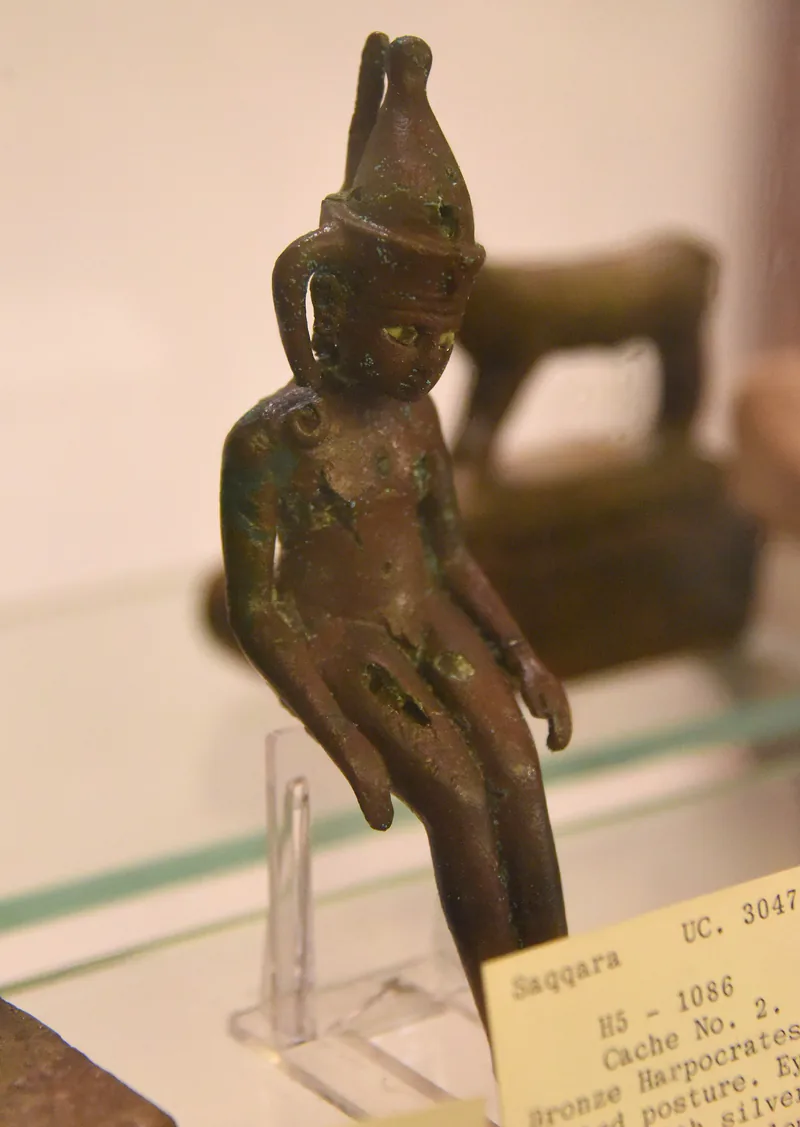
The sun child seated on or emerging from a lotus became one of the most widespread images of Egyptian religion. It was later attached especially to Horus the child, known to the Greeks as Harpocrates, and appears on temple walls, amulets and, in the Graeco-Roman period, on countless small objects. The daily opening of the flower thus rehearsed the first sunrise. These ideas are part of the larger cosmology described in the guide to ancient Egyptian religion.
Nefertem, Lord of Perfume§
The lotus had its own god. Nefertem, a youthful deity usually shown with a blue lotus blossom on his head, sometimes topped with tall plumes, was worshipped above all at Memphis, where he was counted the son of the creator god Ptah and the lioness goddess Sekhmet. The Pyramid Texts already describe the king rising "as Nefertem, as the lotus at the nose of Ra," an image of the flower whose fragrance delights and revives the sun god.
Nefertem shows how closely Egyptians linked the flower with scent. Perfume was a divine quality, and smelling a sacred fragrance was a way of receiving life. Nefertem's figure appears on amulets, discussed in the article on ancient Egyptian amulets, and his association with healing scents connects the lotus with the temple aromatics, such as kyphi and myrrh, that filled Egyptian sanctuaries.
Lotus at the Banquet: Scent, Love and Renewal§
Some of the most familiar images of Egyptian life come from the painted tombs of Thebes in the Eighteenth Dynasty (c. 1550–1295 BCE). In banquet scenes, such as those from the tomb chapel of the official Nebamun, now in the British Museum, elegantly dressed guests hold blue lotus flowers to their noses, wear lotus buds in their hair, and receive wine from servants among jars garlanded with lotus. Musicians and dancers perform, and the atmosphere is one of luxury and festivity.
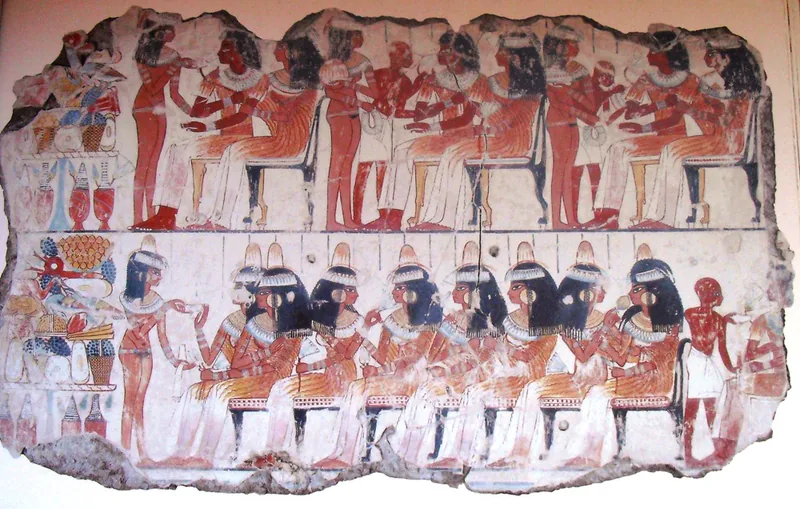
These scenes have been read in several ways. On one level they show the pleasures of elite life, which the tomb owner hoped to enjoy forever. On another, the lotus carries religious meaning: its scent revives, its opening recalls the sunrise, and its presence at a banquet held in the tomb links feasting with rebirth. The lotus also has erotic associations in Egyptian love poetry and art, where flowers and fragrance belong to the language of desire. The flower's place in architecture, in lotus-shaped column capitals and cups, and as the heraldic plant often associated with Upper Egypt, shows how deeply it was woven into Egyptian visual culture.
The Lotus in Death and Rebirth§
Because it rose each morning from the water, the lotus was a natural image of resurrection. The Book of the Dead includes a spell (Spell 81) "for being transformed into a lotus," in which the deceased declares that they are the pure lotus that came forth from the sunlight, identifying their own rebirth with the sun's emergence at creation.
The same idea appears in one of the most famous objects from the tomb of Tutankhamun: a painted wooden head of the young king emerging from a blue lotus, like the sun god at the first sunrise. Flowers, including the petals of the blue water lily, have been identified in the funerary garlands and collars of New Kingdom burials, among them those found in Tutankhamun's tomb. The dead were thus surrounded by the flower of renewal, its scent meant to revive them as Nefertem revived Ra.
Was the Blue Lotus a Sacred Intoxicant? The Modern Debate§
In the late twentieth century, the ethnobotanist William Emboden argued that Nymphaea caerulea had narcotic properties and that Egyptian scenes of people smelling lotus flowers, or of lotus near wine jars, depicted a ritual use of the plant to induce altered states, perhaps even a form of shamanic trance. His work made the blue lotus a fixture of literature on entheogens and sacred plants and fed a modern market in which the dried flower is sold, legally in some countries and restricted in others.
Many Egyptologists are cautious. The plant does contain alkaloids, including aporphine compounds, but their effects in the forms available to ancient Egyptians are uncertain, and no Egyptian text clearly describes the lotus as intoxicating. The iconography can be explained by the flower's scent, beauty and religious symbolism without assuming a drug effect, and the claim that flowers were steeped in wine at banquets rests on inference rather than direct evidence. The debate resembles those over Soma and the Eleusinian kykeon: an attractive hypothesis, difficult to prove or disprove from images and fragmentary texts. What is certain is the flower's enduring symbolic power, which passed into Graeco-Roman Egyptian religion, Western Egyptomania and the imagery of modern esoteric orders. Its pharmacology and safety are poorly studied, and this article describes its history and symbolism only.
Frequently asked questions§
Is the Egyptian blue lotus a real lotus?§
Not botanically. The Egyptian blue lotus is the blue water lily, Nymphaea caerulea. The true lotus, Nelumbo nucifera, is a different plant from Asia that reached Egypt only in the later first millennium BCE.
What did the blue lotus symbolise in ancient Egypt?§
It symbolised creation, the sun and rebirth. Myths described the sun god emerging from a lotus at the beginning of the world, and the flower's daily opening and closing made it an image of the sun's cycle and of the dead person's hoped-for renewal.
Who is Nefertem?§
Nefertem is the Egyptian god of the lotus blossom and its fragrance, shown as a young man with a lotus on his head. At Memphis he was regarded as the son of Ptah and Sekhmet, and texts describe him as the lotus at the nose of the sun god Ra.
Was the blue lotus used as a drug in ancient Egypt?§
This is debated. Some modern writers argue that the flower's mild psychoactive alkaloids were used in ritual and at banquets, but no Egyptian text clearly says so, and many Egyptologists think the images reflect the flower's scent and symbolism rather than drug use.
Sources and further reading§
- The Ancient Egyptian Book of the Dead — Raymond O. Faulkner, 1985
- The Odyssey — Homer, c. 700 BCE
- An Ancient Egyptian Herbal — Lise Manniche, 1989
- Sacred Luxuries: Fragrance, Aromatherapy, and Cosmetics in Ancient Egypt — Lise Manniche, 1999
- The Complete Gods and Goddesses of Ancient Egypt — Richard H. Wilkinson, 2003
- Plants of the Gods — Richard Evans Schultes & Albert Hofmann, 1979