Liber XXIX · Superstitions · Chapter III: Asian Superstitions
Thai Spirit Houses: San Phra Phum, Offerings and Meaning
Thai spirit houses explained: the san phra phum and san chao thi, Phra Phum and the phi, siting and consecration, offerings, the Erawan Shrine and more.

A Thai spirit house is a small shrine, usually raised on a post in the grounds of a home, shop, office or hotel, that provides a dwelling for the guardian spirit of the land. The most common form is the san phra phum, the shrine of Phra Phum, the lord of the place; it is often paired with a san chao thi for local and ancestral spirits. Owners give daily offerings of incense, flowers, food and drink so that the spirits remain content and protect the property rather than disturbing those who live on it.
What a Spirit House Is: San Phra Phum and San Chao Thi§
Spirit houses are among the most visible features of the Thai landscape. They stand in front of suburban houses and rice fields, on the forecourts of petrol stations, at the corners of factories and in the gardens of luxury hotels. Two main types are usually distinguished.
The san phra phum is the shrine of Phra Phum, the guardian of the land on which a building stands. It typically rests on a single pillar and is designed like a miniature temple or palace, often with tiered roofs, gilding and spires. The san chao thi, "shrine of the lord of the place", or san ta yai, "shrine of grandfather and grandmother", stands on four legs and resembles a traditional wooden Thai house. It is associated with the spirits of the locality and of former owners or ancestors. Many properties have both, side by side, with the Phra Phum shrine set slightly higher.
The logic is one of hospitality and negotiation. Before people built on a piece of land, spirits already lived there. Erecting a dwelling for them acknowledges their prior claim and invites them to move into a fitting residence, so that the human household can live alongside them without offence. Comparable ideas of house and land spirits in Europe are discussed in Household Spirits.
Phi, Phra Phum and the Layered Religion of Thailand§
Thai religion has often been described as layered. Most Thais are Theravada Buddhists, following the tradition described in Theravada Buddhism, but Buddhist practice coexists with belief in phi, a broad term for spirits that includes the dead, the guardians of villages and forests, and spirits of particular places and households. Alongside both stands a body of ritual derived from Indian Brahmanism, preserved through the royal court and through local ritual specialists.
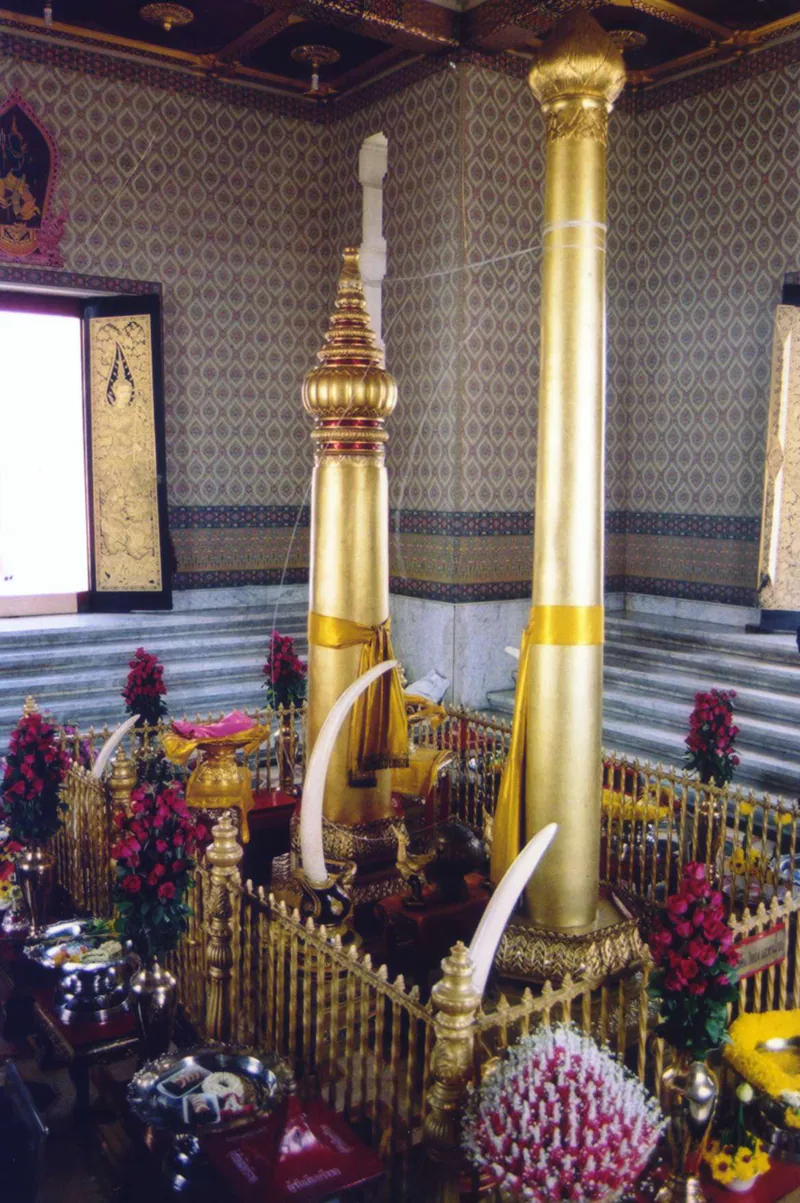
Phra Phum belongs to this Brahmanical layer. His name joins the honorific phra to phum, from the Sanskrit bhūmi, "earth" or "land". Thai ritual texts describe a group of Phra Phum, each guarding a particular kind of place such as houses, gardens, fields, gates or temples; the guardian of houses and dwellings is generally named Phra Chaimongkhon. In everyday speech, however, people usually speak simply of the chao thi, the lord of the place, or of the spirits of the land.
The anthropologist Stanley Tambiah, in his study of a north-eastern Thai village published in 1970, argued that these elements form a single religious field in which Buddhism, spirit cults and Brahmanical rites each have their own specialists and functions rather than being rival systems. Later scholars, including Pattana Kitiarsa and Justin McDaniel, have emphasised how fluid and creative popular practice is, especially in cities. Spirit houses illustrate the point: they are not Buddhist in doctrine, yet they are normal features of Buddhist homes.
Siting and Consecrating a Spirit House§
Traditionally a spirit house is installed before, or soon after, a building is occupied, and the ceremony is led by a ritual specialist, often called a phram (brahmin) or achan. The specialist consults astrological tables to choose an auspicious day and hour, a practice related to the calendars described in Lucky and Unlucky Numbers and Days.
Widely repeated rules govern the site. The shrine should stand in an open position where the shadow of the main house will not fall on it, should not face a toilet or be placed beside one, and should be set at about or above eye level so that the spirits are not looked down upon. A common preference is for the shrine to face north or east, though practitioners differ. In the consecration rite, the specialist invites the spirit to take up residence, offerings are presented, and sacred thread and gold leaf may be used; afterwards the household is responsible for maintaining the shrine.
When a building is demolished or an old shrine is replaced, the old spirit house is not thrown away. It is ritually vacated and often taken to a temple or set beneath a large sacred tree, where clusters of retired spirit houses can sometimes be seen, weathered and still decorated with offerings.
Offerings: Garlands, Figurines and Red Soda§
Daily care for the spirit house is usually the work of the household or the staff of a business. Common offerings include incense sticks, candles, garlands of jasmine and marigold (phuang malai), cooked rice, fruit, sweets, water and drinks. Bottles of red soda, often strawberry flavour, served with a straw, have become one of the most recognisable offerings. Popular explanations vary: red is an auspicious colour, sweet drinks are thought to please spirits, and some people suggest that red soda replaced older offerings associated with blood. None of these explanations is authoritative.
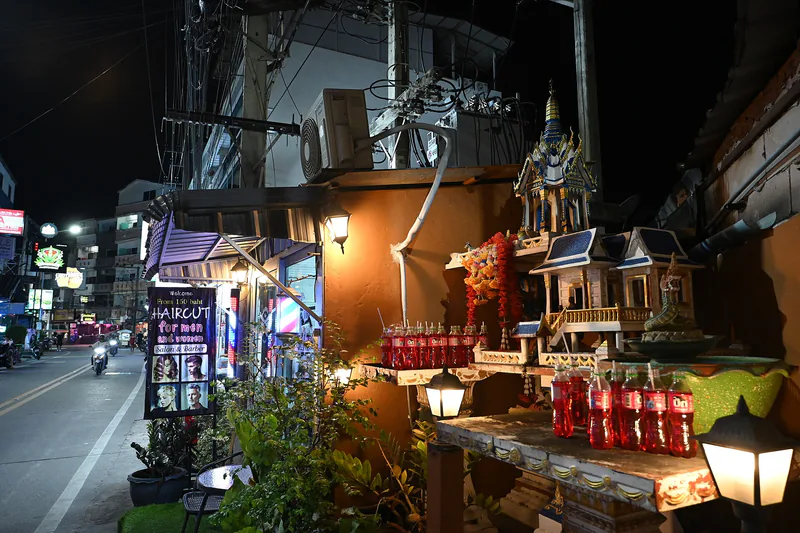
Inside and around the shrine people place small figurines: classical dancers to entertain the spirit, attendants and servants, elephants and horses as mounts, and sometimes models of cars or houses. At dangerous bends in the road, figures of zebras are often left at roadside shrines, a modern custom whose origins are uncertain; one popular explanation links the zebra's stripes to pedestrian crossings and safety. When a wish is granted, people may return with a promised offering as thanks, a pattern of vow and repayment found widely in Thai devotion. The general logic of offering and luck is discussed in Luck, Omens and Portents.
The Erawan Shrine and Spirit Houses in the City§
Spirit houses are not a village survival; they have flourished in modern Bangkok. The most famous is the Erawan Shrine at the Ratchaprasong intersection, built in 1956 during the construction of the government-owned Erawan Hotel after a series of mishaps was blamed on the site's spirits. On a specialist's advice a shrine was erected to the Hindu god Brahma, known in Thai as Phra Phrom, and the problems were said to cease. The shrine became one of the busiest devotional sites in the city, where worshippers commission performances by traditional dancers to give thanks for answered prayers. In August 2015 a bomb exploded at the shrine, killing twenty people; it was repaired and reopened within days.
Bangkok also has its city pillar shrine (lak mueang), established when the capital was founded in 1782, which houses the guardian spirit of the city itself. Office towers, condominiums and shopping centres routinely install substantial shrines, and the choice of god or spirit, the scale of the shrine and the care given to it can become part of a building's public identity.
Spirit Houses Across Mainland Southeast Asia§
Similar shrines are found throughout the region. In Laos, households and villages maintain shrines for local phi, and in Cambodia small houses for neak ta, the guardian spirits of land and place, stand in villages, fields and city streets. In Myanmar, devotion to the nat spirits includes the household guardian, traditionally honoured with a coconut hung in the house. Overseas Chinese communities in Malaysia and Singapore maintain shrines to Datuk Kong, local guardian spirits that blend Chinese and Malay traditions. Spirit houses also travel with migrants and can be found outside Thai restaurants and homes in Europe, North America and Australia.
These practices share the conviction that land is not empty: it belongs first to invisible owners whose goodwill must be secured. Asian beliefs about luck and the spirit world more generally are surveyed in Asian Superstitions, and the Chinese festival for wandering spirits in The Hungry Ghost Festival.
Frequently asked questions§
What is the purpose of a Thai spirit house?§
A spirit house gives the guardian spirits of a piece of land a dwelling of their own. By housing and feeding them with regular offerings, owners hope to keep the spirits content so that they protect the property instead of causing trouble.
What is the difference between a san phra phum and a san chao thi?§
The san phra phum honours Phra Phum, the guardian of the land, stands on a single post and usually looks like a temple. The san chao thi or san ta yai honours local and ancestral spirits, stands on four legs and resembles a traditional Thai house.
Why do people offer red soda at spirit houses?§
Red soda has become a common offering in recent decades. People explain it in different ways: red is lucky, sweet drinks please the spirits, or the soda stands in for older offerings. There is no single agreed explanation.
Are spirit houses Buddhist?§
Spirit houses are not part of Buddhist doctrine; they come from older Thai belief in phi and from Brahmanical ritual. They are nevertheless a normal part of life for most Thai Buddhists, and scholars see them as one layer of a single religious world.
Sources and further reading§
- Buddhism and the Spirit Cults in North-east Thailand — Stanley J. Tambiah, 1970
- Mediums, Monks, and Amulets: Thai Popular Buddhism Today — Pattana Kitiarsa, 2012
- The Lovelorn Ghost and the Magical Monk: Practicing Buddhism in Modern Thailand — Justin Thomas McDaniel, 2011
- Monks and Magic: An Analysis of Religious Ceremonies in Central Thailand — B. J. Terwiel, 1975
- Essays on Thai Folklore — Phya Anuman Rajadhon, 1968