Liber XXIV · Satanism · Chapter V: Temple of Set
The Book of Coming Forth by Night: Temple of Set's Founding Text
The Book of Coming Forth by Night (1975): Michael Aquino's received text, its Egyptian and Thelemic sources, the Aeon of Set, Xeper and the Temple of Set.

The Book of Coming Forth by Night is a short text that Michael Aquino said he received from the Prince of Darkness on the night of the summer solstice, 21–22 June 1975, after he and other members had left the Church of Satan. In it the entity names itself Set, declares the end of the "Age of Satan" proclaimed by Anton LaVey and inaugurates an "Aeon of Set" whose Word is Xeper, "to come into being". It is the founding document of the Temple of Set and one of the few received scriptures in modern Satanism.
The Crisis of 1975 and the Question of Authority§
The Church of Satan had been founded in San Francisco in 1966, and its history is told in LaVeyan Satanism and the Church of Satan. By the mid-1970s tension had grown between Anton LaVey's symbolic, atheistic approach and a group of priests, led by Michael Aquino, who understood the Prince of Darkness as a real intelligence and saw the Church as an initiatory body. When LaVey announced in 1975 that higher degrees could be awarded in recognition of contributions, including material ones, Aquino and others resigned, regarding the decision as the sale of priesthood.
The dissidents faced a problem familiar from the history of religions: on what authority could a breakaway group claim to continue the original movement? The Church of Satan had spoken of an "Infernal Mandate", a commission from the Prince of Darkness that legitimated its priesthood. Aquino's answer was to seek a fresh communication from the source of that mandate. The text he produced settled the question for his followers by declaring that the mandate had been withdrawn from LaVey and transferred to a new organisation. The life of its author is traced in Michael Aquino.
Reception on the Summer Solstice§
According to Aquino's account, he performed a ritual working on the night of 21–22 June 1975, addressed to the Prince of Darkness and asking for guidance in the crisis. In the course of the night he wrote down a text that he understood as a communication from that being. He emphasised that it was not automatic writing in the spiritualist sense but a conscious reception, in which he remained aware of himself as the recorder.
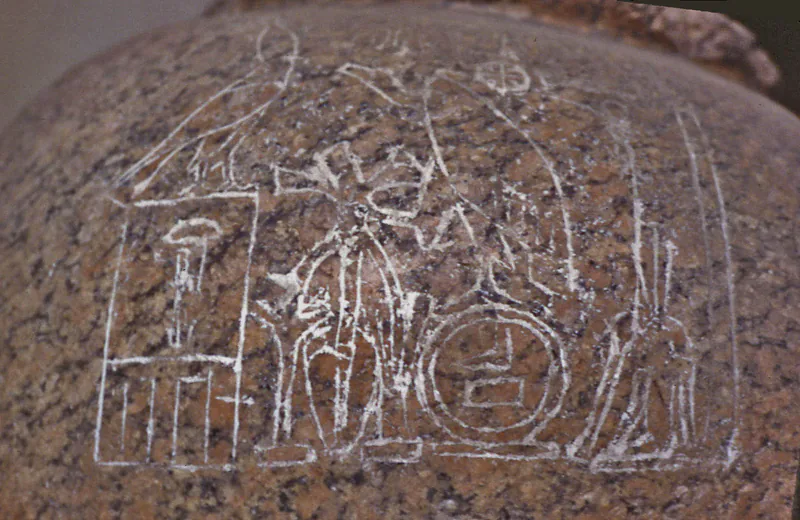
The text is short, a few pages in its usual printed form, and written in an elevated, archaic register. It addresses Aquino directly, comments on the history of the Church of Satan, and lays down principles for the organisation that was to follow. It was circulated first among the founders of the new group and later included in Aquino's own historical writings and in Temple of Set publications. Because it is a modern, copyrighted text, it is summarised here rather than quoted.
Contents and Themes of the Text§
Set as the True Name of the Prince of Darkness§
The central claim of the book is that the being whom the Church of Satan called Satan is in truth Set, the Egyptian god, and that "Satan" was a later, Hebrew-derived name associated with distortion and enmity. Set is presented as the principle of isolate, self-aware intelligence, standing apart from the natural order, who gave humanity the capacity for conscious self-creation. The book asks that he be honoured by his true name and understood as a model rather than worshipped as a master.
The End of the Age of Satan and the Aeon of Set§
The text treats the Church of Satan's "Age of Satan", dated from 1966, as a necessary but transitional stage. Its function had been to break the hold of conventional religion through a provocative image; that work was done, and the image had become a hindrance. In its place the book inaugurates an Aeon of Set, in which the emphasis moves from rebellion to the deliberate development of the individual psyche.
Xeper as the Word of the Aeon§
The book names Xeper as the Word of the new aeon. The term comes from the Egyptian verb ḫpr, "to come into being" or "to become", which is also the root of the name of Khepri, the scarab-headed god of the rising sun. In Setian usage it designates conscious, self-directed becoming: the process by which an individual creates and strengthens a self that is independent of the natural world. The concept is explained further in The Temple of Set and the Left-Hand Path.
Egyptian and Thelemic Sources§
The title is a deliberate allusion. The collection of ancient Egyptian funerary spells known in English as the Book of the Dead was called by the Egyptians the spells for "coming forth by day", meaning the deceased's emergence into the light of the afterlife. By inverting the phrase, Aquino signalled that his text concerned a different kind of emergence: the coming forth of consciousness in darkness, set apart from the solar and natural cycle. The ancient texts themselves are introduced in The Egyptian Book of the Dead.

Aquino read Egyptological scholarship, notably Herman te Velde's study Seth, God of Confusion (1967), which traced how Set changed from a respected, ambivalent deity of the desert, storms and foreigners into a figure demonised in later Egyptian religion and identified by Greek writers with the monster Typhon. Egyptologists stress that the Setian Set is a modern theological construction: it selects the image of a god of the "other" and of boundaries and gives it a philosophical meaning that no ancient source states. The wider religious background is outlined in Ancient Egyptian Religion.
The structural model is unmistakably Thelemic. In 1904 Aleister Crowley had received The Book of the Law in Cairo, a text that proclaimed a new aeon, the Aeon of Horus, and gave the Word Thelema, "will". In Crowley's grade system a Magus is one who utters the Word of an aeon. Aquino accepted this framework and presented his book as continuing and correcting Crowley's revelation, an approach that led him to claim the grade of Magus. The background is explained in Thelema and the Book of the Law. Scholars such as Asbjørn Dyrendal have used the book as a clear example of Crowley's influence on organised Satanism.
Place in the Temple of Set§
The Temple of Set was incorporated in California in 1975, and the book has served from the start as its founding document. Yet Setians are encouraged to read it critically rather than devotionally. The Temple does not require members to believe that Set literally dictated it; some regard Set as a real being, others as a principle or a metaphor for self-awareness, and the organisation tolerates this range of views. The text's practical importance lies in its definition of the Temple's direction: a move away from LaVeyan rebellion towards an initiatory philosophy of self-development.
The book also shaped the Temple's symbolism and structure. Its emphasis on the Word of a Magus made room within Setian theology for later Magi to articulate further Words that refine or extend Xeper, a feature that allows doctrinal development without a single fixed creed. Writers in the Temple's tradition, such as Don Webb, have commented on the text as a starting point for practice rather than a closed revelation.
Scholarly Assessment and Reception§
Historians and sociologists of religion treat The Book of Coming Forth by Night as a classic case of charismatic legitimation. A schism over money and degrees was resolved by an appeal to revelation, which conferred authority on the dissident leader and reframed a quarrel as the turning of an aeon. Kennet Granholm describes the transition it marked as a move from Satanism to what he calls "post-Satanism": a left-hand path philosophy that keeps the Prince of Darkness as an emblem but turns its focus to self-deification and initiatory work.
Outside the Temple, reception has been mixed. The Church of Satan dismissed the text as a pretext for schism, and some Satanists regard its Egyptian framework as an unnecessary metaphysics. Within the broader occult milieu, however, it influenced later initiatory groups, especially in Scandinavia and the English-speaking world, that combine Egyptian, Germanic and Thelemic symbolism with an emphasis on the individual will.
The text also illustrates a recurring pattern in modern esotericism: the received book. From spiritualist communications to Crowley's Book of the Law and later channelled texts, such revelations allow new movements to claim continuity with an ancient source while introducing innovations. Aquino's book is unusual in being self-consciously part of that tradition, citing and correcting its predecessor.
Frequently asked questions§
Who wrote The Book of Coming Forth by Night?§
Michael Aquino wrote it down on the night of 21–22 June 1975. He presented it as a communication from the Prince of Darkness, who identified himself as Set; historians treat it as Aquino's received text.
What does Xeper mean?§
Xeper comes from the Egyptian verb meaning "to come into being" or "to become". In the Temple of Set it denotes the conscious, self-directed development of the individual self and is regarded as the Word of the Aeon of Set.
Do Setians treat the book as scripture?§
It is the Temple's founding text, but members are not required to accept it as literal dictation. It is read as an authoritative starting point and a statement of the Temple's direction rather than as a code of commands.
How is it related to Crowley's Book of the Law?§
It follows the same pattern: a received text that opens a new aeon and gives a Word through a Magus. Aquino presented it as a continuation and correction of Crowley's revelation of 1904.
Sources and further reading§
- The Book of the Law (Liber AL vel Legis) — Aleister Crowley, 1904
- Seth, God of Confusion: A Study of His Role in Egyptian Mythology and Religion — Herman te Velde, 1967
- The Ancient Egyptian Book of the Dead — R. O. Faulkner, 1985
- Mysteries of the Temple of Set — Don Webb, 2004
- Uncle Setnakt's Essential Guide to the Left Hand Path — Don Webb, 1999
- The Devil's Party: Satanism in Modernity — Per Faxneld and Jesper Aagaard Petersen, 2013
- Aleister Crowley and Western Esotericism — Henrik Bogdan and Martin P. Starr, 2012
- Satanism: A Social History — Massimo Introvigne, 2016