Liber XXV · Secret Societies · Chapter V: Templar Legends
The Priory of Sion Hoax: Pierre Plantard and Rennes-le-Château
The Priory of Sion hoax explained: Pierre Plantard's 1956 society, forged secret dossiers, Rennes-le-Château and the road to The Da Vinci Code.

The Priory of Sion was a small French association founded in 1956 by Pierre Plantard, who later presented it as a secret order dating from 1099, guardian of a Merovingian royal bloodline and master of the Knights Templar. The legend was built on forged documents that Plantard and his associates deposited in the Bibliothèque nationale in Paris in the 1960s, popularised by The Holy Blood and the Holy Grail (1982) and The Da Vinci Code (2003), and admitted to be fabricated by Plantard himself under oath in 1993.
What the Priory of Sion Legend Claims§
In its developed form the legend runs as follows. In 1099, after the crusaders took Jerusalem, Godfrey of Bouillon founded an Order of Sion at the abbey of Notre-Dame du Mont Sion. Its purpose was to protect a sacred lineage descended from the Merovingian kings of the Franks, and in particular from Dagobert II, whose son Sigebert IV supposedly survived the assassination of his father in 679. The Knights Templar were created as the order's military and administrative arm. In 1188, at a ceremony called the "cutting of the elm" at Gisors, the Priory separated from the Templars, and it thus survived their suppression in 1307–1314 (see Templar legends).
Since then the Priory had been ruled by a line of "Nautonniers" or grand masters, a list that included Nicolas Flamel, Sandro Botticelli, Leonardo da Vinci, Robert Fludd, Isaac Newton, Charles Nodier, Victor Hugo, Claude Debussy and Jean Cocteau. Its secret, preserved through the centuries, concerned the legitimate claim of the Merovingian bloodline to the throne of France, and Pierre Plantard was presented as its living heir.
Every element of this story can be traced to typescripts produced in France between the late 1950s and the 1970s. There was a real medieval abbey of Mount Sion in Jerusalem, whose canons had houses in Europe, but it has no documented link with Godfrey's descendants, the Templars or the figures on the list.
Bérenger Saunière and the Treasure of Rennes-le-Château§
The Priory legend attached itself to an older local mystery. Bérenger Saunière (1852–1917) was parish priest of Rennes-le-Château, a hilltop village in the Aude, from 1885. In the 1890s and 1900s he spent large sums renovating his church of Sainte-Marie-Madeleine and building a villa, the Villa Bethania, a garden and a crenellated library tower, the Tour Magdala. The church received a striking new decoration, including a holy-water stoup supported by a crouching devil, often identified as the demon Asmodeus, and the Latin inscription Terribilis est locus iste, "this place is terrible" or awe-inspiring, a standard phrase from Genesis used in church dedications (see Genesis 28).
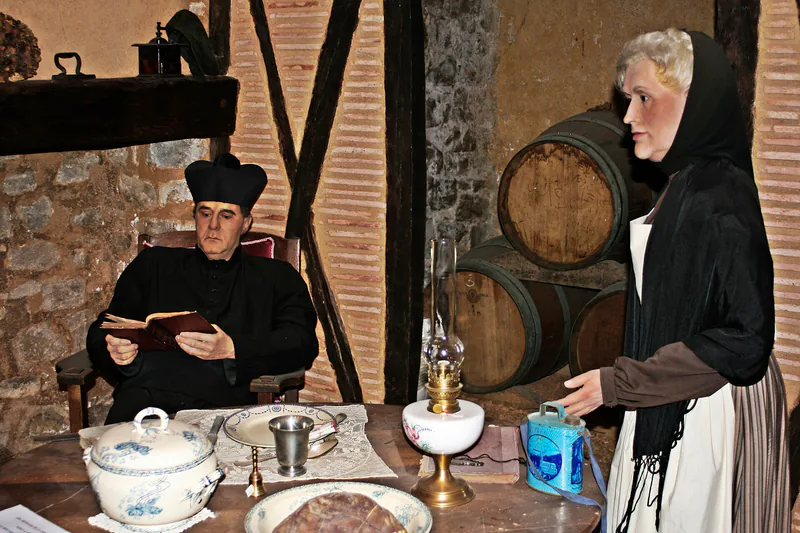
The source of Saunière's money is documented in his own papers and in the proceedings brought against him by his bishop. He advertised widely in Catholic periodicals for mass stipends, receiving far more requests and payments for masses than he could possibly have said; in 1910–1911 he was tried by the diocesan authorities for trafficking in masses and suspended. Historians of the affair, including Bill Putnam and John Edwin Wood, conclude that this, together with donations, explains his wealth.
After Saunière's death his housekeeper Marie Dénarnaud kept the property, and in the 1940s it passed to Noël Corbu, who turned the villa into a hotel-restaurant. In the mid-1950s Corbu told regional journalists that Saunière had discovered a royal treasure, a story that brought visitors and treasure hunters to the village. This was the story Plantard and his circle encountered.
Pierre Plantard and the Real Priory of Sion§
Pierre Plantard (1920–2000) had been active during the Occupation in small nationalist and esoteric groups; in 1942 he founded an association called Alpha Galates and edited a bulletin, Vaincre, with antisemitic and pro-Vichy content. In the 1950s he lived in Annemasse near the Swiss border.
In 1956 Plantard and three acquaintances registered a "Prieuré de Sion" with the sub-prefecture of Saint-Julien-en-Genevois. The name almost certainly came from Mont Sion, a hill near the town. Its statutes and its bulletin, Circuit, concerned the rights of tenants in low-cost housing; nothing in the documents suggests a medieval order. The association soon became dormant. Over the following decade Plantard began to reinvent it as the visible face of an ancient brotherhood, and to present himself as a descendant of the Merovingians under the name Pierre Plantard de Saint-Clair.
The Dossiers Secrets and the Forged Parchments§
The key instrument of the hoax was a set of documents placed in the Bibliothèque nationale between about 1964 and 1967. The best known, the Dossiers secrets d'Henri Lobineau, attributed to a fictitious author, contained genealogies of the Merovingian survival line, lists of the Priory's grand masters and allusions to Rennes-le-Château. Because they were catalogued in a national library, later writers treated them as archival sources rather than as recent deposits by interested parties.
To link the Priory to Saunière, Plantard's friend Philippe de Chérisey, an aristocratic actor and humorist, produced two "parchments" said to have been found by the priest inside a pillar of his church. They contained Latin Gospel passages with hidden messages encoded by displaced letters, one of them reading, in French, that "this treasure belongs to Dagobert II king and to Sion". The journalist Gérard de Sède, who worked with Plantard, published the parchments in his book L'Or de Rennes (1967). De Chérisey later stated that he had composed them himself, and researchers have noted that their Latin follows a modern scholarly edition of the Gospels rather than any manuscript Saunière could have found.
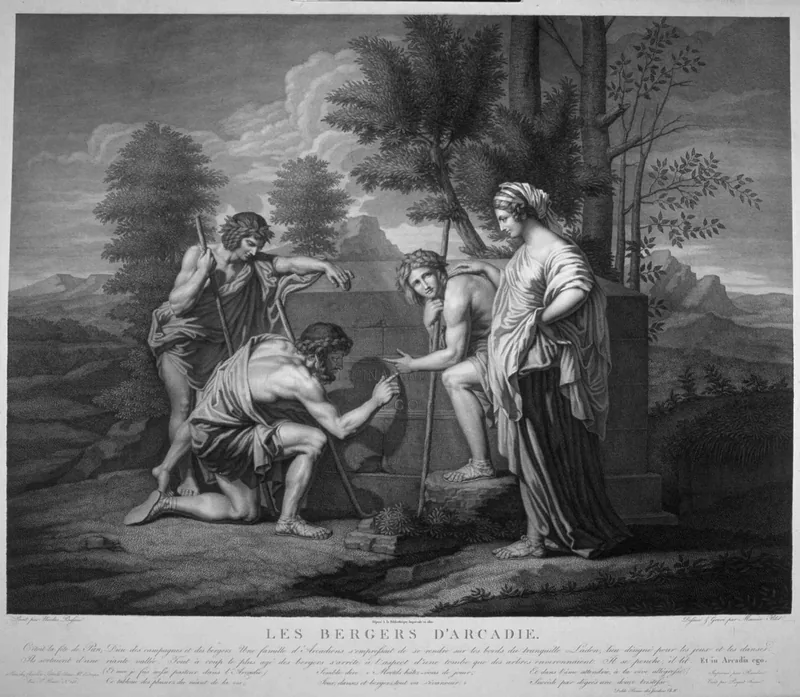
The dossiers also enlisted art. Nicolas Poussin's painting The Arcadian Shepherds, with its tomb inscribed Et in Arcadia ego, was claimed to depict a real tomb near Rennes-le-Château and to conceal the secret. A tomb at Les Pontils did resemble the painting, but it was built in the twentieth century and demolished in 1988.
The Holy Blood and the Holy Grail and The Da Vinci Code§
The story reached an international audience through the British writer Henry Lincoln, who read de Sède and made three BBC Chronicle documentaries on Rennes-le-Château in the 1970s. With Michael Baigent and Richard Leigh he then wrote The Holy Blood and the Holy Grail (1982), which took the Priory's documents largely at face value and added a new hypothesis: that the Merovingian bloodline descended from a marriage of Jesus and Mary Magdalene, and that the Holy Grail, sang réal, meant "royal blood". The book wove in the Cathars, the Templars and Freemasonry, and became a bestseller.
Dan Brown's novel The Da Vinci Code (2003) opened with a page headed "Fact" stating that the Priory of Sion was a real European secret society founded in 1099 and that parchments known as Les Dossiers Secrets in the Bibliothèque nationale proved it. The novel sold tens of millions of copies and made the Priory one of the most widely recognised secret societies in the world. Baigent and Leigh sued Brown's publisher in London for copying their work and lost in 2006, a judgment upheld on appeal in 2007.
How the Hoax Was Exposed§
French researchers were sceptical from the start. Writers such as Jean-Jacques Bedu, Pierre Jarnac and others traced the documents to Plantard's circle, and the quarrels among the hoaxers themselves, who fell out over money and credit in the 1970s, produced partial admissions. De Chérisey's own account of the forged parchments circulated privately.
The end came through an unexpected route. In 1989 Plantard issued a revised history, now dating the Priory to 1681, and named among its recent grand masters Roger-Patrice Pelat, a businessman and friend of President Mitterrand who had died amid an insider-trading scandal. In 1993 the investigating judge Thierry Jean-Pierre summoned Plantard. According to the standard accounts, Plantard admitted under oath that he had invented the Priory's history, his house was searched, and he was formally warned. He withdrew from public life and died in 2000.
For historians the Priory is now a case study in modern legend-making: a few typescripts, a real local mystery, and the prestige of a national library combined into a myth that borrowed the older Templar survival legend and the language of secret-society conspiracy.
Frequently asked questions§
Is the Priory of Sion real?§
An association called the Priory of Sion was registered in France in 1956 by Pierre Plantard and three others, but it was a minor local group. The claim that it was founded in 1099 and directed by Leonardo da Vinci, Newton and Victor Hugo rests on documents fabricated in the 1960s, and Plantard admitted inventing its history in 1993.
Who created the Priory of Sion hoax?§
The principal author was Pierre Plantard, assisted by Philippe de Chérisey, who forged the coded parchments, and promoted by the writer Gérard de Sède. The British authors of The Holy Blood and the Holy Grail later popularised it, apparently believing much of it.
Did Bérenger Saunière find a treasure at Rennes-le-Château?§
There is no evidence that he did. His papers and his trial before the diocesan court show that he raised large sums by soliciting payments for masses, which he could not all have said, together with donations. The treasure story was spread from the 1950s by the hotelier Noël Corbu.
Is The Da Vinci Code based on fact?§
No. Its "Fact" page about the Priory of Sion repeats claims from Plantard's forged dossiers. Historians reject the novel's account of the Priory, the Merovingian bloodline and the history of early Christianity.
Sources and further reading§
- L'Or de Rennes — Gérard de Sède, 1967
- The Holy Blood and the Holy Grail — Michael Baigent, Richard Leigh and Henry Lincoln, 1982
- Rennes-le-Château: autopsie d'un mythe — Jean-Jacques Bedu, 1990
- The Treasure of Rennes-le-Château: A Mystery Solved — Bill Putnam and John Edwin Wood, 2003
- The Da Vinci Code — Dan Brown, 2003
- Truth and Fiction in The Da Vinci Code — Bart D. Ehrman, 2004
- The Murdered Magicians: The Templars and Their Myth — Peter Partner, 1982