St Agnes' Eve Dream Divination for a Future Love
The St Agnes' Eve custom of dreaming of a future love, with pins, prayer and not looking back, plus the Hallowe'en love divinations and their history.
- TraditionEnglish and Scottish folk custom, recorded from the 17th century; Hallowe'en love divinations of the same family
- ForDreams, Love, Divination
- DifficultySimple
- TimeAn evening and a night
- WhenSt Agnes' Eve, the night of 20 January, before her feast on 21 January; Hallowe'en (31 October) for related customs

On the night of 20 January, the eve of St Agnes' feast, young women in England and Scotland followed simple rites in the hope of seeing their future love in a dream. They went to bed after a light supper or none, lay on their backs, did not look behind them, and asked the saint for a vision. John Keats made the custom famous in The Eve of St Agnes. The working below follows the recorded customs gently and keeps the question open: not "will this person love me?" but "what does love hold for me?"
How to do it§
- Keep the day simple. The old custom was a fast — "St Agnes' fast" — and some went to bed supperless. Instead, eat a light, early supper and drink water; there is no need to go hungry.
- Prepare the bed. Put on clean night clothes or fresh sheets. Place a notebook and pen within reach.
- The pins. John Aubrey recorded that on St Agnes' night one took a row of pins and pulled them out one after another, saying a Paternoster with each and sticking each pin in the sleeve, to dream of a future spouse. A gentler form: hold a sprig of rosemary or thyme and say the Lord's Prayer, or a short prayer of your own, once.
- Ask your question. Lying on your back, ask in your own words: "St Agnes, show me in my dreams what love will come to me." Keep it general; the custom was a hope for one's own future, not a means of drawing a particular person.
- Do not look back. Custom said not to look behind you, or to speak, after the prayer; settle down and sleep.
- Record the dream. On waking, before getting up or speaking, write down whatever you remember: people, places, colours, feelings. Folk belief said the dream would show the face of a future partner; most people today read it more loosely.
- Close. Thank St Agnes, or simply mark the end of the custom, and put the pins away or the sprig in a vase.
Origins and history§
St Agnes was a young Roman martyr, probably killed in the early fourth century, whose feast falls on 21 January. Her legend made her a patron of purity and of girls, and in medieval and later folk belief her eve became a night for maidens' divinations about marriage. The antiquary John Aubrey, writing in the late seventeenth century, records the pin custom described above in his Miscellanies (1696), one of the earliest clear descriptions of the custom.
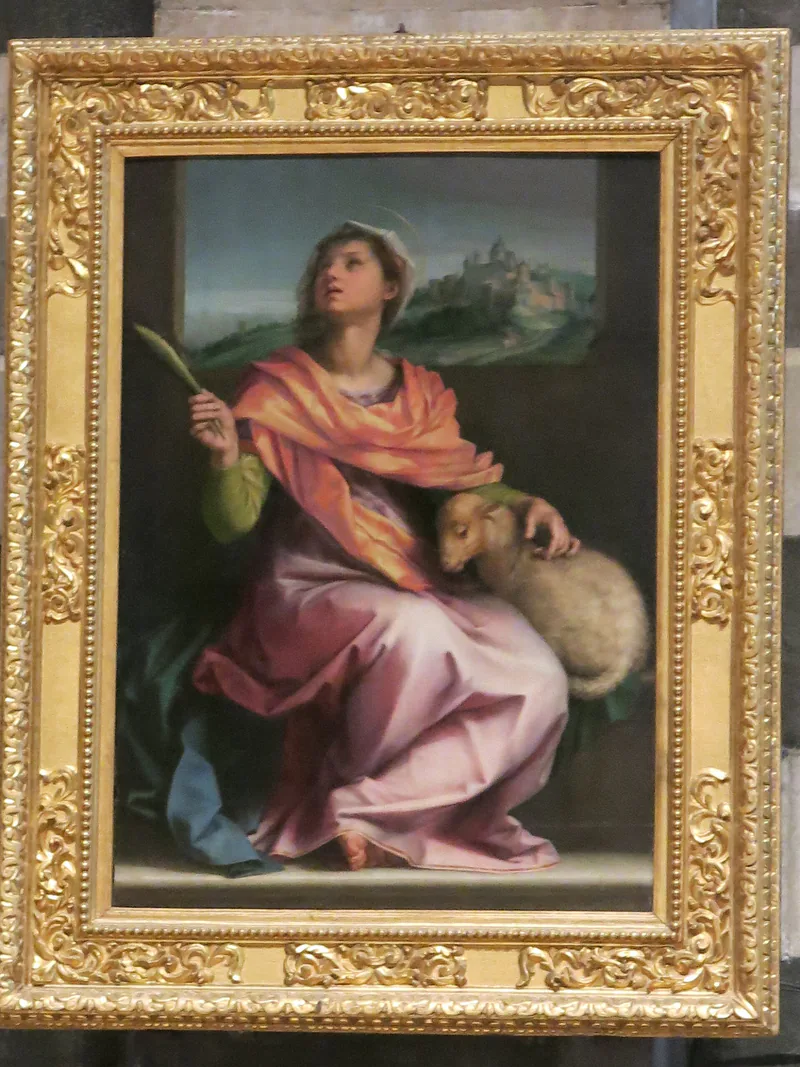
Keats's poem, written in 1819 and published in 1820, draws on this lore: Madeline goes supperless to bed, must not look behind or sideways, and hopes for "visions of delight." Its opening line, "St. Agnes' Eve—Ah, bitter chill it was!", fixed the night in the English imagination.
St Agnes' Eve was one of several nights for love divination in the British year. On St Mark's Eve (24 April) people watched the church porch or baked a "dumb cake" in silence; on Midsummer Eve they sowed hempseed; and above all on Hallowe'en young people in Scotland, Ireland and northern England tried a host of rites. Robert Burns's poem "Halloween" (1786) describes many of them: pulling kale stalks blindfolded, burning paired nuts in the fire to see whether they burned quietly together or jumped apart, eating an apple before a mirror to glimpse a face over one's shoulder. Ronald Hutton's The Stations of the Sun traces these customs and shows how they were often light-hearted games as much as serious divinations. See what is divination and dreams and astral projection.
Variations§
- Hallowe'en nuts: two hazelnuts placed together at the edge of a fire; if they burn quietly side by side, love will be steady.
- Apple peel: peel an apple in one long strip and toss it over your shoulder; the letter it forms is read as an initial.
- Kale or cabbage stalks: pulled from the garden blindfold on Hallowe'en; their shape and the earth clinging to them told of a future partner.
- Herbal dream pillow: a small pillow of lavender or hops under the pillowcase, a later and modern addition.
Safety and good sense§
- Do not fast if you have diabetes, an eating disorder, are pregnant or take medication that requires food; a light supper keeps the spirit of the custom.
- Keep pins well away from the bed and from children; never sleep with pins in clothing.
- If you burn nuts or use a mirror by candlelight, keep the flame in a secure holder, never unattended, and away from hair and bedding.
- Dreams reflect our hopes and worries; they do not oblige anyone to love us. Divination of this kind is a seasonal custom, not a guide to choices about real relationships.
Sources and further reading§
- The Stations of the Sun: A History of the Ritual Year in Britain — Ronald Hutton, 1996
- Popular Magic: Cunning-Folk in English History — Owen Davies, 2003
- Religion and the Decline of Magic — Keith Thomas, 1971
- Miscellanies upon Various Subjects — John Aubrey, 1696
- The Eve of St Agnes — John Keats, 1820