Liber XXIII · Rastafari · Chapter V: Nyabinghi, Reasoning & Ritual
Burru and Kumina: The African Roots of Nyabinghi Drumming
Burru and Kumina, the Afro-Jamaican drum traditions behind Nyabinghi: Kongo religion in St Thomas, Burru drummers of Kingston and their Rastafari heirs.

The drums of the Rastafari Nyabinghi, the bass, funde and repeater, did not originate with the movement. Most scholars trace them to Burru, a secular drumming tradition of rural Clarendon and West Kingston, and more distantly to Kumina, a Kongo-derived religion of ancestor veneration brought to the parish of St Thomas by Central African indentured labourers after emancipation. Rastafari took up these African-Jamaican forms in the 1940s and 1950s and turned them into a vehicle for chant and praise.
The Rastafari drums and the gatherings at which they are played are described in Nyabinghi and reasoning; this article looks at what came before them.
Drums, Slavery and Survival in Jamaica§
Enslaved Africans in Jamaica came from many regions, among them the Gold Coast, the Bight of Biafra and West-Central Africa, and they brought with them a wealth of drum traditions. Planters and colonial governments regarded drumming with suspicion, since drums could summon gatherings and signal revolt, and laws in Jamaica and other colonies at times restricted or banned them. Drumming nonetheless survived in religious gatherings, at funerals and wakes, at the Christmas festivities of Jonkonnu, and among the Maroons, the communities of escaped Africans who won their autonomy from the British in treaties of 1739.
After emancipation in 1838, Jamaica's poor developed several drum-centred traditions: the healing and possession religion of Myal and its successor Revival, the Gumbay drumming of certain rural districts, the Maroon Kromanti ceremonies, and the two traditions that matter most for Rastafari, Kumina and Burru. Their place in the wider family of African diasporic religions has been a major subject of Caribbean scholarship.
Kumina: A Kongo Religion in St Thomas§
Between 1841 and 1865 several thousand Africans arrived in Jamaica as indentured labourers. Many had been taken from slave ships by the British navy and resettled; a large proportion came from the Kongo region of West-Central Africa. The historian Monica Schuler traced their history, and the linguist Maureen Warner-Lewis showed that many of them settled in the parish of St Thomas, in eastern Jamaica, where their descendants preserved a religion called Kumina.
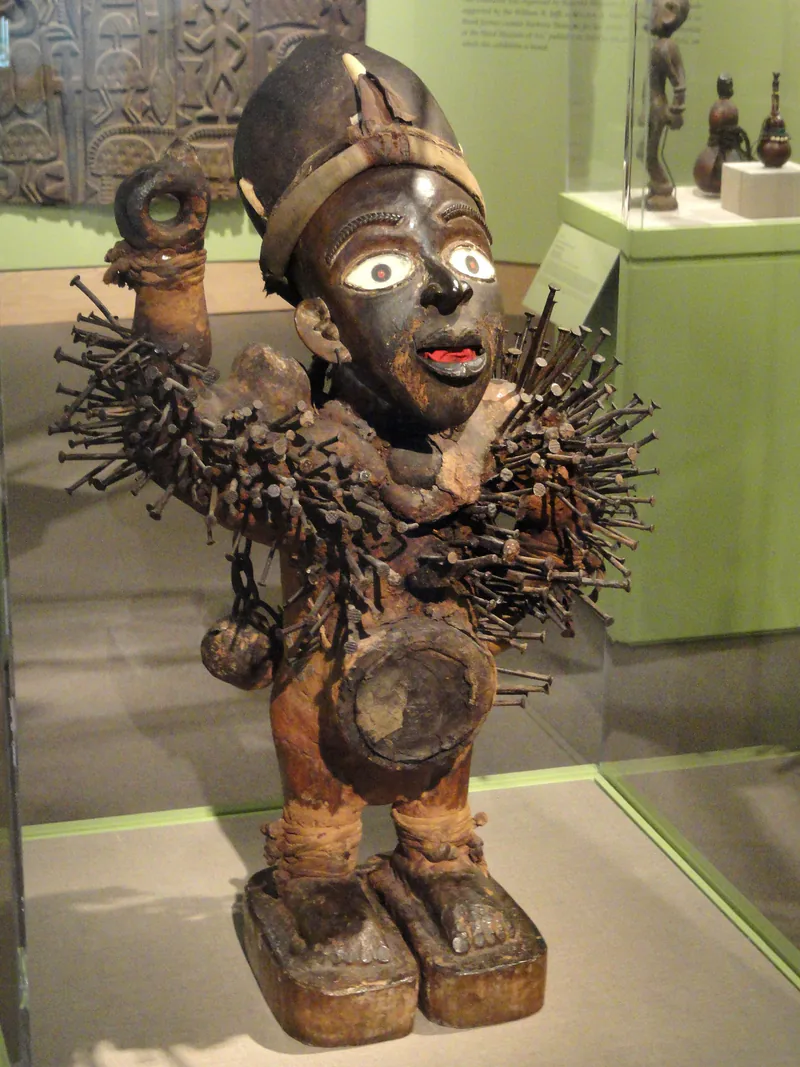
Kumina is centred on the ancestors. Its ceremonies, held at wakes, memorials, times of illness or trouble, and celebrations, invite the spirits of the dead to join the living. Songs are sung in two registers: bailo songs in Jamaican English and sacred "country" songs in a language derived from Kikongo, which Warner-Lewis studied in detail. At the height of a ceremony, participants may be possessed by ancestral spirits, who are understood to dance, speak and give counsel through them. The religion has clear parallels with the Kongo traditions of medicine and the dead described in minkisi, Kongo sacred medicines.
The music is carried by two drums: the deep kbandu, which keeps a steady pulse, and the playing cast, the lead drum, whose drummer sits astride it and varies its pitch with his heel. Shakers, scrapers and sticks beaten on the drum's body complete the ensemble. One of the best-known Kumina leaders of the twentieth century was Imogene "Queenie" Kennedy, whose performances and teaching made the tradition known well beyond St Thomas. The anthropologist Kenneth Bilby and the Kongo scholar Fu-Kiau kia Bunseki published a classic study of Kumina in 1983.
Burru: Drums of Work, Welcome and Song§
Burru is less well documented. Most accounts associate it with the parish of Clarendon, in central Jamaica, and describe it as a tradition of drumming and song that had no religious ceremony of its own. A traditional explanation, recorded by later writers but difficult to verify, holds that some planters allowed Burru drummers to play in the fields during slavery to keep the rhythm of work.
In the early twentieth century Burru drummers moved with other migrants to Kingston and settled in the poor districts of the west of the city. There they were known for a distinctive custom: at Christmas and on other occasions they welcomed people returning home from prison with drumming and with songs that commented on the events of the past year, often naming and mocking wrongdoers in the community. Burru men had a reputation among the respectable classes as rough characters, and they shared the margins of urban society with the early Rastafari.
The Burru ensemble had three drums: a large bass drum played with a padded stick, a mid-sized funde that kept a steady rhythm, and a smaller repeater (sometimes called kete or akete) that improvised over the others. These are the names and roles of the Rastafari Nyabinghi drums today. The ethnomusicologist Verena Reckord, writing in the 1970s, gave the most influential account of how this ensemble passed to the Rastafari.
How Rastafari Took Up the Burru Drums§
In the late 1940s and early 1950s, a new generation of Rastafari in West Kingston, especially the radical circle known as the Youth Black Faith, sought forms of worship that were their own and owed nothing to the European churches or to the Revival religion of their parents. According to Barry Chevannes, who interviewed many of the participants, these young Rastafari found allies among the Burru men. Burru drummers joined the movement, and Rastafari adopted the Burru drums and rhythms, renaming the music and the gathering Nyabinghi.
The change was not a simple borrowing. Burru drumming was secular and its songs were topical; Rastafari turned it to praise and to the chanting of hymns and psalms reworded to honour Jah Rastafari. Above all, Rastafari rejected spirit possession, which was central to Kumina and Revival. In their view the divine was not a spirit who came down and took over a person, but Jah living within each believer and manifest in Haile Selassie. Nyabinghi drumming was meant to bring the worshippers into a heightened, collective state of praise without anyone losing control of themselves. The drummer Count Ossie became the master of the new style, as told in Count Ossie and the Mystic Revelation of Rastafari.
Kumina, St Thomas and the First Rastafari§
Kumina's connection with Rastafari is more indirect. St Thomas, its heartland, was also the parish where Leonard Howell preached in the early 1930s and where the movement took early root; the story is told in Leonard Howell and Pinnacle. Several scholars, Kenneth Bilby among them, have suggested that some rhythmic patterns and drumming techniques in Rastafari music, including some associated with Count Ossie, owe something to Kumina.
The relationship was also one of contrast. Early Rastafari preachers condemned the ancestor rites and healing practices of Kumina and Revival as superstition and as distractions from the worship of the living God. In this sense Rastafari defined itself partly against the African-Jamaican religions from which it drew its members, while keeping their drums, their communal gatherings and their belief that Africa was the source of spiritual power. The same mixture of continuity and rupture is traced in the origins of Rastafari.
Recognition, Folklore and Scholarship§
For much of the twentieth century, Kumina, Burru and Rastafari drumming were dismissed by the colonial elite as primitive or dangerous. Attitudes changed slowly. Early folklorists, such as Martha Warren Beckwith in the 1920s, recorded African-Jamaican customs, and in the 1950s Edward Seaga, later prime minister, made field recordings of Revival and Kumina music. After independence in 1962, the annual national Festival competitions brought Kumina groups to public stages, and the musicologist Olive Lewin collected and published Jamaican folk music, including Kumina songs.
Today Kumina is recognised as one of the most important African-derived religions in the Caribbean, and its practitioners continue to hold ceremonies in St Thomas and elsewhere. Burru, by contrast, has largely disappeared as a separate tradition; it survives above all in the Nyabinghi drums of the Rastafari and in the music that grew from them. Scholars of African-Caribbean folk belief see in this history an example of how African forms were preserved, transformed and passed from one community to another.
Frequently asked questions§
Where do the Nyabinghi drums come from?§
Most scholars trace them to Burru, a three-drum tradition of Clarendon and West Kingston, which Rastafari adopted in the late 1940s and 1950s. Kumina, a Kongo-derived religion of St Thomas, may also have influenced some Rastafari rhythms.
What is Kumina?§
Kumina is an African-Jamaican religion of ancestor veneration brought to Jamaica by Central African indentured labourers between 1841 and 1865. Its ceremonies use drumming, song in a Kikongo-derived language and possession by ancestral spirits.
Do Rastafari practise spirit possession?§
No. Unlike Kumina and Revival, Rastafari reject spirit possession. They understand Jah as living within each believer, and Nyabinghi drumming aims at collective praise rather than trance.
Sources and further reading§
- Kumina: A Kongo-Based Tradition in the New World — Kenneth Bilby and Fu-Kiau kia Bunseki, 1983
- Central Africa in the Caribbean: Transcending Time, Transforming Cultures — Maureen Warner-Lewis, 2003
- Alas, Alas, Kongo: A Social History of Indentured African Immigration into Jamaica, 1841–1865 — Monica Schuler, 1980
- Caribbean Currents: Caribbean Music from Rumba to Reggae — Peter Manuel, Kenneth Bilby and Michael Largey, 1995
- Rock It Come Over: The Folk Music of Jamaica — Olive Lewin, 2000
- Black Roadways: A Study of Jamaican Folk Life — Martha Warren Beckwith, 1929
- Rastafari: Roots and Ideology — Barry Chevannes, 1994