Lamp Divination in the Greek and Demotic Magical Papyri
Lamp divination in the Greek and Demotic magical papyri of Roman Egypt: how the rite was performed, who took part, and why it is presented as history only.
- TraditionGreco-Egyptian magic of Roman Egypt, 2nd–4th century CE (Greek Magical Papyri and the Demotic Magical Papyrus of London and Leiden)
- ForDivination
- Presented asHistory only
- WhenThe sources prescribe specific days, hours and lunar phases, often with periods of purification beforehand

Lamp divination, or lychnomancy, was one of the favourite oracular techniques of the ritual experts of Roman Egypt. A lamp was lit in a darkened, purified room; a god was called to appear in or beside its flame; and a seer, very often a young boy, gazed into the light and reported what the god said. The Greek Magical Papyri and their Egyptian-language counterpart, the Demotic Magical Papyrus of London and Leiden, preserve a number of such rites. They are presented here as history only.
Why this entry is historical§
These rites were built around calling a god or spirit into visible presence (a form of evocation) and around using a child as a medium in a state of trance. Some recipes also prescribe animal substances. For those reasons this library describes what the sources say without reconstructing a usable procedure. Readers interested in practical, safe divination may turn instead to the Homeric oracle or the dream request elsewhere in this Spellbook.
How it was done§
Taken together, the papyri describe a recognisable pattern, though no two recipes are identical.
- Purity and preparation. The practitioner and the medium kept themselves pure, often for several days, abstaining from sex and certain foods. The room was cleaned and sometimes dark, with its window facing a particular direction.
- The lamp. A new lamp was required, frequently one "not coloured red", filled with pure oil (olive oil, or in some Demotic recipes oasis oil), with a wick of clean linen. Some texts ask for names or figures to be written on the wick.
- The medium. A boy, described as pure and not yet adolescent, sat before the lamp with his eyes closed or fixed on the flame. The Demotic texts repeatedly specify a child, on the ancient view that a child's purity let him see what adults could not.
- The invocation. The practitioner recited an invocation over the boy's head or into the lamp. Long sequences of divine names were spoken, often of Anubis, who in Egyptian religion opened the way, and of solar gods. In some rites Anubis was asked to come first and bring the other gods.
- The vision. The boy was told to open his eyes and report what he saw: the light growing, a figure arriving, a throne being set up, and finally a god who would answer questions put through the medium.
- The dismissal. The texts close with a formula sending the god back to his own place, and with protective measures for the practitioner.
Related rites used a bowl of water and oil (lekanomancy) in place of a flame, or let the practitioner alone gaze into the lamp for a "direct vision".
Origins and history§
Most of the Greek and Demotic papyri come from Upper Egypt and date to the second to fourth centuries CE. The Demotic Magical Papyrus of London and Leiden, edited by F. Ll. Griffith and Herbert Thompson in 1904, is an especially rich source: its many "vessel inquiries" and lamp divinations are written in Demotic Egyptian with glosses in Greek and in an early form of Coptic. Robert Ritner and other Egyptologists have argued that such texts were the working books of temple-trained priests. As state support for the temples declined under Roman rule, these men adapted traditional divinatory skills for private clients.
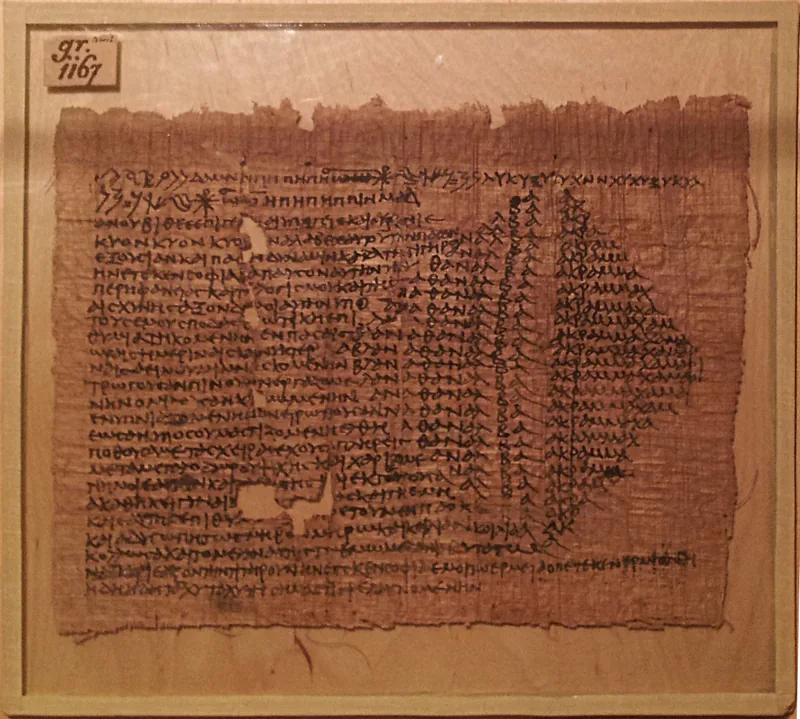
Seeing gods in lamps was not confined to Egypt. Greek and Roman authors mention lamp oracles. The Neoplatonist Iamblichus, in On the Mysteries (c. 300 CE), discusses divination by light and gives it a philosophical justification. Sarah Iles Johnston has studied the recurring use of children as mediums across ancient divination, linking it to ideas about purity and receptivity. The practice survived the end of paganism. Similar child-medium rites using lamps, ink pools and mirrors appear in medieval Arabic, Jewish and Latin magical manuscripts. Nineteenth-century travellers such as Edward Lane described Egyptian ink-mirror divination with boys in Cairo.
Safety and good sense§
The historical rites relied on open flames in dark rooms and on altered states in children; neither should be imitated. Anyone who simply enjoys candle-gazing as a meditation should keep the flame in a stable holder, never leave it unattended, and stop if they feel dizzy or distressed. Divination is not a substitute for professional advice.
Sources and further reading§
- The Greek Magical Papyri in Translation — Hans Dieter Betz (ed.), 1986
- The Demotic Magical Papyrus of London and Leiden — F. Ll. Griffith and Herbert Thompson, 1904
- The Mechanics of Ancient Egyptian Magical Practice — Robert K. Ritner, 1993
- Ancient Greek Divination — Sarah Iles Johnston, 2008
- Magic in the Ancient World — Fritz Graf, 1997
- An Account of the Manners and Customs of the Modern Egyptians — Edward William Lane, 1836