Chaos Magick vs Ceremonial Magic: Key Differences Compared
Chaos magick vs ceremonial magic compared: authority and lineage, cosmology, ritual method, aims and organisation, and how much the two approaches share.

Chaos magick and ceremonial magic are the two most influential styles of Western magical practice since the late nineteenth century, and they differ chiefly in their attitude to authority and belief. Ceremonial magic, shaped by the Hermetic Order of the Golden Dawn and Aleister Crowley, works within an elaborate inherited system of correspondences, grades and rituals aimed at spiritual attainment; chaos magick, emerging in Britain in 1978, keeps a few techniques, discards the fixed cosmology and treats every system as a tool to be chosen for its results.
Two Approaches to Modern Magic§
The term "ceremonial magic", also called "high magic", refers to a tradition of learned ritual practice whose modern form was defined by the Hermetic Order of the Golden Dawn, founded in London in 1888. Drawing on Renaissance occult philosophy, the Qabalah, astrology, alchemy, Enochian magic and the grimoires, the Golden Dawn created a graded curriculum of study and ritual that was later adapted by Aleister Crowley in Thelema and by many twentieth-century orders. Its history and methods are surveyed in What Is Ceremonial Magic?.
Chaos magick appeared ninety years later, in the work of Peter J. Carroll and Ray Sherwin in northern England, as a deliberate reaction against what its founders saw as the dogmatism and complexity of the older orders. Yet it did not arise in opposition from outside; its founders had themselves studied Crowley and the Golden Dawn. The comparison is therefore best understood as a family argument within modern occultism, one that is introduced in What Is Chaos Magick?.
Authority and Tradition: Lineage versus Experiment§
The deepest difference lies in where each approach locates authority. Ceremonial magic generally assumes that its symbols and rituals carry inherited wisdom. Orders trace their charters to founders and lineages, rituals are transmitted in set forms, and the student learns by accepting a received body of teaching before being allowed to innovate. Even sceptical ceremonialists tend to treat the system as a carefully tested whole whose parts make sense in relation to one another.
Chaos magick locates authority in the practitioner's own experience. Its founding texts insist that no tradition has a monopoly on truth and that techniques should be adopted, modified or discarded according to whether they work for the individual. This is the principle known as "belief as a tool", explained in Paradigm Shifting in Chaos Magick. Where a ceremonial magician might ask whether a ritual is correct, a chaos magician is more likely to ask whether it is effective.
Cosmology and Correspondences: A Fixed Map versus Many Maps§
Ceremonial magic is built on a cosmology. Its central diagram is the Tree of Life of the Qabalah, with its ten sefirot and twenty-two paths, onto which the Golden Dawn mapped the planets, the zodiac, the elements, the Hebrew letters, the tarot trumps, colours, divine names, angels and much else. Crowley's tables in Liber 777 codified these correspondences. To work ceremonially is to move within this map, so that a ritual addressed to Venus, for example, draws on a consistent set of associated colours, numbers, names and symbols.
Chaos magick does not require any such map. Practitioners may use the Tree of Life when it suits them, but equally a Norse, Hindu, scientific or fictional framework, or a personal system invented for the occasion. Carroll's eight "colours" of magic in Liber Kaos (1992) are a kind of correspondence scheme, but they were offered as a convenient classification rather than as a description of the structure of the cosmos.
Ritual Method: Liturgy versus Minimal Technique§
| Aspect | Ceremonial magic | Chaos magick |
|---|---|---|
| Typical ritual | Long scripted rites with robes, tools and divine names | Short workings, often improvised |
| Key altered state | Concentration, invocation, devotional exaltation | "Gnosis", inhibitory or excitatory |
| Signature technique | Invocation and evocation through correspondences | The sigil, after Austin Osman Spare |
| Typical tools | Wand, cup, dagger, pentacle, temple furniture | Few or none; whatever is to hand |
| Language | Hebrew, Greek, Enochian divine names | Any language, including invented words |
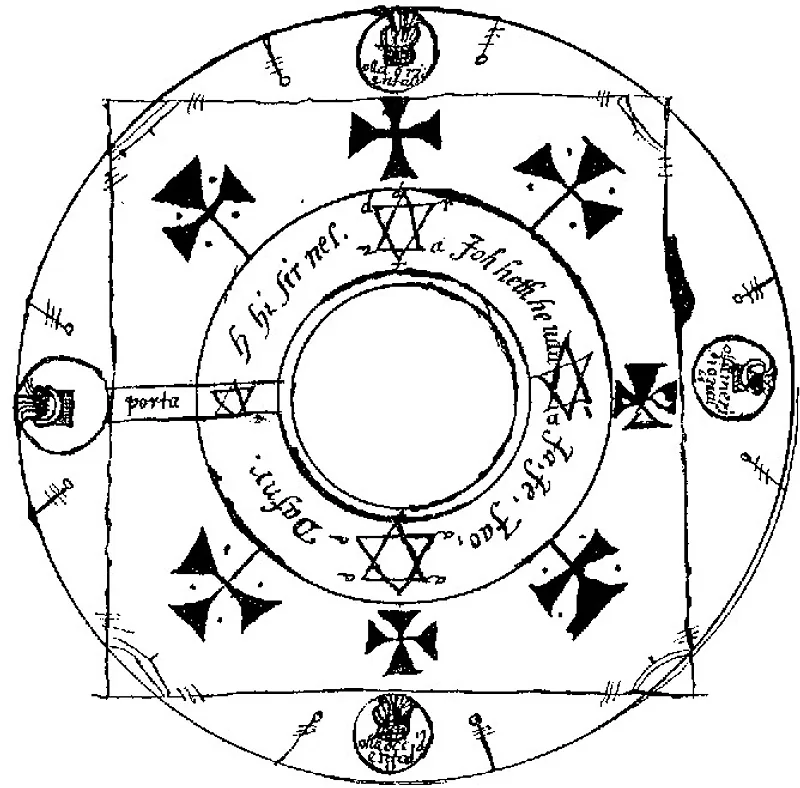
The table simplifies a varied reality, but it captures a genuine difference of style. Golden Dawn and Thelemic rituals, such as the Lesser Banishing Ritual of the Pentagram, use precise words, gestures and visualisations whose meaning depends on the wider system. Ceremonial workings may last hours and require extensive preparation of the temple and the magician.
Chaos magick reduced ritual to what its founders considered essentials. The key ingredient is gnosis, a state of one-pointed concentration reached either through stillness or through excitation; the key technique is the sigil, a glyph encoding a desire that is charged in gnosis and then forgotten. Chaos magicians did write rituals, including banishings adapted from the Golden Dawn and group rites such as Carroll's Mass of Chaos, but they presented them as templates to be altered rather than as fixed liturgy.
Aims: Spiritual Attainment versus Results and Freedom§
Ceremonial magic, in its Golden Dawn and Thelemic forms, is above all a path of spiritual transformation. Its goal is often described as the Great Work: the purification and integration of the self, union with the divine or, in Crowley's terms, the Knowledge and Conversation of the Holy Guardian Angel. Practical or "results" magic is permitted but usually regarded as subordinate.
Chaos magick gave practical results a more central place, as the title of Sherwin's The Book of Results (1978) suggests. Yet it also had a liberating aim of its own: freeing the practitioner from conditioned beliefs, habits and identities. Carroll's writing in particular speaks of enlightenment in terms of liberation from fixed patterns rather than ascent through a cosmic hierarchy. In this sense both approaches seek self-transformation, but they imagine its destination differently.
Organisation, Grades and the Question of Hierarchy§
The Golden Dawn introduced a system of grades corresponding to the sefirot of the Tree of Life, from Neophyte upward, which became the model for most later orders. Advancement involved examinations, ceremonies of initiation and the gradual revelation of more advanced teaching.
Chaos magick began as a reaction against such structures, yet it soon developed its own. The Illuminates of Thanateros, founded in 1978, acquired a formal structure in the 1980s with degrees, offices and rules. Ray Sherwin left the order in 1982 partly over this development. The history suggests that the contrast between hierarchical ceremonialists and anarchic chaos magicians is less sharp in practice than in rhetoric.
Overlap and scholarly views§
Historians of modern magic, such as Dave Evans and Nevill Drury, emphasise continuity as well as rupture. Chaos magick took from Crowley its experimental language, its use of the magical diary, its banishing rituals and even the spelling "magick". Many contemporary practitioners combine the two, using Golden Dawn rituals within a chaos framework or approaching ceremonial systems with chaos scepticism. Scholars often describe chaos magick as a radical simplification and psychologisation of the ceremonial tradition rather than its opposite.
Frequently asked questions§
What is the main difference between chaos magick and ceremonial magic?§
Ceremonial magic works within an inherited system of correspondences, rituals and grades, centred on the Qabalah, and values tradition. Chaos magick treats every belief system as a tool and values personal experiment and practical results over lineage.
Is chaos magick easier than ceremonial magic?§
It requires less memorisation and equipment, which made it attractive to people working alone. Its own writers stress, however, that concentration, self-observation and disciplined record-keeping are demanding in their own way.
Can you practise both chaos magick and ceremonial magic?§
Many people do. Chaos magicians often use Golden Dawn banishing rituals or Qabalistic correspondences, and some ceremonial magicians adopt chaos ideas about belief and experiment while retaining traditional ritual forms.
Did chaos magick come from ceremonial magic?§
In large part, yes. Its founders studied Crowley and the Golden Dawn, and they combined elements of that tradition with Austin Osman Spare's sigil method while rejecting the idea that any single system is uniquely true.
Sources and further reading§
- The Golden Dawn — Israel Regardie, 1937
- Magick: Liber ABA, Book Four — Aleister Crowley, 1997
- Liber Null and Psychonaut — Peter J. Carroll, 1987
- The Book of Results — Ray Sherwin, 1978
- Condensed Chaos: An Introduction to Chaos Magic — Phil Hine, 1995
- The Place of Enchantment: British Occultism and the Culture of the Modern — Alex Owen, 2004
- The History of British Magick After Crowley — Dave Evans, 2007
- Stealing Fire from Heaven: The Rise of Modern Western Magic — Nevill Drury, 2011