Liber III · Black & White Magic · Chapter III: Money & Prosperity Magick
Money Sigils and Chaos Magick: Results Magic for Wealth
Money sigils and chaos magick: from Agrippa's Jupiter seals to Spare's sigils, Carroll's results magic, servitors and modern financial sorcery.

A money sigil is a symbol created to represent a desire for wealth or income and then "charged" so that, in the theory of its users, the desire works below conscious awareness to bring about the result. The technique descends from Austin Osman Spare's early twentieth-century method of sigilisation and became a staple of chaos magick, the experimental, results-oriented current founded in the late 1970s. Because money is easy to measure, chaos magicians have often treated it as a test case for magic, and since the financial crisis of 2008 a small literature on "financial sorcery" has grown around it.
Why Chaos Magicians Turned to Money§
Chaos magick emerged in England in the late 1970s with Peter J. Carroll's Liber Null (1978) and Ray Sherwin's The Book of Results (1978), and with the founding of the Illuminates of Thanateros. It rejected the hierarchies, initiations and fixed cosmologies of older orders and treated belief as a tool to be picked up and discarded. Its test of any method was pragmatic: does it produce results? Money was an obvious candidate. It is measurable, universally desired and indifferent to symbolism, so a gain or loss after an enchantment can be noted in a magical diary. Sherwin's title expressed the new attitude, and later writers spoke openly of "enchanting for cash".
This frankness distinguished chaos magicians from some contemporaries in Wicca and the Golden Dawn tradition, who regarded magic for personal gain as spiritually dubious. It also connected them, perhaps unexpectedly, with the much older practical magic of the grimoires, where riches and treasure were constant aims. For the wider background see What Is Chaos Magick?.
From Planetary Seals to Spare's Sigils of Desire§
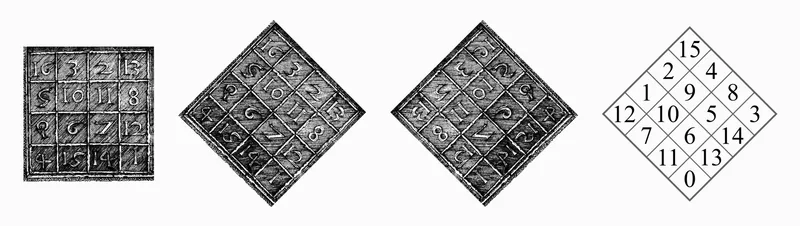
The word sigil comes from the Latin sigillum, "seal". In Renaissance magic, a planet's seals were geometrical figures traced on its magic square. Agrippa's Three Books of Occult Philosophy (1533) gave the seal of Jupiter and the sigils of its intelligence and spirit, derived from the four-by-four square whose rows add to 34 (see Seals and Kamea of Jupiter). These were cosmic signatures, not personal creations, and they were meant to work through the planet's influence, a tradition described in Jupiter talismans for wealth.
Austin Osman Spare (1886–1956), an English artist briefly associated with Crowley, invented something new. In The Book of Pleasure (Self-Love): The Psychology of Ecstasy (1913), he proposed writing a statement of desire, removing repeated letters and combining the rest into a single glyph. The sigil was then charged in a moment of "vacuity", when ordinary thinking is suspended, and deliberately forgotten, so that the desire could sink into what Spare called the subconscious without the interference of conscious lust for result. The method is described historically in our articles on sigils and the sigil method of Spare and Carroll.
The difference matters for money magic. A Jupiter seal invokes an external cosmic power; a Spare sigil works, in its own theory, through the practitioner's psyche. Many modern practitioners combine the two, tracing a personal statement on the Jupiter square or charging a sigil on Thursday.
Liber Null, Gnosis and the Probability of Results§
Carroll gave Spare's psychology a systematic form. In Liber Null he described "gnosis", altered states reached by inhibitory means such as stillness and meditation or excitatory means such as dance, chanting or sexual arousal, as the moment in which a sigil is fired. In Liber Kaos (1992) he went further, proposing a quasi-mathematical theory in which magic shifts the probability of events, with greater effect on outcomes that are already possible and uncertain. On this view, a sigil for a specific sum appearing from nowhere is unlikely to succeed, while one that nudges an uncertain job interview or sale might.
This probabilistic language, borrowed from physics and statistics, became typical of chaos writing about money. Practitioners were advised to choose achievable targets, to allow natural "channels" for the result, and to keep records. Phil Hine's Condensed Chaos (1995) popularised these ideas, insisting on practical common sense and experiment rather than faith.
Servitors, Egregores and Money Entities§
Alongside sigils, chaos magicians create servitors: artificial spirits given a name, a sigil, a purpose and sometimes a lifespan, and periodically "fed" with attention. A servitor might be assigned to find work, attract customers or watch over a business. The method is discussed in Hine's books and in Frater U.D.'s Practical Sigil Magic (1990); a non-financial example is described in our spellbook entry on a benign servitor. Larger collective entities, egregores, are thought to be formed by group belief; some chaos writers describe corporations, brands and currencies themselves as egregores.
Grant Morrison's essay "Pop Magic!", published in the anthology Book of Lies (2003), drew the provocative conclusion that corporate logos function as sigils, endlessly repeated to shape desire. Morrison's language helped popularise the idea that money and advertising are already a kind of magic, and that the magician can learn from, or subvert, them.
Financial Sorcery After 2008§
The financial crisis of 2008 and the insecure economy that followed produced a new genre of practical books. The German magician Frater U.D., whose Money Magic appeared in English in 2011, approached money magic largely through the practitioner's psychology, urging readers to examine their inherited attitudes to wealth before enchanting for it. Jason Miller's Financial Sorcery: Magical Strategies to Create Real and Lasting Wealth (2012) combined sigils, planetary and spirit work with budgeting, debt reduction and investing, arguing that enchantment works only alongside sound financial behaviour. Gordon White's The Chaos Protocols: Magical Techniques for Navigating the New Economic Reality (2016) addressed a generation facing precarious work and housing, framing magic as a way of navigating a broken economic system rather than of getting rich quickly.
These books share an unusual realism. They warn against expecting windfalls, insist on practical action and present magic as a complement to financial planning. In that respect they echo the medieval and early modern sources, which also hedged their promises, and they are a useful corrective to the mass-market "manifestation" literature discussed in money magick in witchcraft and New Thought.
Sigils in Witchcraft and Online Practice§
Since the 2010s, sigils have spread far beyond chaos magic. Laura Tempest Zakroff's Sigil Witchery (2018) presented a visual, design-based approach for witches, and online communities share money sigils as images, tattoos and phone wallpapers. In this setting, the original theory of forgetting the sigil is often abandoned: users look at money sigils daily, much as New Thought writers recommended repeating affirmations. Historians of esotericism note how quickly a technique born in an English artist's private system has become a global visual folk practice.
Frequently asked questions§
What is a money sigil?§
A money sigil is a personal symbol made to represent a financial desire, often by writing a statement such as a wish for steady income, removing repeated letters and combining the rest into a design. In chaos magic it is "charged" in an altered state and then forgotten.
How is a sigil different from a Jupiter seal?§
A Jupiter seal is a traditional figure derived from the planet's magic square and meant to draw on planetary influence. A modern sigil is a personal glyph created by the practitioner and, in Spare's theory, works through the subconscious mind.
Do chaos magicians believe money magic works?§
Chaos magicians treat belief as a tool and judge methods by results, which they record. Most influential authors stress that magic shifts probabilities at best and must be combined with practical effort; there is no scientific evidence that sigils produce money.
Sources and further reading§
- The Book of Pleasure (Self-Love): The Psychology of Ecstasy — Austin Osman Spare, 1913
- Liber Null & Psychonaut — Peter J. Carroll, 1987
- Liber Kaos — Peter J. Carroll, 1992
- The Book of Results — Ray Sherwin, 1978
- Condensed Chaos — Phil Hine, 1995
- Practical Sigil Magic — Frater U∴D∴, 1990
- Book of Lies: The Disinformation Guide to Magick and the Occult — Richard Metzger (ed.), 2003
- Money Magic: Mastering Prosperity in Its True Element — Frater U∴D∴, 2011
- Financial Sorcery: Magical Strategies to Create Real and Lasting Wealth — Jason Miller, 2012
- The Chaos Protocols: Magical Techniques for Navigating the New Economic Reality — Gordon White, 2016
- Sigil Witchery — Laura Tempest Zakroff, 2018